You have a small amount of money, you keep hearing that some shares “pay you to hold them”, and you have no idea where to press the button. Here is the plain version: a dividend is a slice of a company’s profit paid to the people who own its shares, usually four times a year. With a commission-free account and fractional shares you can start with a few dollars, reinvest those payouts automatically, and spot a yield that looks too good to be true before it bites you.
TL;DR / Quick insight: A dividend is regular cash a company pays its shareholders out of profit. To start: open and fund a stock account, pick a steady payer (on stability, not the biggest headline yield), buy a share or a fraction of one, and turn on reinvestment so each payout buys a little more stock. Watch the yield trap: a very high yield often means the price has fallen, not that the deal is great. For a dividend-paying FTSE 100 energy major, see how to buy BP shares. On Volity the Markets account is commission-free, and fractional shares earn dividends in proportion to what you own.
Dividend investing for beginners works best when it turns owning a share into something that quietly pays you while you hold it. Most guides chase the flashiest numbers and skip the mechanics that protect a small account. This guide does the opposite: never buy on yield alone.
1. What a dividend is and how it actually pays you
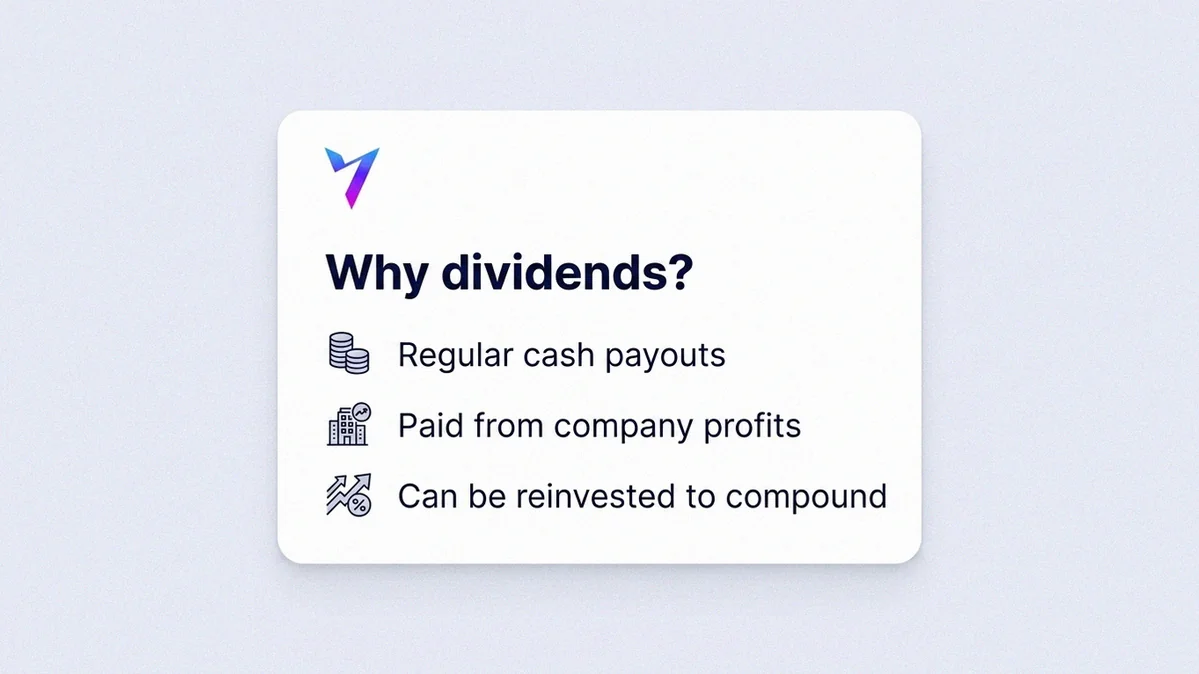
A dividend is part of a company’s profit handed back to shareholders as cash. Own a share in a profitable, mature business and the company may pay some of that profit out per share. Own more shares, get more total cash. A well-known UK example is Rolls-Royce, which reinstated its dividend after the pandemic; our guide covers how to buy Rolls-Royce shares.
Four dates matter, one line each. Declaration date: the company announces the dividend and amount. Ex-dividend date: the cut-off; you must own the share before this date to receive the next payout. Record date: the company checks who the owners are. Payment date: the cash lands in your account.
The ex-dividend date trips up beginners. Buy on or after it and you miss that round. Action: when a payout matters, own the share before the ex-dividend date. Do not rush an order just to “catch” a dividend.
2. Dividend yield explained, and the trap
Dividend yield lets you compare payouts across shares. The formula: yield equals the annual dividend per share divided by the share price, as a percentage.
Illustrative example (made-up round numbers, not a real stock): a share trades at $100 and pays $2 a year. $2 divided by $100 is 0.02, so the yield is 2%. The same $2 on a $50 share would be 4%. Same cash, different price, different yield.
That second half is the whole trap. Yield goes up when the price goes down. So an unusually high yield is often not a gift; it can mean the market marked the price down because it expects trouble, sometimes a payout cut. A big percentage can be a warning light.
There is no single “good” number: modest yields are common for stable, growing companies, while very high yields deserve suspicion. Action: before chasing a high yield, check whether the price has been falling sharply and whether the company looks able to keep paying. A yield that is high only because the price collapsed is a falling knife, not income. Do not buy on yield alone.
3. How to buy your first dividend stock, step by step
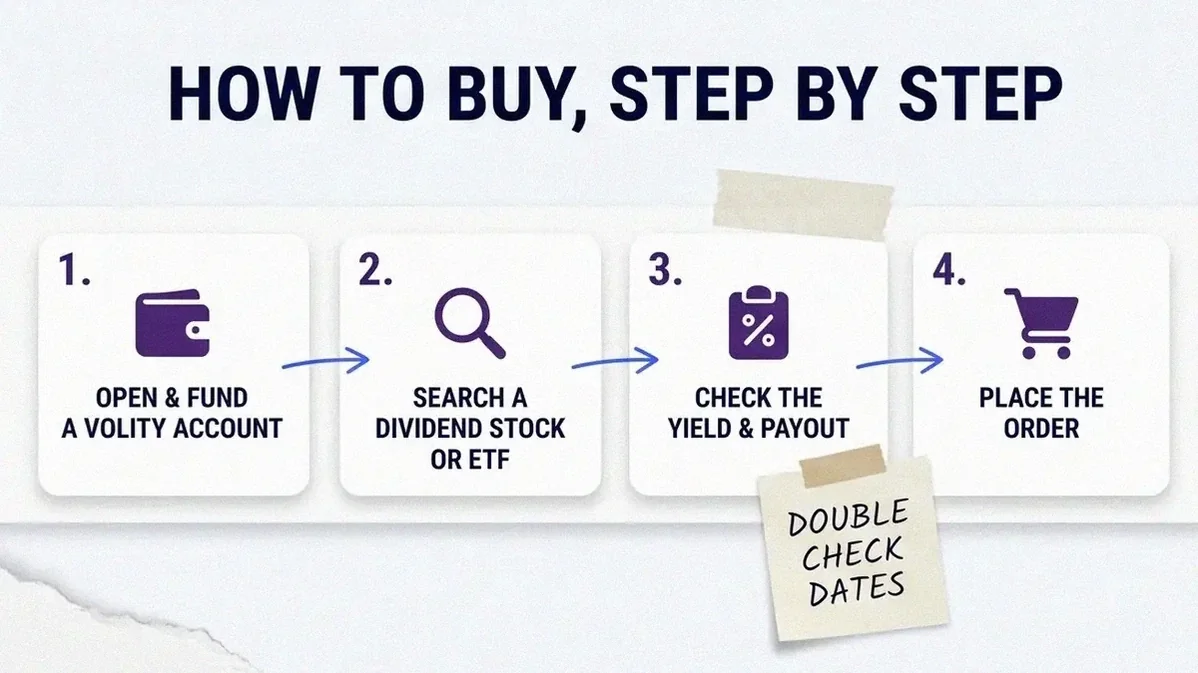
Here is the concrete sequence, every step an action:
- Open and fund a stock-trading account. Choose a broker that buys real shares without a commission eating small orders. On Volity the Markets account is commission-free with a $1 entry minimum, so a small first buy is not swallowed.
- Practise the order on a free demo first. A free demo account is available on every Volity tier. Place a pretend dividend buy, learn the order screen, then go live.
- Pick a steady payer using criteria, not a hot tip. Favour established, profitable companies with a long history of paying and ideally slowly raising the dividend. Do not pick a stock purely for the biggest yield.
- Decide your buy size before you open the order. Set the amount you will commit and stick to it. A small, deliberate first position beats an impulsive one.
- Place the order and confirm you own the share. Submit the buy, then check your holdings. For the next payout, confirm you bought before the ex-dividend date.
- Write down what you bought and why. One line is enough: company, date, reason. It makes tax records painless.
Action: place one small first order today using the criteria above, never a stranger’s tip. OPEN A VOLITY ACCOUNT to place that first buy, or TRY A FREE DEMO ACCOUNT to practise with zero risk first.
4. Reinvesting dividends to compound
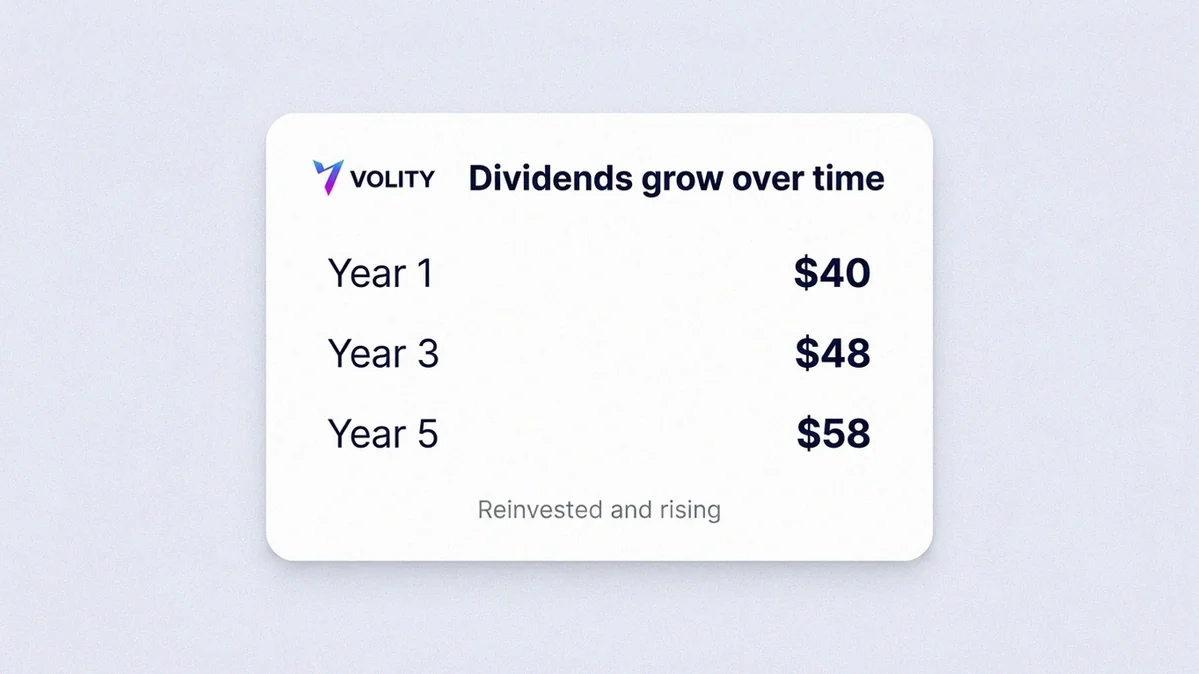
This is where dividends get genuinely powerful. Reinvesting means each payout buys a little more of the same stock instead of sitting as idle cash. Those extra shares then pay their own dividends, which buy yet more shares. That loop is compounding, and over years it does the work.
The reinvestment loop:
You own shares → company pays a dividend → the cash buys more stock → you own more shares → next dividend is larger → repeat.
A plain illustration with round, made-up numbers: a holding pays you $10 this quarter. Spend it and you keep the same shares; reinvest it and that $10 buys more stock, so next quarter’s payout sits on a bigger holding. One quarter the difference is tiny; across many years it grows large. This is a mechanism, not a promise.
Action: switch reinvestment on from day one, or manually reinvest each payout the moment it lands, so your money keeps working.
The most common beginner blocker is “I cannot afford a full share”. You do not need one. A fractional share is what it sounds like: a slice of a single share for a few dollars instead of the whole thing.
The part beginners miss: fractional shares still earn dividends, in proportion to the fraction you hold. Own a tenth of a share and you receive roughly a tenth of its dividend. That makes small-account reinvestment smooth: a $3 payout buys $3 of more shares even when one full share costs far more.
Volity lets you trade real and fractional shares in one account, and the $0 multi-currency wallet holds your cash between buys. Action: if a full share is too expensive, open a fractional position rather than waiting to save up, and reinvest those fractional payouts straight back.
| Question | Full share only | Fractional shares |
|---|---|---|
| Start with a few dollars? | No, you pay the full price | Yes, buy a slice for a few dollars |
| Still earn dividends? | Yes | Yes, in proportion to the fraction owned |
| Easy to reinvest small payouts? | Hard if a share costs more than the payout | Yes, a small payout buys a small fraction |
6. Checklist: build a starter dividend plan
Run this before a real buy. It bakes in the small-account mechanics and the yield-trap defence:
- Account opened and funded (Volity Markets minimum is $1).
- Confirmed trading is commission-free, so small buys are not eaten.
- Payer chosen on stability and a consistent payout history, not the biggest yield.
- Yield sanity-checked: high number explained, price not in free-fall.
- Buy size set in advance, kept small for a first position.
- Bought before the ex-dividend date if you want the next payout.
- Reinvestment turned on, or a plan to reinvest each payout.
- Fractional shares used if a full share is too expensive.
- Record kept of what you bought and why, for review and tax.
- Review cadence set, for example a quick check each quarter.
Action: run the checklist top to bottom, then place or practise your first buy today. Confirm every fee first: SEE FEES AND ACCOUNT TYPES.
Two reads help next: our stocks hub on fractional shares, ETFs and what to own, and the trader education hub that takes you from a nervous first order to a confident one.
Reviewed for accuracy: A. Bennett, Volity editorial desk.
Data integrity: all Volity product facts (commission-free Markets account, $1 entry minimum, fractional shares and dividends, free demo, $0 wallet) are verified against Volity’s published account and fee documentation as of June 2026. Yield figures are labelled illustrations, not advice.
Related Volity guides
- Fractional shares: start investing with $50
- Dollar-cost averaging explained
- ETF vs index fund: which to pick
Related coverage on Volity
- Fractional Shares Explained: How to Start Investing With $50
- How to Start Stock Trading: A 2026 Beginner Guide
- Fundamental Analysis in Stock Trading: A Working Definition
- How to Avoid Common Stock Trading Mistakes
- Best Forex Traders in the World: 6 Legends and Their Lessons
- Charlie Munger: mental models and investing legacy
For a worked example on a single dividend-paying bank, see our guide on how to buy Barclays shares. For a dividend-paying FTSE 100 pharmaceutical, see our guide on how to buy AstraZeneca shares.
Frequently asked questions
How do dividends actually work?
A company pays part of its profit back to shareholders as cash, usually each quarter, set per share, so the more shares you own the more you receive. You must own the share before the ex-dividend date to get the next payout, which arrives on the payment date.
What is a good dividend yield?
There is no single magic number, and treating one as a target is a mistake. Stable, growing companies often pay modest yields, while unusually high yields frequently signal a falling price or a payout at risk. Judge a payer on the consistency of its dividend, not the biggest yield.
Can you live off dividends?
Not quickly, and not from a small start. Meaningful dividend income requires a large amount of invested capital and many years of patient compounding. Treat dividends as a slow, reinvested wealth-builder, and be sceptical of “live off dividends” pitched as fast or easy.
Yes. Fractional shares earn dividends in proportion to the fraction you own, so a tenth of a share earns roughly a tenth of its dividend. This is what makes small-account dividend investing work: even a few dollars of payout can buy a little more stock.
Do I need a lot of money to start dividend investing?
No. With commission-free trading and fractional shares you can start small: fees do not eat the order and you can buy a slice of a share. On Volity the Markets account opens from a $1 entry minimum, with a free demo to rehearse first.
Sources
This guide draws on the following public sources.
- BIS – BIS Quarterly Review on the growth of passive investing
- European Central Bank – ECB Economic Bulletin on markets and household investment
- ESMA – ESMA investor corner on funds, ETFs and costs
- London Stock Exchange – London Stock Exchange listing and market structure
- CFA Institute – CFA Institute Research and Policy Center publications
- Bank of England – Why inflation erodes the real value of returns
- Bank of England – How interest rates and inflation interact
- Bank of England – The 2% inflation target and why it matters to savers
- ESMA – MiFID II rules on costs, charges and disclosure