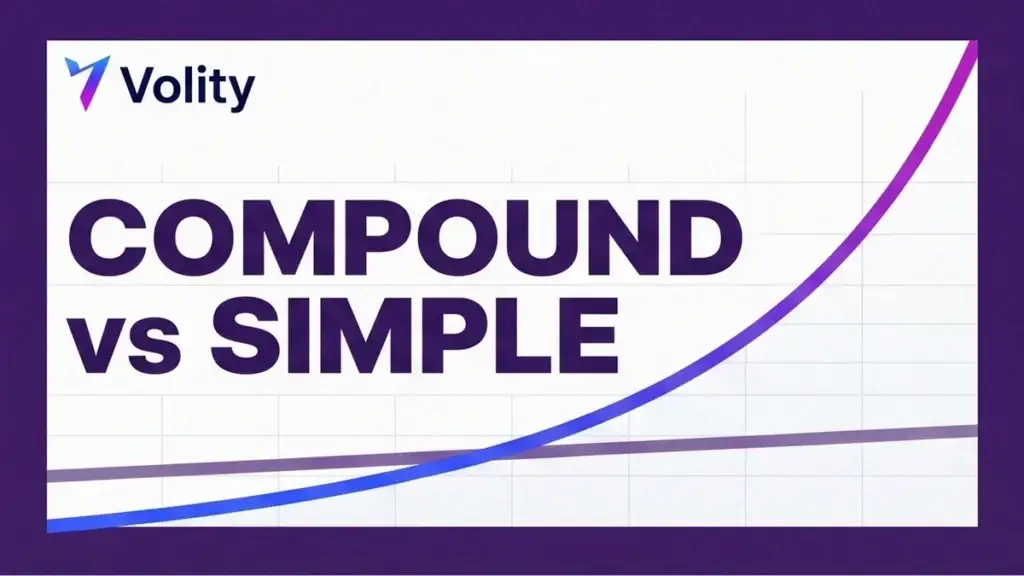
Two accounts can start with the same money, earn the same rate and finish years apart. The reason is compound interest vs simple interest, the quiet difference in how returns are calculated. Simple interest pays you on your original sum and nothing more. Compound interest pays on your original sum plus the interest you have already earned, so growth feeds on itself. This guide walks through both with one shared example and shows how to put compounding to work.
TL;DR / Quick insight: Simple interest is paid only on the money you started with, so it grows in a straight line. Compound interest is paid on your starting money plus the interest already added, so it grows in a curve that steepens over time. The longer you leave it and the more often interest is added, the wider the gap. The same idea drives investing when you reinvest dividends and returns. With Volity you can hold shares, fractional shares and crypto in one commission-free account and let reinvestment do the work.
Nothing here is personal advice – investing carries risk, and the numbers below are illustrations rather than promised returns.
The one-line difference
Simple interest is calculated only on your original amount, called the principal. Compound interest is calculated on the principal plus the interest you have already earned.
That second clause is the whole story. With simple interest, each period pays the same fixed amount, because the base never changes. With compound interest, each period pays a little more than the last, because the base keeps growing.
Picture a snowball. Simple interest adds the same handful of snow each minute. Compound interest is that snowball rolling downhill, picking up more with every turn because it is already big.
How simple interest works, with an example
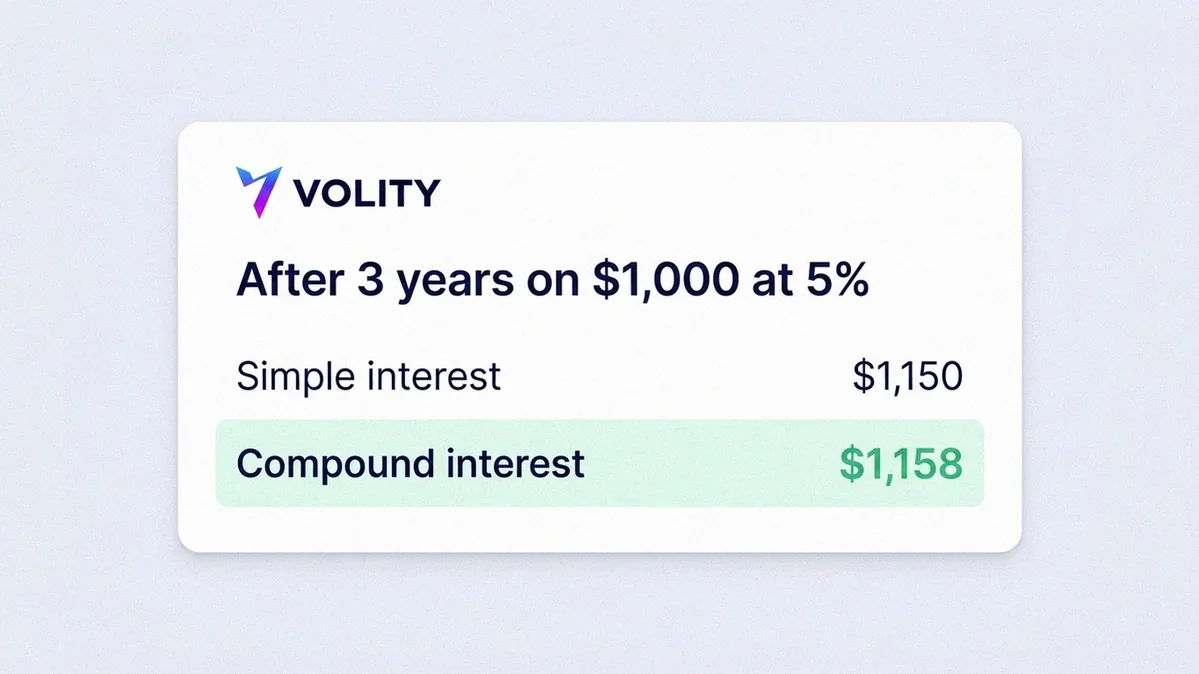
One example runs through the rest of this guide: 1,000 units of any currency, earning 5% a year, left for 3 years. Treat them as an illustration, not a forecast.
Simple interest pays 5% of the original 1,000 every year. That is 50 units a year, every year, because the base stays at 1,000. The interest never earns interest of its own.
- Year 1: 1,000 + 50 = 1,050.
- Year 2: 1,050 + 50 = 1,100.
- Year 3: 1,100 + 50 = 1,150.
After 3 years you hold 1,150 units. The total interest is 150, just 50 added three times: principal times rate times years, or 1,000 times 0.05 times 3 = 150. Clean and predictable, which is why it shows up in many short-term loans.
How compound interest works, with the same example
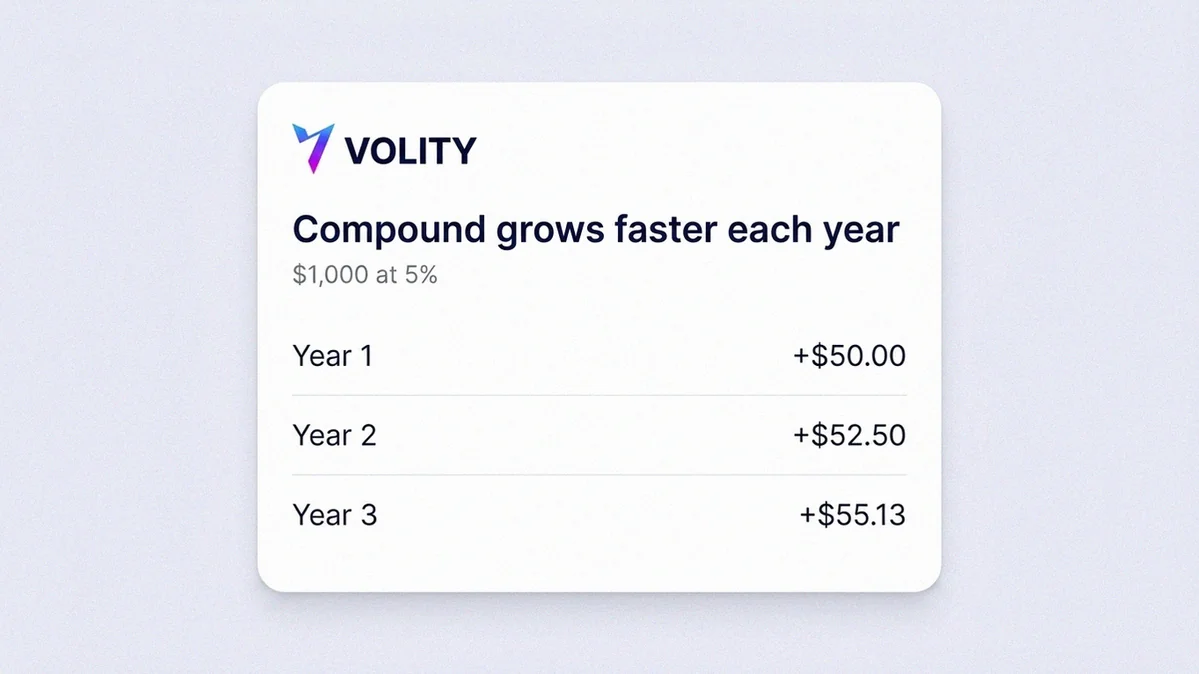
Same 1,000 units, same 5%, same 3 years. The difference: each year’s interest is added to the base, so the next year earns on the larger amount.
- Year 1: 1,000 + 5% = 1,050. (Interest 50.)
- Year 2: 1,050 + 5% = 1,102.50. (Interest 52.50, because you earned 5% on 1,050.)
- Year 3: 1,102.50 + 5% = 1,157.625, which rounds to about 1,157.63. (Interest 55.13.)
After 3 years you hold roughly 1,157.63 units against 1,150 with simple interest, a gap of about 7.63 units. It is small here because three years is short and the rate is modest. What matters is the shape: the yearly interest rose from 50 to 52.50 to 55.13 without you adding a single unit. That rising interest on interest is compounding.
The gap over time, and why compounding wins
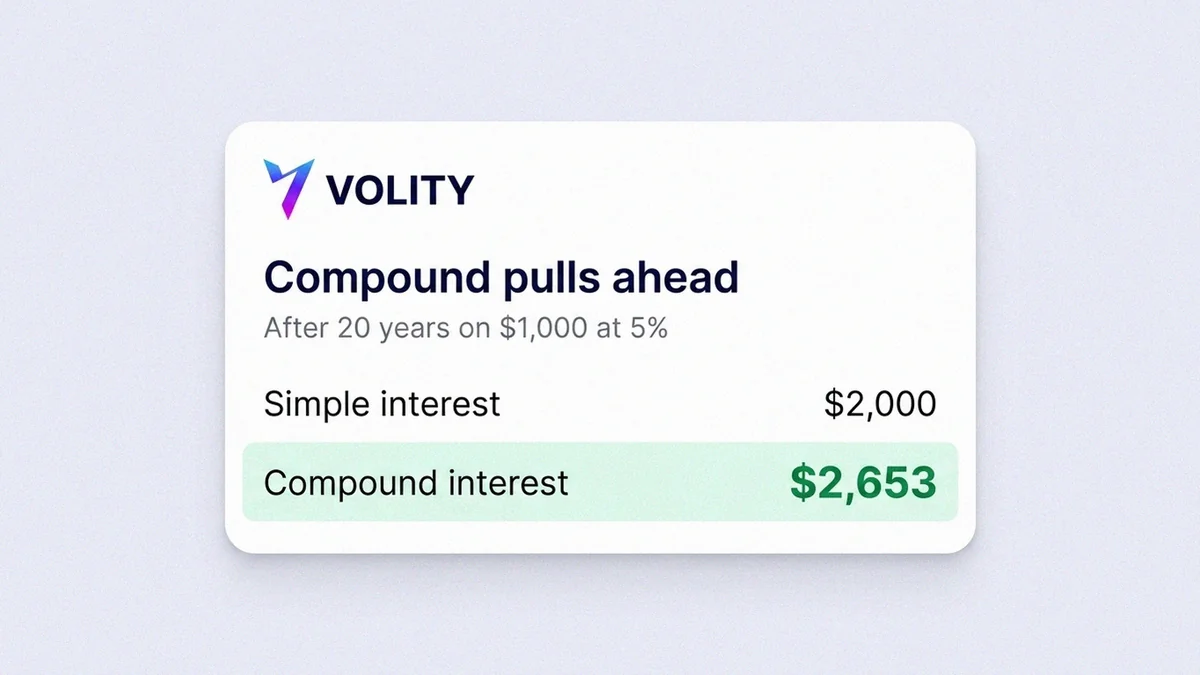
Stretch the same 1,000 units at 5% across decades and the paths separate dramatically. Simple interest keeps adding 50 a year, reaching 2,500 after 30 years. Compound interest keeps earning on a bigger base, so the curve pulls far above the straight line. The longer the horizon, the wider the gap.
Two levers control the speed. The first is time: every extra year lets the interest-on-interest effect run longer. The second is frequency: interest added monthly compounds faster than yearly.
A handy shortcut is the Rule of 72, a rough rule of thumb for how long money takes to double. Divide 72 by the yearly rate as a whole number. At 6%, 72 divided by 6 is 12, so a sum roughly doubles in about 12 years. It is an approximation, but it gives a feel for how rate and time trade off.
| Feature | Simple interest | Compound interest |
|---|---|---|
| Calculated on | Original principal only | Principal plus interest already earned |
| Growth shape | Straight line, fixed each period | Upward curve, rising each period |
| Effect of time | Steady, predictable | Accelerates the longer you wait |
Compounding beyond savings, from returns to reinvested dividends
Compounding is not only a savings-account idea. It is the engine behind long-term investing too, when you reinvest what your holdings pay out.
Take dividends, the cash some companies pay shareholders. Take the dividend as cash and your share count stays flat, so growth is closer to a straight line. Reinvest it to buy more shares and those new shares pay dividends of their own next time, so your holding compounds much like interest on interest. The same applies to investment gains left invested.
This is where keeping costs low matters, because fees quietly eat the base that compounding works on. Volity fits the reinvestment habit. Trading on the Markets account is commission-free, so small, regular reinvestments are not nibbled away by per-trade charges, and the $0 multi-currency wallet keeps cash ready to redeploy. You hold real shares, fractional shares, crypto and CFDs in one login, and a fractional share lets even a small dividend buy another slice rather than sit idle. The Volity stocks hub is built around that approach.
Decide upfront whether each holding’s payouts get reinvested or taken as cash, then use the free demo to see a reinvested position behave differently from one you drain.
What slows compounding down, fees and withdrawals
Compounding has two natural enemies, and both shrink the base it grows on.
The first is fees. Every charge comes out of the balance, so the money that would have earned next period is gone, and that loss compounds against you exactly as gains compound for you. A portfolio bled by per-trade commissions or conversion costs grows a flatter curve than one left intact. Commission-free trading, free custody and a free FX wallet keep the base intact.
The second enemy is withdrawals. Taking money out, or taking payouts as cash instead of reinvesting, resets the base lower and the curve climbs again from there. An occasional withdrawal is fine. Just know the cost: each one trims the snowball.
So start early, keep costs near zero, reinvest payouts and disturb the balance only when you truly need to. With Volity, FX fees and custody are free and crypto deposits are free and instant and card deposits carry a 2.99% fee, so more of your money stays in the curve.
Put compounding to work
Run through this before and during any long-term plan to keep the maths in your favour.
- Start as early as you can. Time is the biggest lever in compounding.
- Reinvest dividends and gains rather than spending them.
- Favour more frequent compounding where you have the choice.
- Keep costs near zero. Commission-free trades and free custody protect the base.
- Reinvest small payouts with fractional shares so nothing sits idle.
- Resist needless withdrawals. Each one resets the curve lower.
- Rehearse on a free demo before committing real money.
If a line gets a “no”, that is the leak to fix first.
What to do next
Run the shared example yourself, then set up a position that reinvests its payouts so compounding can take hold – shares, fractional shares, crypto and CFDs in one account, plus a $0 wallet for ready cash. Rehearse on the free demo first if new. OPEN A VOLITY ACCOUNT to start reinvesting commission-free, or read more in the stocks hub. Want numbers first? SEE FEES AND ACCOUNT TYPES.
Reviewed by: A. Bennett, Volity editorial desk.
Data integrity: the worked figures (1,000 units, 5%, 3 years) are illustrative arithmetic, not promised returns; every product figure here (commission-free Markets trading, $0 wallet, free demo, free FX and custody) is verified against Volity’s published account and fee docs.
Related Volity guides
- Dollar-cost averaging explained
- Dividend reinvestment (DRIP), explained
- How much money do you need to start trading?
Related coverage on Volity
- Dollar-Cost Averaging Explained: A Beginner Guide
- Dividend Investing for Beginners: How to Start
- Dividend Reinvestment Plan (DRIP): How It Works and Who It Suits
- ETF vs Index Fund: The Difference and Which to Pick
- Fractional Shares Explained: How to Start Investing With
Frequently asked questions
Is compound interest better than simple interest?
For money you are growing, yes, because compound interest pays on your interest as well as your principal, so the same rate produces more over time. Simple interest only ever pays on the original sum. The advantage widens the longer you leave the money invested.
How do you calculate compound interest?
Add each period’s interest to the balance, then calculate the next period’s interest on that larger balance. Using 1,000 units at 5%: year one becomes 1,050, year two earns 5% on 1,050 to reach 1,102.50, and so on. The formula is principal times one plus the rate, raised to the number of periods.
What is the rule of 72?
The Rule of 72 is a rough shortcut for how long money takes to double under compounding. Divide 72 by the yearly rate written as a whole number. At 6% you get 12, meaning a sum roughly doubles in about 12 years. It is an approximation that helps you compare rates quickly, not an exact calculation.
Does compounding work for investing?
Yes, when you reinvest what your holdings pay out. Reinvested dividends buy more shares, which then pay dividends themselves, and gains left invested keep earning. That is compounding in action. Keeping fees low matters, since charges shrink the base.
Why does compound interest matter so much for long-term goals?
Because its effect accelerates with time. Over a few years the gap against simple interest is small, but over decades the curve pulls far ahead of the straight line. Starting earlier and reinvesting consistently usually beats a higher rate started late.
Sources
The guidance above draws on the following public sources.
- Corporate Finance Institute – interest earned on interest
- Corporate Finance Institute – the Rule of 72 shortcut
- Investor.gov – run the compounding numbers yourself
- Investor.gov – model contributions toward a target
- OpenStax, Principles of Finance – time value of money basics
- OpenStax, Principles of Finance – why money today is worth more
- Bank of England – how savings interest is expressed
- Nasdaq – reinvesting dividends buys more shares
- GOV.UK – tax on savings interest
- Financial Conduct Authority – keeping investment costs in check