Crypto digest: XRP thins out, bitcoin wobbles, and regulators move in
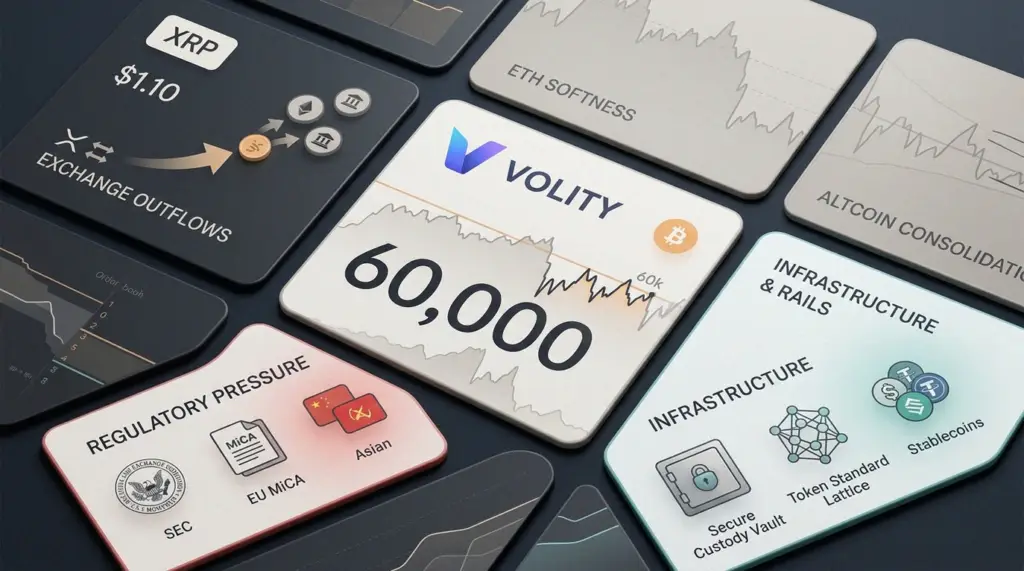
The crypto market entered the session with a split personality. Prices looked tired, yet the plumbing kept improving. XRP slipped near the low $1.10 area, Bitcoin hovered around the low $60,000s, and regulators kept tightening their grip from Washington to Brussels and Seoul.
However, the real story is not just a red screen. Exchange balances, custody moves and stablecoin trials suggest large players still want a bigger role. They are not chasing every rally. Instead, they are building places to hold, lend, trade and settle digital assets.
XRP: supply leaves exchanges, but buyers still hesitate
XRP has become the day’s most interesting contradiction. The token is changing hands around $1.10 across major venues, including Coinbase, Kraken, Binance and Crypto.com. Meanwhile, circulating supply sits a little above 62 billion tokens.
Yet exchange supply appears to be shrinking. That can mean several things, and not all are bullish. Some holders may be moving coins into cold storage. Others may be shifting into custody products or institutional wallets. In quieter cases, market makers may simply be reshuffling inventory.
Still, traders care because thinner exchange balances can sharpen price moves. If demand returns, less visible supply can help a rally travel further. However, that trade needs one missing ingredient – conviction.
For now, XRP’s tape remains soft. The token has shown a modest weekly bounce in some trackers, but it still struggles for daily upward momentum. Therefore, the market is not rewarding the supply story yet.
That matters for short-term traders. A falling exchange balance can support a bullish thesis, but price must confirm it. Without higher volume and firmer bids, “scarcity” remains a talking point, not a trade.
Bitcoin: the market’s risk gauge still runs the room
Bitcoin remains the market’s anchor, both emotionally and mechanically. A recent June 8 snapshot placed BTC at $63,563.66, while current market chatter centres on the low $60,000s.
Meanwhile, traders are watching the $60,000 line closely. That level is not magic, but it is crowded. Stops, options hedges and dip-buying plans often gather around such round numbers.
Geopolitical tension has added pressure. As worries around the US-Iran conflict rise, Bitcoin has traded less like “digital gold” and more like a high-beta risk asset. In plain English, buyers get picky when the world feels hotter.
However, institutions are not stepping away. Bitmine reportedly added another $70 million of ETH, bringing its treasury exposure close to 5% of supply. Separately, VanEck argued that Strategy’s $135 million Bitcoin sale did not wreck its broader accumulation plan.
That contrast defines the current market. Fast money is nervous. Longer-horizon capital is still setting pipes, opening accounts and building balance-sheet positions.
Ethereum and altcoins: dominance bites at the edges
Ethereum looks fragile as well. Technical traders are watching a possible move toward $1,650 after a bearish rounding pattern developed on the chart.
Meanwhile, the broader altcoin market remains under strain. Roughly 40% of altcoins are sitting near all-time lows, while Bitcoin dominance stays elevated. That is a harsh backdrop for smaller tokens.
In this kind of market, capital usually crowds into the strongest name first. Then it tests large-cap alternatives. Only later does it spill into the thinner, stranger corners of the token board.
So far, that final rotation has not arrived. Therefore, altcoin traders face a market with fewer tailwinds and harsher punishment for weak stories. Balance sheets matter. Liquidity matters more.
Regulation: the slow trade becomes the biggest one
Price action still grabs the screen. However, regulation is setting the terms of the next cycle.
In the United States, the SEC is pushing three major rule proposals that could reshape parts of crypto trading. Meanwhile, Congress continues to debate the CLARITY Act, with arguments over ethics, DeFi and $1.35 billion in yield-related questions.
The fight has changed. Lawmakers are no longer asking whether crypto should face rules. Instead, they are arguing where the fence should sit.
Europe already moved first with MiCA. Now the European Parliament is looking beyond that framework, with fresh attention on DeFi and NFTs. At the same time, privacy campaigners are watching renewed debate over Chat Control rules.
That debate matters for crypto because money increasingly moves through messaging layers, wallets and embedded apps. If communications rules tighten, financial privacy may tighten with them.
Elsewhere, the map is just as busy. India’s central bank has renewed its hard line over tax reporting concerns. Kenya is preparing blockchain analytics before licensing starts. Russia is advancing a crypto bill after dropping a wallet-address disclosure rule.
South Korea, meanwhile, keeps building institutional rails. Dunamu, the operator behind Upbit, secured a police custody contract, adding another formal link between public authorities and crypto infrastructure.
Infrastructure: the quiet money keeps laying tracks
The better market signal may come from infrastructure, not price. Clearstream is expanding custody to XRP, SOL, ADA and AVAX. That places more large-cap tokens within reach of institutional settlement and safekeeping systems.
Meanwhile, Base has activated the B20 token standard for stablecoins and tokenised assets. South Korean super-app Toss has also partnered with Optimism for a won-linked stablecoin trial.
These moves lack the fizz of a meme-coin rally. However, they matter more for the market’s adult phase. Custody, tokenisation and payments decide whether crypto becomes infrastructure or stays mainly a casino with better branding.
Traders should not ignore that distinction. Infrastructure does not always lift prices tomorrow. Yet it can decide which assets remain tradeable, financeable and useful when the next cycle matures.
Security and products: the industry grows, then trips
Security remains crypto’s old bruise. Ctrl Wallet shut down after an exploit. Secret Network may leave Cosmos for Arbitrum after a bridge incident.
Once again, cross-chain systems carry outsize risk. Bridges promise convenience, but they also create inviting attack surfaces. When liquidity moves faster than security, somebody usually pays.
At the same time, trading platforms keep widening their menus. Gemini launched commission-free US stock trading, pushing deeper into the all-in-one finance app model. Polymarket now supports Bitcoin Lightning deposits through Spark.
Strike is also offering Bitcoin loans without margin calls, although the structure carries a stated 14% APR trade-off. That product may appeal to holders who dislike forced liquidations. Still, the price of calm is not cheap.
By the numbers
- $1.10 – approximate XRP trading area across major venues.
- 62 billion-plus – XRP tokens in circulating supply.
- $63,563.66 – Bitcoin level in a June 8 market snapshot.
- $60,000 – key Bitcoin zone traders are watching.
- 14% – stated APR on Strike’s Bitcoin loan product.
Key takeaways
- XRP’s exchange-supply drop needs price confirmation before it becomes a stronger long setup.
- Bitcoin remains the market’s main risk gauge, especially near the $60,000 zone.
- Altcoins face a tough tape while Bitcoin dominance stays high.
- Regulatory headlines now shape liquidity, listings and institutional access.
- Custody, tokenisation and stablecoin trials are the quieter bullish story.
The market, then, is not giving one clean message. Prices are fragile. Rules are tightening. Yet institutions keep widening the road beneath the traffic. For traders, that means less romance and more discipline. Watch the levels, but do not ignore the rails.
Related coverage on Volity
- How to Avoid Crypto Scams: A Beginner Safety Checklist
- How to Choose a Trading Platform: A 10-Point Checklist
- Demo vs Live Trading Account: A 7-Step Checklist Before You Go Live
- How to Size a Trade: Position Sizing and Risk Per Trade for Beginners
- Risk-Reward Ratio Explained: How to Set It and Why It Matters
- ETF vs Index Fund: The Difference and Which to Pick