Watchlists need trade plans, not ticker soup
Volity already has the hard part: ideas, themes and enough ticker flow to keep traders busy.
However, a strong watchlist still needs a steering wheel. Traders need time frames, triggers and risk lines. Otherwise, a list becomes interesting reading, not a trade plan.
The market backdrop helps, but it should stay in the background. “U.S. stocks higher, futures stronger” sets the mood. It does not justify buying every green ticker on the screen.
Instead, use index strength to judge sector appetite. If consumer discretionary leads, longs there deserve more attention. Meanwhile, lagging health care names need cleaner setups before traders add risk.
Momentum needs a clock
Momentum names work best when the plan says exactly how long the trade should live.
A scalp, a 2-5 day swing and a rumour trade all behave differently. Therefore, each line should answer three questions: what is the trigger, what is the time frame, and where is the trade wrong?
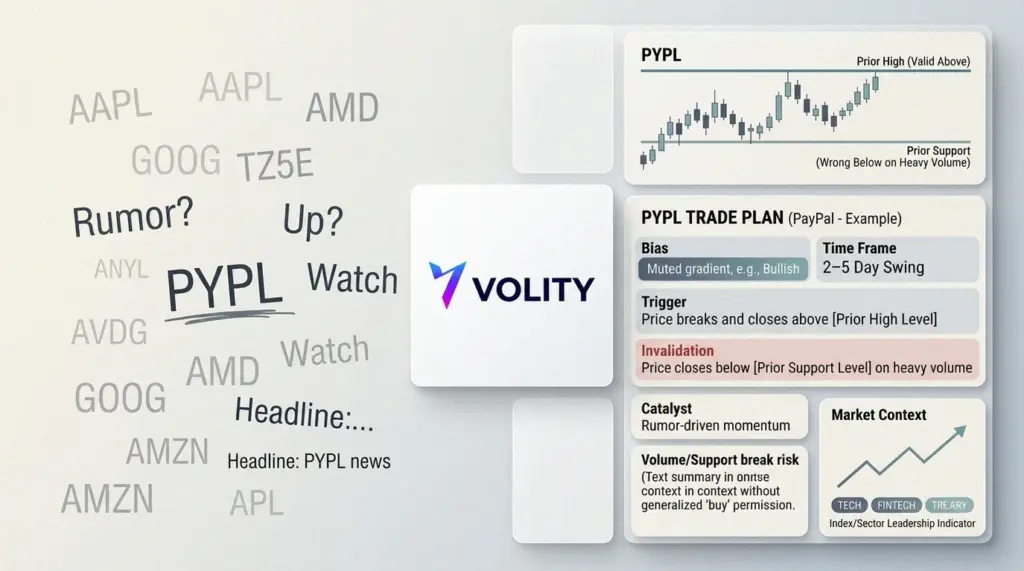
PayPal (PYPL) is the clearest example. Reports of Stripe and Advent floating a joint offer near $60.50 a share put the stock into play. That price implied roughly a 28% premium to the prior close.
Still, this is not deal arbitrage. Talks appear early, and headline risk cuts both ways. So the right label is catalyst momentum watch, not “deal certainty”.
- Bias: bullish, but headline-sensitive.
- Time frame: intraday to a few days.
- Trigger: in play above the prior high while rumour flow stays active.
- Risk: invalid if it loses the prior support zone on heavy volume.
Alibaba (BABA) also fits the momentum bucket, though with cleaner technical boundaries. Recent trading around $112-$115 puts resistance close by. Support sits roughly near $109-$110.
Therefore, the cleaner note reads like this: BABA has a short-term momentum long bias for a 2-5 day swing. It needs a push through $115-$117 with volume, or a controlled dip that holds $109-$110.
However, a break below $109 changes the character. At that point, the trade no longer looks like a healthy pullback.
Liquidity checks matter
Smaller momentum names need stricter quality control. LCID, KOPN, MNSO, MESO and NXST may all produce action. Yet action without liquidity can punish late entries.
For day traders, each small-cap or mid-cap line should pass two quick tests. First, the stock should trade at least around 1 million shares. Second, relative volume should run near 2 times normal or better.
Meanwhile, vague or mislabelled names should leave the list. A misspelt microcap does not add colour. It adds noise, spread risk and avoidable mistakes.
A clean momentum line would say: “Intraday only; valid above the pre-market high with RVOL above 2; stop below the pre-market low.” That is short, useful and tradable.
Earnings give the cleanest edge
Earnings and analyst revisions remain the strongest part of the watchlist. They create fresh information, volume and disagreement. Traders can work with that.
Morgan Stanley (MS), Goldman Sachs (GS) and Bank of America (BAC) fit the post-earnings momentum basket. A beat and stronger guidance can fuel drift for several sessions.
However, the trigger still matters. Watch for a break above the earnings-day high on volume. Alternatively, look for a pullback that holds the gap low or VWAP.
The expected time frame should be 1-5 trading days. After that, the earnings edge usually fades into broader market noise.
Pre-earnings names need different language. Autoliv (ALV), Fifth Third (FITB), UnitedHealth (UNH) and AMC (AMC) are event watches, not automatic directional trades.
That distinction matters. Newer traders often try to guess the gap. More experienced traders often wait, then trade the post-release move once price confirms.
Analyst targets are not triggers
Analyst targets help with backdrop, not timing. A 12-month upside call on CrowdStrike (CRWD) may support a bullish view. However, it rarely creates a day-trade entry by itself.
So, analyst-heavy names need a second filter. Is the stock above its key moving averages? Is it pressing resistance? Has volume confirmed the breakout?
The same rule applies to GS, BAC and other large-cap financials. A bullish note can support a swing thesis. Still, price must provide the trigger.
Technical setups need live levels
AMC remains a valid high-volatility trading candidate. Earnings, retail attention and a history of sharp moves all matter. However, most traders should treat it as intraday only.
The useful levels are simple: pre-market high, pre-market low and VWAP. Tight stops matter because spreads and sudden reversals can turn quickly.
CoreWeave (CRWV) needs a two-sided plan. The trend looks weak, but oversold bounces can move violently. Therefore, traders should watch for a fresh breakdown, or a reclaim of a clear resistance level.
Palantir (PLTR) fits better as a trend-following swing candidate. Partnerships and analyst action can support attention. Still, the plan needs a 2-10 day window, a resistance trigger and a last-swing-low invalidation.
Meanwhile, SNDK needs clarification. SanDisk as a common equity ticker is legacy after its sale to Western Digital. If the list means another instrument, spell it out. If not, drop it.
Overbought does not mean short
PGNY, TXG and PRVA may show RSI readings above 70. That is useful, but it is not a short signal by itself.
High RSI can simply mean strong demand. Therefore, these names belong in a risk-control bucket. Tighten stops on existing longs, then watch for failed breakouts, bearish reversals or divergence.
Only after price confirms weakness should traders consider short exposure. Otherwise, they risk shorting strength too early.
Income ideas need a warning label
UnitedHealth (UNH) works as an income plus event watch. The dividend gives longer-term investors a reason to care. Meanwhile, earnings create a near-term catalyst.
High-yield industrials need one extra sentence every time. A yield above 5% can signal value, but it can also signal higher business or cyclical risk.
That honesty helps income investors. It also stops yield from masquerading as safety.
Macro is a risk map
Inflation returning towards 6% and Treasury yields near 8% is a tail-risk scenario, not a daily buy or sell signal.
However, it can shape positioning. Traders may hedge duration risk, reduce long-duration growth exposure, or favour financials if rates pressure tech multiples.
Geopolitical risk belongs in the same bucket. Iran headlines can move oil, defence, gold and volatility. Still, price must confirm the move.
Look for crude spikes, defence breakouts, gold strength and a rising VIX. Without confirmation, macro fear becomes an expensive hobby.
By the numbers
- $60.50: reported PYPL offer level floated by Stripe and Advent.
- 28%: approximate premium implied by that PYPL level.
- $109-$110: near-term BABA support zone.
- $115-$117: BABA resistance zone for continuation traders.
- 2x RVOL: minimum relative-volume filter for many intraday momentum names.
Key takeaways
- Use market tone as context, not as a single-name entry signal.
- Every ticker needs bias, time frame, trigger and invalidation.
- Treat PYPL as rumour momentum, not as a confirmed deal trade.
- Frame pre-earnings names as event watches, not gap guesses.
- Move high-RSI names into risk control unless price confirms reversal.
The fix is not complicated. Keep the themes, keep the ticker flow, but force every idea through the same trade-plan filter. Bullish, bearish, neutral or event-driven. Intraday, 2-5 day swing, post-earnings drift or position income. Valid above one level, invalid below another.
That turns the daily watchlist from a loose set of ideas into a trading map.
Related coverage on Volity
- What Is a P/E Ratio and How to Use It
- Fundamental Analysis in Stock Trading: A Working Definition
- Growth Investing vs Value Investing: Which Style Fits You?
- Fractional Shares Explained: How to Start Investing With $50
- How to Start Stock Trading: A 2026 Beginner Guide
- Dividend Investing for Beginners: How to Start