There are three practical ways to invest in the S&P 500 index: buy an S&P 500 index fund, buy an S&P 500 ETF, or trade the index directly as a contract for difference. The first two suit patient, buy-and-hold investors who want to own the market for years. The CFD route suits active traders who want leverage and the freedom to go both long and short. You do not need a US-based account for any of them.
What is the S&P 500 index?
The S&P 500 is a stock-market index that tracks 500 of the largest companies listed on US exchanges, weighted by market capitalisation. It is the most widely followed gauge of large-cap US equities, and investors around the world treat it as shorthand for “the market”. Because it reaches across every major sector, one S&P 500 position hands you broad, diversified exposure in a single line.
Here is the part that trips up newcomers. You cannot buy the index itself, because the S&P 500 is a calculation rather than a security. What you actually buy is a product that tracks it: a fund, an ETF, or a contract whose price follows the index. That one distinction shapes every route below.
What are the ways to invest in the S&P 500?
The three routes differ in how you hold the exposure, whether leverage is on the table, and which direction you can trade. The table sets them side by side.
| Route | What it is | Best for | Leverage | Direction |
| Index fund | A pooled fund tracking the index, priced once a day | Long-term buy-and-hold | None | Long only |
| ETF | A fund tracking the index that trades intraday like a share | Flexible long-term holding | None (standard ETFs) | Long only |
| Index CFD | A contract whose price follows the index (the US500 on Volity) | Active trading and hedging | Available | Long or short |
If your aim is to own the market for years and let it compound, an index fund or an ETF is the natural home for that money. Investing in the S&P 500 index fund route mostly comes down to picking a low-cost tracker and then leaving it alone for a decade or two. If your aim is to trade the index over days or weeks, position for a specific move, or profit when the market falls, an index CFD gives you the leverage and the two-way access that a fund cannot.
How do you invest in the S&P 500 from the UK?
Investors across the UK, Ireland, and the wider non-US English-speaking world do not need a US account to hold the index. In the UK, people usually buy S&P 500 index funds and ETFs on a local investment platform, often inside a tax-efficient ISA. Two of the most searched options are the Vanguard S&P 500 UK ETF and the UBS S&P 500 index fund, and they sit among dozens of comparable trackers, including funds from iShares.
Picking the best S&P 500 index fund UK or best S&P 500 ETF UK for your situation comes down to a few practical things rather than the brand on the label:
- The ongoing charge looks tiny, but it compounds over decades, so a lower annual cost usually wins on a long hold.
- Accumulating share classes reinvest dividends for you, while distributing ones pay them out as cash, and the Vanguard and UBS S&P 500 ranges both come in either form.
- Most trackers are priced in your local currency yet hold US-dollar assets underneath, so the exchange rate quietly feeds into what you take home.
That fund route is built for patient, long-term holding. Active traders who would rather take shorter-term positions on the index, with leverage and in either direction, trade the S&P 500 as a CFD instead. The two approaches work together more often than they compete; plenty of people hold funds for the core of a portfolio and use index trading for tactical positions on top. If the mechanics are new to you, our guide to how to trade indices walks through them.
What is the UK equivalent of the S&P 500?
The closest S&P 500 UK equivalent is the FTSE 100, the benchmark of the 100 largest companies on the London Stock Exchange. It plays the same headline role for British large-caps that the S&P 500 plays for American ones. It is not a like-for-like swap, though. The S&P 500 is far broader at 500 constituents and leans heavily on technology, while the FTSE 100 tilts toward energy, financials, and consumer staples. If you want the fuller picture of how these benchmarks are built, our explainer on what are indices covers the mechanics.
Because the two indices behave differently, many investors hold both for geographic and sector spread rather than picking one to stand in for the other. On a single platform you can follow and trade the US500 and the UK100 side by side.
Strictly, the index has a level rather than a share price. When people track the Vanguard S&P 500 share price, what they are really watching is the price of an ETF that follows the index, which is why the ETF chart and the index chart move almost in lockstep. The small gaps between them come down to fees, dividends, and currency.
The index level itself reflects the combined, size-weighted share prices of all 500 constituents, so the largest technology names carry the most sway. A handful of broad forces do most of the moving:
- Corporate earnings set the tone, since rising profits across large US companies lift the index and disappointing results drag it lower.
- Interest-rate expectations matter almost as much, because higher expected rates tend to squeeze equity valuations while lower ones support them. Shifts in central-bank policy, of the kind the Bank of England sets out, move the index accordingly.
- Inflation and growth data feed straight through whenever a release changes the outlook for rates or company revenues, often sharply.
- Market sentiment handles the short-term noise, with risk appetite, geopolitics, and fund flows pushing price around the fundamentals from day to day.
Whether you follow a Vanguard S&P 500 share price chart, a raw index chart, or the US500 price on Volity, you are looking at the same underlying market through slightly different lenses. They rise and fall together.
How do you trade the S&P 500 as a CFD on Volity?
Volity is an all-in-one money hub that keeps your wallet, payments, and trading in one account. You can trade the S&P 500 as the US500 index CFD directly on Volity MT, alongside other global indices, forex, commodities, and crypto. Because a CFD tracks the index price without you owning any fund units, you can go long when you expect the market to rise and short when you expect it to fall, which is exactly how active traders position around earnings season and rate decisions.

The index-trading route is what indices trading and CFD trading on Volity are built for, and the same desk covers related markets such as index CFDs across the US, Europe, and Asia. Leverage is available on indices, up to 1:500 depending on the product, with the required margin shown before every order and negative balance protection in place so you cannot lose more than your account balance. CFDs carry an overnight financing charge, which is why they suit shorter-term positions rather than multi-year holding. None of this needs a big outlay to get going. You can open an account for nothing, practise on a free demo that mirrors live pricing, then invest from $1 and start trading from $1. Check the published charges and fees for the full cost picture before you place a trade.
What are the risks of investing in the S&P 500?
Every route carries market risk. The S&P 500 can fall, sometimes hard and for long stretches, and past performance tells you nothing reliable about future returns. Funds and ETFs leave you exposed to those drawdowns for as long as you hold them. Trading the index as a CFD adds leverage on top, which magnifies losses as readily as gains, so a smaller move against you does more damage to your capital. Currency swings affect anyone holding US-dollar assets from another country, and it is worth weighing the index against other holdings, whether bonds, cash, or gold versus the S&P 500.
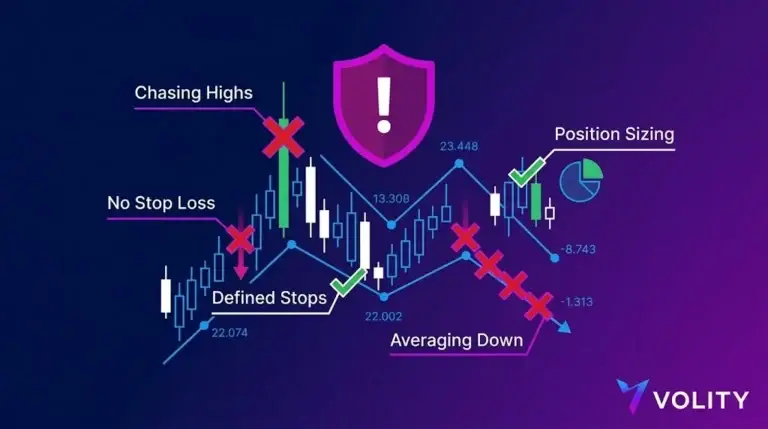
Regulators treat leveraged CFDs as high-risk products for good reason. Both the FCA in the UK and ESMA across the EU have restricted how they are sold to retail traders, and Volity’s own trading execution is regulated by CySEC through UBK Markets under licence 186/12. This article is educational rather than personal advice. Match the route to your goal and time horizon, size positions to a risk level you can stomach, and on any leveraged trade set a stop and a fixed risk per trade before you enter. If you are unsure which approach fits your circumstances, take independent guidance before committing capital.
Frequently asked questions
How can a beginner invest in the S&P 500?
For a beginner, the simplest way to invest in the S&P 500 is a low-cost index fund or ETF that tracks it, bought on a reputable platform and held for the long term. If you would rather learn to trade the index actively, start on a free demo, get comfortable with how leverage and CFDs behave, and keep your size small until real money feels routine.
What is the difference between an S&P 500 index fund and an ETF?
Both track the same index. An S&P 500 index fund is usually priced once a day and bought straight from the provider, which suits regular, automated investing. An ETF trades on an exchange through the day like a share, so you get more control over timing. Costs are close across the major low-cost trackers, so the decision often comes down to how you prefer to buy and hold.
Can you invest in the S&P 500 from outside the United States?
Yes. Investors across the UK, Ireland, Canada, Australia, and beyond reach the S&P 500 through locally available index funds and ETFs, or by trading the index as a CFD. You do not need a US-based account. Providers such as Vanguard, UBS, and iShares offer S&P 500 trackers built for international investors, and index CFDs give active traders another way in.
Can you short the S&P 500?
Standard index funds and ETFs are long-only, so they gain only when the index rises. To bet on a fall, traders use an index CFD such as the US500 on Volity, which trades in both directions. Shorting with leverage carries higher risk than simply holding, so it calls for a clear stop and disciplined position sizing.