Volity daily watchlist: event trades versus theme trades
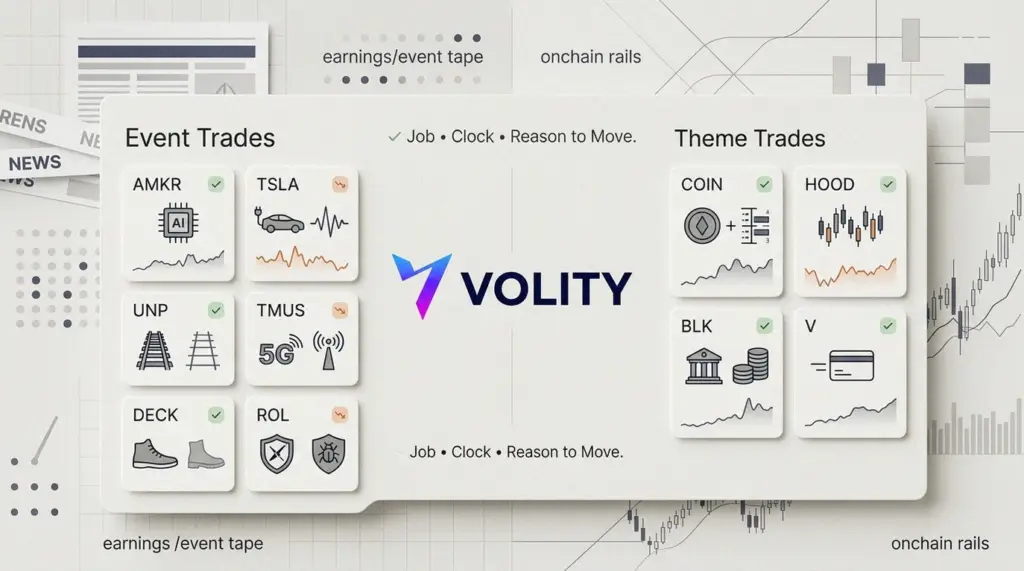
The market still wants proof, not poetry. Fresh earnings, AI hardware spending and onchain finance remain the liveliest seams for traders. However, the better watchlist now separates near-term catalysts from slower, narrative-led trades.
That split matters. An earnings beat can move a stock this week. A tokenisation theme may need months, plus patience. Therefore, today’s list keeps the fast money apart from the bigger story trades.
Event trades with fresh fuel
Amkor Technology, AMKR, sits in the AI hardware slipstream. The stock is not Nvidia, and that is partly the point. Traders keep searching for second-order winners from data-centre spending, especially in packaging, testing and advanced chip supply chains.
Amkor’s packaging partnership with Nvidia gives the trade a cleaner hook than most AI-adjacent names. Meanwhile, any fresh hyperscaler capex chatter could pull the stock back onto momentum screens. The setup works best if volume expands with the move.
Still, this is a chase candidate, not a sleepy compounder. Therefore, traders should watch for high-volume continuation alongside broader semiconductor strength. If the AI hardware tape stalls, AMKR can lose sponsorship quickly.
Union Pacific, UNP, offers a more old-fashioned earnings follow-through trade. The rail operator delivered an upbeat second-quarter report, with a clean beat and better operating metrics. Analysts then grew more constructive, citing execution and margin progress.
That combination usually gives portfolio managers cover to add exposure. However, rail stocks rarely move in straight lines. The trade now turns on whether the post-report move holds above breakout levels, or fades into a failed-news reaction.
For traders, UNP is less about glamour and more about confirmation. If margins keep improving, the stock can keep attracting generalist money. If the tape rejects the earnings move, the setup becomes a short-term reversal candidate.
T-Mobile, TMUS, remains a post-earnings repricing watch. Telecom has quietly become a defensive growth pocket, which is a rare phrase that almost earns its keep. Recent results brought estimate revisions and target increases, so the move is tied to new information.
Meanwhile, investors are still judging the balance between subscriber growth, pricing power and network spending. A sustained bid in TMUS would suggest buyers accept the capex path. A reversal would hint that expectations moved too far, too quickly.
Deckers Outdoor, DECK, belongs in the high-beta consumer bucket. Fresh earnings put the name back on screens, while discretionary stocks remain a test of household resilience. Traders often use Deckers as a cleaner read on premium consumer demand.
However, high-quality consumer growth can still trade like a leveraged factor bet. If retail flows improve, DECK can press through post-report highs. If the consumer tape weakens, the same stock can become a failed-breakout candidate.
Rollins, ROL, is a quieter post-earnings reaction play. The pest-control company lacks the fireworks of AI or crypto, but it offers company-specific execution. That matters in a market where investors say they want real earnings growth beyond mega-cap technology.
Therefore, the key test is relative strength. ROL should work if estimates keep filtering higher and service names stay bid. If it cannot outperform its peer group, the catalyst has probably gone cold.
Tesla, TSLA, should be treated as a volatility vehicle. It should not be dressed up with stale market-cap swings or recycled wipeout figures. The stock remains a large-cap, high-beta mix of technology, autos and autonomy hopes.
That makes TSLA unusually sensitive to analyst calls, Robotaxi updates and Musk-related headlines. Meanwhile, dated references to a late-June 2026 market value near $1.4 trillion are no longer useful for a live trade. The cleaner approach is to trade the volatility, not the folklore.
Theme trades with structural backing
Robinhood, HOOD, is the most liquid listed expression of retail trading meeting crypto activity. The company sits between ordinary brokerage, options speculation and onchain exposure. That position matters when volumes rise across equities, tokens or both.
However, HOOD is not just a “crypto stock”. Its attraction lies in the overlap between regulated brokerage rails and younger investors’ trading habits. Product launches, regulatory clarity and sudden volume spikes can all tighten the theme into a catalyst.
HYPE represents the more speculative infrastructure side of onchain finance. The thesis is about financial plumbing, not today’s earnings line. Partnerships, protocol integrations and asset-manager adoption would carry more weight than broad enthusiasm.
Therefore, this belongs in a theme sleeve, not the event-trade section. It can move sharply, but its evidence will usually arrive through ecosystem signals rather than quarterly beats.
Coinbase, COIN, remains a direct proxy for crypto-market cyclicality. It has exposure to spot volumes, custody, staking and institutional adoption. As traditional finance edges toward tokenised products, COIN keeps appearing in the path of that traffic.
Still, the stock can punish sloppy timing. Bitcoin and ether direction matter. Regulatory headlines matter. ETF flows matter as well. Traders should treat COIN as crypto beta with an operating business attached.
BlackRock, BLK, offers the institutional side of the same convergence trade. The asset manager sits at the centre of ETF innovation, model portfolios and tokenisation experiments. It also has scale that smaller fintech names can only envy.
Meanwhile, BLK will not usually move like COIN or HOOD on crypto headlines. Its appeal is steadier. The trade is about distribution power, product design and institutional adoption of digital-asset rails.
Visa, V, is the quieter payments expression. The company is tied to global transaction volumes, digital wallets and settlement technology. It gives investors exposure to financial infrastructure without taking a pure token-price bet.
However, V still needs clean volume trends and constructive commentary on interchange. Partnership news can help, particularly where digital wallets and cross-border settlement overlap. The trade is boring only until the numbers move.
By the numbers
- 6 event-driven names: AMKR, UNP, TMUS, DECK, ROL and TSLA.
- 5 theme names: HOOD, HYPE, COIN, BLK and V.
- Q2 earnings remain the key hook for UNP and several consumer or service names.
- $1.4 trillion Tesla market-cap references from late June 2026 are too stale for today’s setup.
- 3 main market engines: earnings, AI spending and TradFi-onchain convergence.
Names needing sharper catalysts
Several tickers can still make the secondary blotter, but only with tighter evidence. BAH needs an exact earnings surprise, price reaction and volume context. GEV needs proper technical levels, not a vague “bullish signal”.
Meanwhile, AMD needs a fresh product, guidance or data-centre demand update. A broad AI market forecast for 2030 is background, not a trade. HIMS needs precise regulatory timing, preferably paired with earnings or user-growth detail.
NUE can work for income-minded investors, but traders need consensus EPS, steel-price commentary or guidance colour. NFLX, ABBV and RIG also need specific earnings surprises, guidance changes or analyst revisions before they deserve headline space.
Trading implications
- Separate clocks: trade AMKR, UNP and TMUS around near-term confirmation, but give BLK and V longer room.
- Demand volume: momentum ideas need expanding turnover, especially AMKR and DECK.
- Avoid stale figures: TSLA needs live catalysts, not recycled market-value claims.
- Watch crypto flows: HOOD, COIN and HYPE need activity, not just narrative heat.
- Respect failed breakouts: post-earnings strength that fades can turn quickly into a short-term sell signal.
The cleaner watchlist is not the longest one. It is the one where every ticker has a job, a clock and a reason to move.
Related coverage on Volity
- What Is a P/E Ratio and How to Use It
- Fundamental Analysis in Stock Trading: A Working Definition
- Growth Investing vs Value Investing: Which Style Fits You?
- Fractional Shares Explained: How to Start Investing With $50
- How to Start Stock Trading: A 2026 Beginner Guide
- Dividend Investing for Beginners: How to Start