Crypto markets get squeezed as options, rules and AI fight for cash
Bitcoin is not doing much, which is rarely the same as nothing happening.
Prices remain pinned near the low-$60,000s, while larger forces pull at the market from every side. Options dealers are defending settlement levels. Miners are switching off machines. ETF flows are returning. Meanwhile, companies with crypto treasuries are selling coins to chase AI infrastructure.
For traders, this is a week to watch positioning before price. The chart looks sleepy. The balance sheet does not.
Bitcoin stalls near resistance
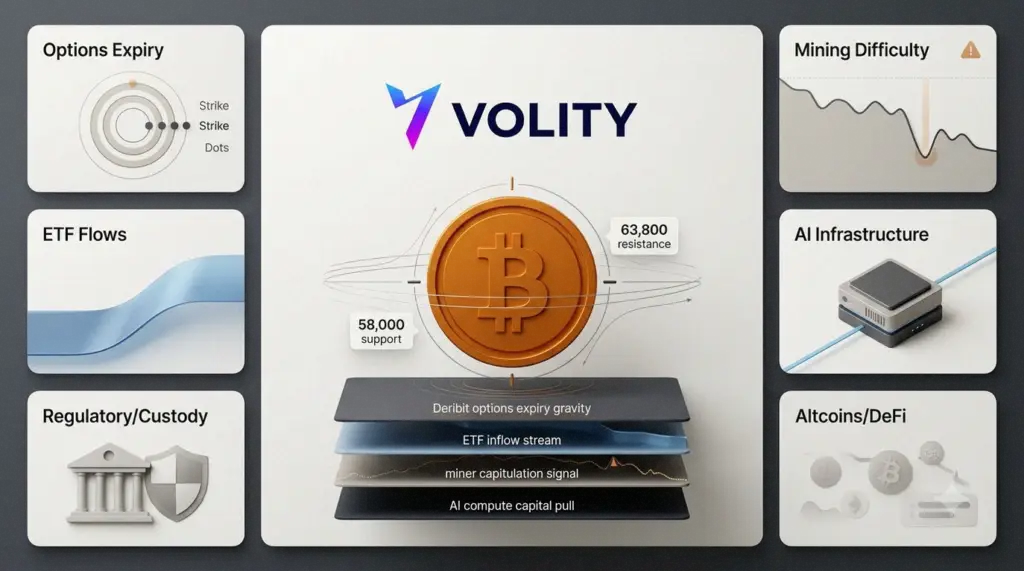
The biggest near-term event was a $9.6 billion Bitcoin options expiry on Deribit. That expiry helped trap BTC below resistance, with traders fighting around the mid-$60,000 area.
Options expiries often create strange gravity. Dealers hedge near large strike prices, while short-term funds push for profitable settlement levels. Spot Bitcoin can look dull even as derivatives desks sweat.
Technicians are watching $58,000 as support and $63,800 as near resistance. A clean move above that ceiling could invite trend-following buyers. However, a break below support would likely flush late longs.
ETF flows offer the better mood music. After heavy June outflows, spot Bitcoin ETFs have seen renewed demand. One recent session brought in about $233 million, led by BlackRock’s fund.
That matters because ETF flows now function like a slow-moving whale. They do not always decide the day’s candle. However, they often shape the next month’s liquidity.
Miners, meanwhile, are showing strain. Bitcoin difficulty has dropped nearly 19.9%, pointing to a sharp retreat by weaker operators. Less efficient miners are shutting rigs, selling coins, or waiting for better economics.
Historically, miner capitulation can arrive near turning points. Still, it needs help from liquidity and risk appetite. Without that, miner pain becomes just another source of forced selling.
Altcoins struggle for sponsorship
Outside Bitcoin, the market is more fragmented. Traders are rewarding local catalysts, then selling quickly when momentum fades.
SHIB’s latest meme run has already cooled after a roughly 40% breakout. Bulls now need fresh volume to defend the new support zone. Otherwise, profit-taking may drag it back into the old range.
BNB has fared better, snapping a 45-day downtrend with a 5% rise. Even so, the token still cannot convincingly clear $600. That level is symbolic, but symbols matter in thin markets.
Ethereum looks more fragile. ETH has slipped below $1,900, with traders watching $1,850 as the next floor. A failure there would hit more than Ether holders.
That is because ETH remains the market’s shorthand for DeFi risk. When Ether falls, collateral feels weaker. Lending desks pull back. Liquidity providers get pickier. A small spot move can travel widely through on-chain finance.
DeFi has already shrunk hard this year. Market estimates suggest about $43.4 billion of value disappeared in the first half. Lower token prices explain part of that. Yet lower leverage and bored users matter too.
The easy-yield era has thinned out. Investors now want cleaner cash flows, better distribution and products people actually use.
AI pulls money from crypto treasuries
The most revealing shift is not on the screen. It is in treasury decisions.
Some digital-asset-heavy companies are treating Bitcoin and Ether as funding sources for AI infrastructure. That is a sharp change from the 2021 playbook, when holding crypto itself was the message.
- Quantum Solutions sold 1,000 ETH to help fund AI expansion.
- Hyperscale Data sold 100 BTC for similar infrastructure plans.
- Other crypto treasuries are reviewing holdings as compute costs rise.
Meanwhile, Google’s backing of a $15 billion Anthropic data centre project in Texas shows where big capital is moving. Compute has become the scarce asset. Tokens without clear use cases now face tougher questions.
For investors, the signal is plain. Crypto exposure is no longer enough. Projects need links to payments, data, tokenisation, security or real infrastructure. Otherwise, they risk becoming funding stock for someone else’s AI build-out.
New york tests prediction markets
Regulation is also pressing on the market’s edges. New York has sued Kalshi, one of America’s best-known prediction-market platforms. The state is seeking penalties tied to event contracts it views as illegal gambling.
The headline number is huge: up to $36 billion. Even if that figure changes, the message landed quickly. Prediction markets may have users, volume and clever design. However, they still sit near one of finance’s most sensitive borders.
That border separates hedging, speculation, gambling and political influence. Crypto builders often blur it by design. Regulators rarely enjoy the blur.
The case arrives as prediction markets prove they can scale. World Cup-linked markets reportedly handled around $20 billion in volume. This is not a niche fight about one platform. It is a test case for a whole category.
Washington is shifting too. The merged CLARITY Act text now sits before the White House after Senate revisions. Odds of passage are estimated near 30%, but the substance matters even before a vote.
Law-enforcement support shows where agencies are focused. They are watching crypto, lobbying, campaign finance and event markets move closer together.
Stablecoins keep building quietly
While tokens chop sideways, the payment rails are improving. This part of the market lacks drama, but it keeps attracting serious attention.
A Bank of Italy sandbox test found stablecoin remittances captured about 9% of flows. That is modest, not magical. Still, it shows users will move when settlement improves and fees fall.
Corporate finance is moving in the same direction. Robinhood has received a $160 price target from Bernstein, partly because of its tokenisation plans and Rothera growth. Investors increasingly view it as more than a retail brokerage.
DTCC, the clearing giant behind much of US securities settlement, is also running tokenisation pilots at scale. Consumer crypto brands still get the noise. However, settlement infrastructure may capture the durable economics.
Payments are changing as well. Solana Pay is being tested in South Korea through KSNet and the Solana Foundation. The country’s dense retail network makes it a useful laboratory for low-fee crypto transactions.
Separately, MoonPay is rolling out PayBox for crypto payments inside ChatGPT. That points to a different wallet future. The interface may become conversational, not just another app icon.
Custody remains the weak spot
Security remains the market’s least glamorous risk and often its most expensive.
Swan Treasury reported a loss of about $625,000 after a signer-key leak. Attackers used the weakness to buy STY at a steep discount and drain value from treasury operations.
Separately, warnings around Coldcard Mk3 devices followed a $38 million Bitcoin drain. The episode pushed traders to review hardware wallets, signing flows and recovery procedures.
The old slogan still says, “not your keys, not your coins”. Yet the trade-off has become more complicated. Self-custody removes platform risk. However, it can turn one operational mistake into a permanent loss.
Regulated platforms are easier to use. Still, they bring counterparty, seizure and policy risks. BNB Chain’s self-custody guide, written against the backdrop of Europe’s MiCA rules, captures that tension neatly.
By the numbers
- $9.6 billion – Bitcoin options expiry on Deribit.
- $233 million – recent one-day inflow into spot Bitcoin ETFs.
- 19.9% – approximate drop in Bitcoin mining difficulty.
- $43.4 billion – estimated first-half contraction in DeFi value.
- $36 billion – potential penalties sought in New York’s Kalshi case.
Key takeaways
- Respect the expiry zone. Bitcoin may stay pinned until options pressure fades.
- Watch ETF flows. Sustained inflows would strengthen the recovery case.
- Be selective in altcoins. Momentum without adoption is getting sold quickly.
- Treat custody as trading risk. Wallet design and signer controls now matter deeply.
- Track regulation early. Prediction-market rules could reshape several crypto themes.
The market looks fragile because it is. Leverage is lower, fear is higher and old narratives are wearing thin. Yet capital is not leaving entirely. It is moving toward infrastructure, tokenisation, payments and AI-linked assets.
That makes this a harder market, but not an empty one. The next winners will probably look useful before they look exciting.
Related coverage on Volity
- How to Avoid Crypto Scams: A Beginner Safety Checklist
- How to Choose a Trading Platform: A 10-Point Checklist
- Demo vs Live Trading Account: A 7-Step Checklist Before You Go Live
- How to Size a Trade: Position Sizing and Risk Per Trade for Beginners
- Risk-Reward Ratio Explained: How to Set It and Why It Matters
- ETF vs Index Fund: The Difference and Which to Pick