A prediction market pays out on its written rules, not on what the headline appears to promise. Resolution is the step where a venue decides which side won, and the criteria that drive that decision are published before trading opens. Polymarket’s own documentation is blunt about the gap between the two: the market title describes the question, but the rules define how it resolves. This guide covers who decides, from which source, how long the money takes to arrive, and what happens when someone disagrees.
The Crypto Trading Starter Kit
A plain-English PDF: what to check before you trade, how orders and risk really work, and the mistakes to skip. Get it free.
TL;DR / Quick insight: The resolution rule is the contract. Two markets on the same real-world event can settle differently because they name different sources, different cut-off dates and different treatment of edge cases. Read the settlement criteria and the exact wording before you buy, not after the event. On Polymarket an undisputed outcome settles in roughly two hours; a disputed one takes four to six days. Winning shares redeem at $1.00 and losing shares are worth nothing.
Nothing here is personal advice. An event contract can settle at zero, which means losing the full amount you paid for it.
Why the resolution rule is the whole contract
Every serious derivative works this way. The payoff is defined by a specification document rather than by the name of the product, which is why professional traders read contract terms before they read a chart. Look at any regulated index derivative and the settlement variables are pinned down to the minute. Eurex’s contract specification for EURO STOXX 50 index options states that the final settlement price is based on the average of the index values calculated between 11:50 and 12:00 CET on the final settlement day. Named source, exact window, stated method, fixed date.
Event contracts inherit that logic in a compressed form. The entire specification is a short block of text sitting under the order book, and it is the only thing that decides whether your share is worth a dollar or nothing. Kalshi puts it in one sentence: the rules for determining a contract’s outcome, the information that will be used, and the source of this information are included in each contract’s terms and conditions.
The economics literature has treated these instruments as forecasting tools for two decades. Wolfers and Zitzewitz set out the framework in the Journal of Economic Perspectives, defining them in the companion NBER working paper as markets where participants trade contracts whose payoffs are tied to a future event. The payoff is tied to the event as the contract specifies it, which is a narrower thing than the event itself.
Both major venues put the same warning in front of new users. Polymarket’s help centre states that markets resolve according to pre-defined rules that can be found under the market’s order book. Kalshi tells traders that each market operates under its own regulations documented on the market page, and adds a plain instruction to read market rules before trading. Different architectures, identical advice.
Reading the settlement criteria before you buy
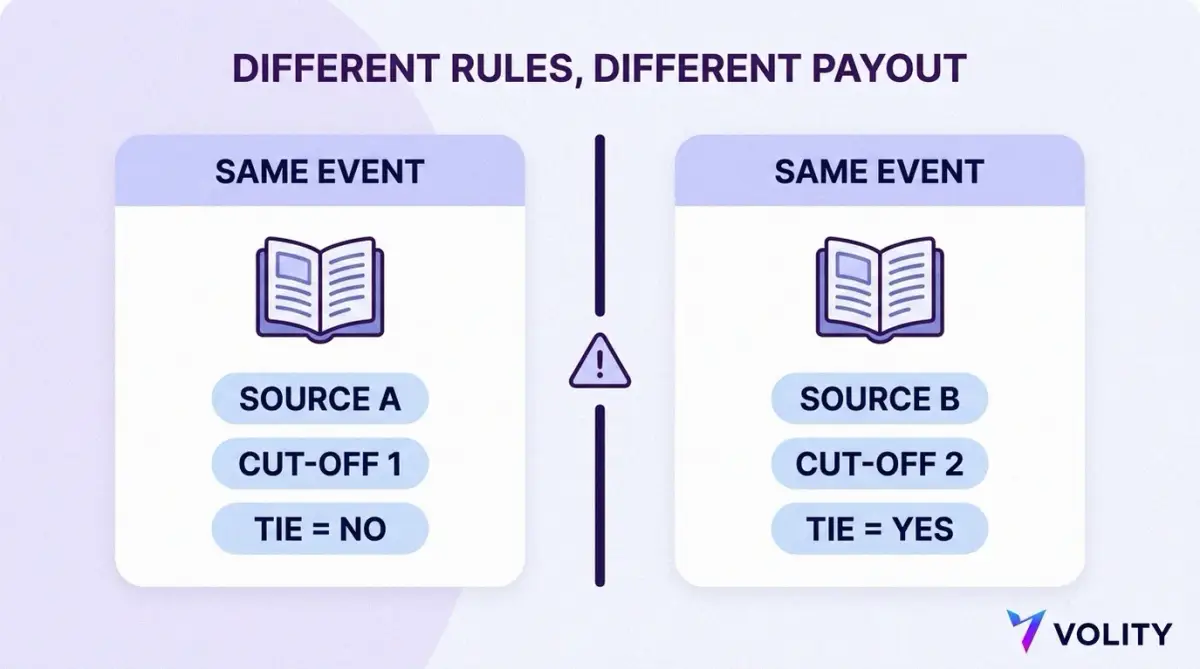
A resolution rule has a job to do, and Polymarket’s documentation sets out what every market has to define: the resolution source, the end date, and how edge cases are handled. Markets phrased almost identically can differ on all of them, and that is where money is lost by people who never read a price incorrectly.
Take a real one. A Polymarket market on the next Prime Minister of Ethiopia, read live on 2 August 2026, resolves to whoever assumes the office after the 2026 general elections. The rule then narrows that: the person must be officially appointed and sworn in, and any interim or caretaker Prime Minister does not count toward resolution. It also names a primary source, allows corroborating reporting, and sets a backstop date after which the market resolves to Other. Every clause there is a place where a reasonable person could have guessed wrong.
Now imagine a second market on the same election that omits the interim clause. A caretaker taking office would settle one market and not the other, on the same day, on the same facts. Nothing has gone wrong in either case. The contracts simply asked different questions behind similar titles.
Kalshi splits this into layers so traders can see the shape quickly. Each market carries a rules summary covering the value being measured, the timeline and the verification source, and the exchange notes that a summary does not contain the entire text of the full rules, which sit below it. A summary is a map. The full rules are the territory, and the payout follows the territory.
What counts as the source of truth
The resolution source is the named authority whose statement ends the argument. It is usually an official announcement, a governing-body publication, a data provider or a specific named site, and it is chosen when the market is created. Polymarket asks anyone suggesting a new market to state what the resolution source is as part of the proposal, alongside the title and evidence of demand.
Precision matters more than it sounds. “The price of bitcoin” is not one number, and a well-written rule says which number. Kalshi settles its crypto contracts by averaging 60 seconds of CF Benchmarks Real-Time Indexes, which report a price once per second, so the final value is the mean of the last sixty prints before expiry rather than a tick on any single exchange. Two contracts on the same asset at the same strike would settle differently if one used a spot print and the other used that average.
Sources come in three shapes, and the shape changes your risk. A single named authority or index is the cleanest: one publication, one moment, one answer. A multi-source rule requires several outlets to agree before the market settles, which is slower but harder to game. A consensus-of-credible-reporting rule is the loosest, because it hands judgement to whoever is resolving rather than to a document.
The two venues then diverge on who applies that source. Kalshi determines outcomes itself, and states that determination can take anywhere from one hour to more than twelve hours after market closure, usually dictated by when the data arrives from the source agency. Polymarket hands the job to an external oracle instead, using the UMA Optimistic Oracle for decentralised, permissionless resolution, where anyone can propose an outcome and anyone can dispute it. For the venue mechanics underneath all this, see our walkthrough of how Polymarket works.
The timeline from event to payout
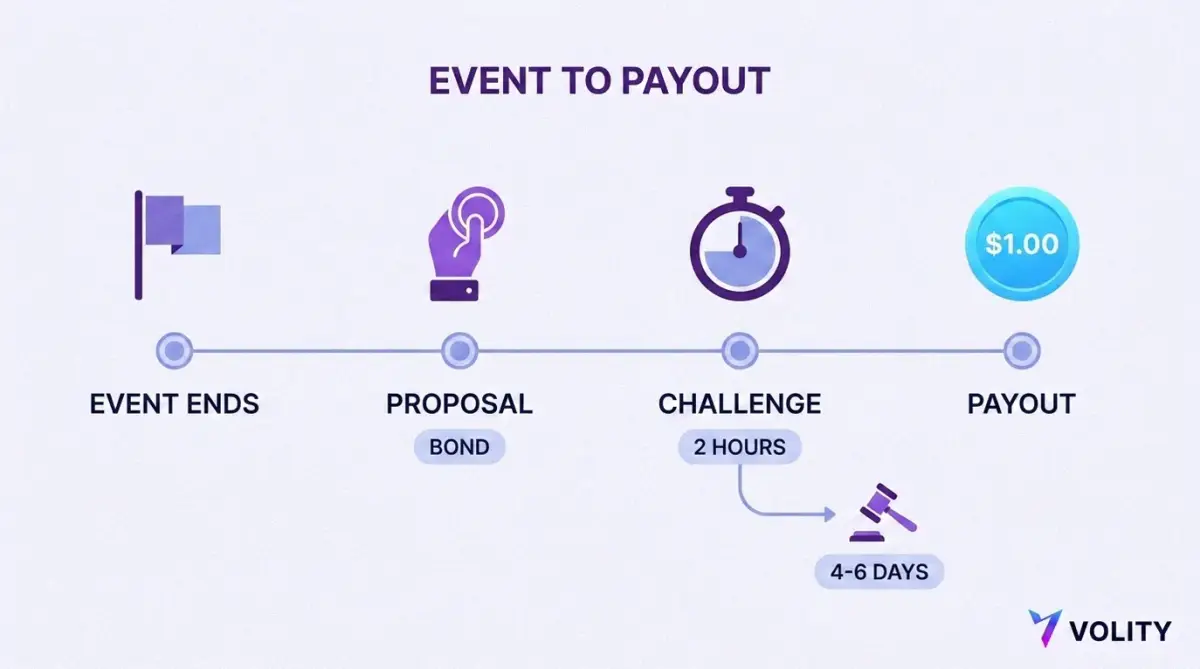
An event ending is not the same as being paid. On an oracle-resolved venue the sequence runs: the event concludes, someone proposes the outcome and posts a bond, a challenge window opens, and only then do winning shares become redeemable. Polymarket’s documented figures, as of 2 August 2026, put the proposer bond at typically $750, followed by a two-hour challenge period, with the bond forfeited if the proposal is wrong or made too early.
| Phase | Typical duration | What is happening |
|---|---|---|
| Proposal | Any time after the end date | A proposer selects the outcome and posts a bond |
| Challenge window | 2 hours minimum, extendable | Anyone may dispute by posting a matching bond |
| Undisputed settlement | About 2 hours after proposal | Winning shares become redeemable at $1.00 |
| Debate period, if disputed | 24 to 48 hours | Evidence is submitted publicly |
| Token-holder vote, if disputed | About 48 hours | Stakers commit and reveal votes |
| Disputed settlement | 4 to 6 days total | Outcome finalised by the vote |
The challenge window is not a fixed constant. UMA’s developer documentation sets a default liveness window of two hours and advises against configuring anything shorter. Its prediction-market page then explains that flagged proposals get an extension, so a routine sports proposal can settle after roughly 15 minutes while a complex or subjective geopolitics proposal is held open past the two-hour default. The harder the question, the longer your capital stays committed.
Kalshi’s timing works differently but demands the same attention. Its help centre notes that markets close either when the outcome occurs or at a listed date and time, and that traders should read the timeline and payout information before trading to know which of the two applies. Money committed to an event contract is not money you can plan around on a fixed date.
What happens when an outcome is contested
Disputes are a designed feature, not a failure. The point of an optimistic system is that a cheap, fast answer is accepted unless somebody is willing to put money behind the claim that it is wrong. UMA describes its oracle as resolving the vast majority of requests, currently 99.8%, quickly and cheaply, escalating the remainder to a dispute-resolution mechanism where stakers commit votes in a 24-hour window and reveal them in the next.
The escalation path is public and mechanical. A disputer posts a bond matching the proposer’s, which opens a debate period of 24 to 48 hours where evidence is submitted, after which token holders vote over roughly 48 hours. Polymarket’s help centre lists four possible results: proposer wins, disputer wins, Too Early, or Unknown. The losing side forfeits its bond and half of it goes to the winner as a bounty, which is what keeps frivolous disputes rare.
Half of those results catch traders off guard. Too Early means the underlying event had not actually concluded, so the clock resets and the market stays open. Unknown, described as rarely used, resolves the market 50-50, and every share redeems for $0.50 whichever side it was held on. A market you were winning on paper can end as a half refund.
One mechanical detail matters for expectations. Polymarket states that it is non-custodial and cannot alter or reverse market resolutions, and that once finalised by UMA, outcomes are immutable. There is no appeal desk to email afterwards. The place to influence the outcome is the rules, and the time is before you buy.
The trap of ambiguous wording
Most resolution arguments are arguments about language. A rule that says a policy must be “announced” leaves open whether a leaked draft counts. A rule that says a figure must “exceed” a level leaves open what happens at exactly that level. A rule with no stated time zone leaves open which calendar day a late-evening event falls on. None of that is visible in the title.
The clearest published illustration is a pair of Polymarket contracts on the same corporate action. The software company Strategy sold 32 bitcoin between 26 and 31 May 2026, then disclosed the sale in a filing on 1 June. CoinDesk reported that the venue’s resolvers ruled the 31 May contract No and the 30 June contract Yes. Their view was that the transaction was not public until 1 June, so it could not count toward a May cut-off. One real event, two contracts, opposite payouts, decided entirely by whether the rule dated the transaction or its publication.
Definitional wording is the other common trap. A market on whether Ukraine’s president would wear a suit at a NATO summit attracted, by CoinDesk’s reporting, more than $160 million of trading before the question of what counts as a suit turned out to have no obvious settlement source at all. Compare that with a crypto price contract, where “above $120,000” is fully machine-decidable against a named index over a stated window. The mechanics are identical; only the wording differs in how much room it leaves.
This is not a quirk of one venue. Research on automated resolution finds it hard in general: a 2026 study evaluating multi-agent oracle systems across 1,189 already-resolved prediction market questions reports a best configuration accuracy of 83.43%, with many questions resisting correction by any architecture and needing human arbitration. A meaningful share of real questions are genuinely ambiguous before anyone starts trading them.
Venues patch this with clarifications, and both are careful about the limits. Polymarket may publish an “Additional context” update where unforeseen circumstances require it, but the documentation is explicit that clarifications cannot change the fundamental intent of the question and are published on-chain. Kalshi adds “additional details” when traders are confused about interpretation, while stating that it has no responsibility to add additional details to a market page. A clarification is a courtesy, not a guarantee.
Ambiguity also multiplies when one event is split into several contracts. Polymarket structures a market as a single binary question and groups related questions under an event that acts as a container, so a four-way race is several Yes/No markets side by side. Each carries its own rules text, and reading one does not tell you what the neighbouring contract says. If the pricing side is what you want next, our guide to prediction market odds covers reading a price as a probability.
A pre-trade checklist for a market’s rules
Work through this before you commit money to any single market. It takes about a minute once you know where to look.
- Open the full rules, not the summary. The summary is a convenience. The full text is what settles.
- Identify the named resolution source, and whether it is one authority, an index with a stated measurement window, several outlets that must agree, or a general consensus of reporting.
- Find the end date and check whether the market closes on a date or when the outcome occurs.
- Ask whether the rule dates the event itself or its publication. That single distinction has decided real markets.
- Read the exclusion clauses. Interim holders, caretakers, provisional results, partial completions and cancellations are usually addressed explicitly.
- Check the backstop. Work out what the rule says if the event never happens or the source never publishes.
- Look for the time zone and the exact cut-off moment, then convert it to your own clock.
- Note the settlement path. Roughly two hours undisputed, four to six days if disputed, so do not commit money you need back on a fixed date.
- Check whether a clarification has already been posted, and read it alongside the original wording.
- Compare against any near-identical market before sizing. A different source or cut-off makes it a different instrument.
- Accept the downside. A losing share pays nothing, and an Unknown resolution can return half.
If you are still deciding whether this instrument suits you at all, start with what prediction markets are, compare the structure against fixed-odds products in prediction markets versus betting, and browse the rest of our crypto guides for wider context.
Where Volity fits
The Markets screen in your Volity dashboard lets you connect a Polymarket account, fund it from your Volity USD wallet and track the balance from the same place you manage the rest of your money. Dollars leave the wallet and arrive at the venue as a dollar stablecoin balance, which is the unit these contracts are collateralised in, so a settled winning share redeems in that same unit.
Your position lives at the venue, not with us. Balances and positions are held on the external platform, and trading, availability and withdrawals are subject to that platform’s own terms. Volity does not place or manage orders on your behalf, and resolution is decided by the venue’s own published process rather than by us. The step-by-step setup is in our guide to funding a Polymarket account.
Who decides the outcome of a prediction market?
It depends on the venue’s design. Kalshi determines outcomes itself, applying the contract’s terms and the named source agency. Polymarket uses the UMA Optimistic Oracle, where anyone can propose the outcome by posting a bond and anyone can dispute it during a challenge window, with unresolved disputes going to a token-holder vote. In both cases the decision follows the market’s published rules and the source named in them, not an opinion about what the event meant.
How long does it take to get paid after an event?
On Polymarket an undisputed market settles roughly two hours after someone proposes the outcome, and a disputed one takes four to six days once the debate period and the vote are included. On Kalshi, determination after a market closes can take from about one hour to more than twelve, depending on when the source publishes its data. Settlement time is a property of the market you chose, so check it before you need the cash.
What if the wording of a market is ambiguous?
The rules text usually anticipates the common ambiguities with exclusion clauses and a backstop condition, which is why reading it in full is worth the minute it takes. Where something genuinely unforeseen happens, a venue may publish a clarification, though a clarification cannot change the fundamental intent of the question. Anything the rules do not address gets decided by whoever resolves the market, under the process that market uses.
Can a resolution be disputed?
Yes, on venues built around an optimistic oracle. A dispute is opened by posting a bond equal to the proposer’s during the challenge window, which triggers a debate period and, if needed, a token-holder vote. The losing side forfeits its bond, so disputes carry a real cost and are uncommon in practice. UMA reports that 99.8% of requests resolve without escalating at all.
What happens if an event is cancelled?
Look at the rules first, because most define this in advance with a backstop date or a stated fallback outcome. Where none of the normal outcomes apply, a market can resolve as Unknown, in which case every share redeems for $0.50 regardless of the side it was held on. A cancelled or indefinitely postponed event is the classic case where two similar-looking markets settle differently, purely because one wrote the clause and the other did not.