Hyperliquid is a derivatives exchange that runs as its own blockchain. The question what is Hyperliquid has an unusual answer because the venue is not a company running a matching engine behind an API. Its own documentation describes it as a layer one blockchain written and optimised from first principles, built so that the order book itself lives inside the chain’s consensus. This guide covers what that design actually changes for a trader, how the two halves of the chain fit together, and what you can check for yourself before you trust any of it.
The Crypto Trading Starter Kit
A plain-English PDF: what to check before you trade, how orders and risk really work, and the mistakes to skip. Get it free.
TL;DR / Quick insight: Hyperliquid is a Layer 1 blockchain whose consensus exists to run an order book. Every order, cancel and liquidation is a transaction agreed by validators, so there is no off-chain matching engine to take on trust. The chain has two halves: HyperCore, which holds the order books and your margin, and HyperEVM, a smart contract environment under the same consensus. They keep separate balances, so moving value between them is an explicit transfer you make. Placing and cancelling orders costs no gas.
Nothing here is personal advice. These are leveraged instruments, and leverage amplifies losses as readily as gains. A position that moves far enough against you is closed by the protocol, and you do not choose the moment.
A derivatives exchange that happens to be a blockchain
Most crypto venues are a website in front of a private matching engine. Orders arrive at a server the operator controls, the server decides the sequence they were received in, and you find out the result afterwards. The database is theirs. Hyperliquid inverts that arrangement by making the exchange the chain, so the sequence of orders is the thing validators reach agreement on.
The consensus algorithm is called HyperBFT. The documentation describes it as a variant of HotStuff consensus, referring to the HotStuff protocol published in 2018, which gave Byzantine fault tolerant consensus a linear communication pattern and a simple three-phase commit. That academic lineage matters because it is the reason a blockchain can plausibly keep up with an order book at all.
The performance claims are specific rather than vague. For an order sent from a geographically co-located client, the docs state end-to-end latency with a median of 0.2 seconds and a 99th percentile of 0.9 seconds, measuring the full round trip from sending a request to receiving a committed response. Throughput is given as roughly 200,000 orders per second, with execution named as the current bottleneck rather than consensus.
Scale followed the design. CoinGecko’s derivatives API listed Hyperliquid with open interest of about 162,124 BTC and 364 perpetual pairs when checked on 1 August 2026, which converted to roughly $10.2 billion of open interest and about $2.1 billion of perpetual volume over the preceding day. CoinDesk reported the venue extending its lead over rival on-chain perpetual venues in January 2026 with around $9.57 billion of open interest at the time. Treat every one of those numbers as a snapshot. Venue volume and open interest move continuously, and any figure in an article is only as good as its date.
Why the order book lives in consensus rather than a matching engine
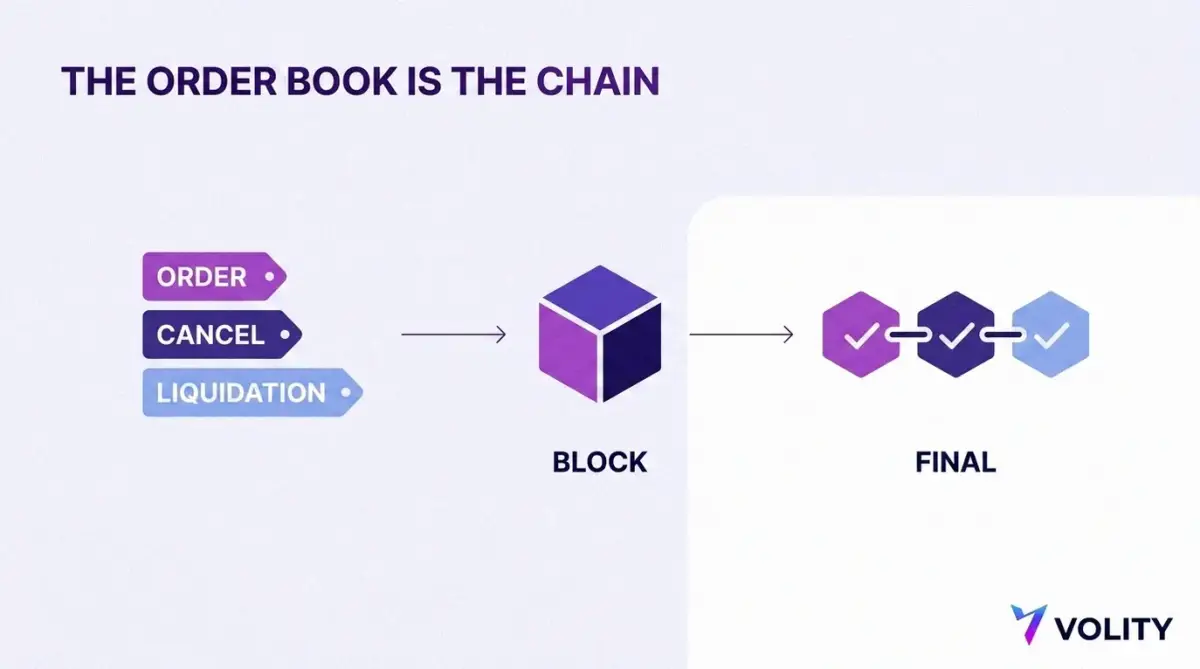
The docs put the design principle bluntly, saying HyperCore does not rely on the crutch of off-chain order books and that every order, cancel, trade and liquidation happens transparently with one-block finality. An order is not a message to a server. It is a transaction that validators sequence and commit, and the API only answers once that transaction sits in a committed block.
One detail shows what this really means better than any summary. The chain’s mempool and consensus logic are semantically aware of transactions that interact with the order books, and within each block actions are sorted into a fixed order: first actions that place no aggressive order, then cancels, and only then actions that send a good-till-cancelled or immediate-or-cancel order. Cancels are sequenced ahead of new aggressive orders at the consensus layer itself. A market maker’s withdrawal of a stale quote gets priority over someone trying to hit it in the same block, and that rule is part of the protocol rather than a courtesy from an operator. Matching within the book is otherwise conventional price-time priority.
Placing and cancelling orders costs no gas, which surprises people who expect an on-chain venue to charge per action. Block space is rationed by trading activity instead. The published rate limits give an address one request per 1 USDC traded cumulatively since inception, with a starting buffer of 10,000 requests, alongside a per-IP cap on REST weight. A brand-new account also pays a one-off activation fee of one quote token on its first transaction. Quoting and requoting all day is therefore cheap for someone who trades, and expensive in rate limit for someone who only spams.
Liquidation is the part of this that is most worth understanding, because on most venues it happens somewhere you cannot see. Here, a position whose equity falls below maintenance margin is first sent to the order book as ordinary market orders, so any trader can compete for that flow and the liquidated trader keeps whatever margin survives. Only if equity falls below two thirds of maintenance margin does a backstop vault take the position over, and in that case the maintenance margin is not returned. Maintenance margin is half the initial margin at maximum leverage, which puts it between 1.25% and 16.7% depending on the asset. Liquidations use a mark price that blends outside exchange prices with the local book rather than a single instantaneous print.
HyperCore and HyperEVM hold separate balances
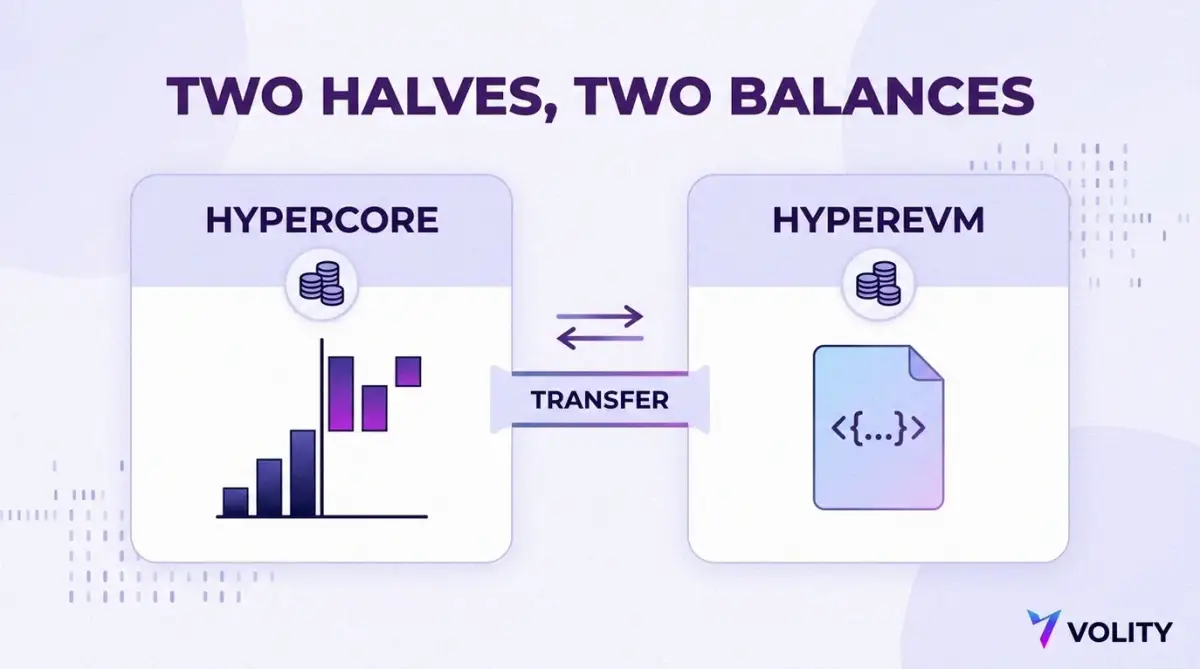
The chain’s state is split into two execution environments. HyperCore holds the perpetual and spot order books, the margin state and the clearinghouse. HyperEVM is a general purpose smart contract environment of the kind Ethereum popularised. The documentation is careful on the relationship: HyperEVM is not a separate chain, but secured by the same HyperBFT consensus as HyperCore. It runs as chain ID 999, and you can confirm that yourself in a few seconds, which the last section shows you how to do.
Here is the distinction that trips people up. One consensus and one state does not mean one balance. Your spot balance on HyperCore and your balance on HyperEVM are different places, and value moves between them only when you send it. The venue exposes a Transfer to/from EVM control for exactly this, and the move costs gas in HYPE. Underneath, the mechanism is a transfer to a system address: HYPE goes to the address 0x2222222222222222222222222222222222222222, and every other spot asset has its own unique transfer address derived from its token index. Send an asset to the wrong one and it is gone.
Calling that a bridge would be wrong, and the difference is worth getting right because it changes the risk. A cross-chain bridge involves a separate validator set, wrapped assets and a trust assumption between two chains. This transfer stays inside one state machine under one set of validators, which is why the docs say there is no bridging risk between the two halves. Hyperliquid does use the word bridge, for something else entirely: the Arbitrum USDC bridge that moves collateral in and out of the venue, secured by validator signatures weighted by two thirds of staked value. Those are two different mechanisms with two different risk profiles, and conflating them is a common error.
HyperEVM also runs on a two-speed block schedule, with fast blocks of one second carrying a 3M gas limit and slow blocks of one minute carrying a 30M gas limit. Small transactions confirm quickly while heavy contract deployments wait for the roomier block. Gas on that side is paid in HYPE, unlike order placement on HyperCore.
Perpetual futures margined in USDC
The venue’s core product is the perpetual future, a leveraged contract with no expiry that tracks a market price and is settled in cash. We cover the instrument itself in our explainer on what a perpetual contract is, and the periodic payment that keeps its price tethered in our guide to the funding rate. On the main HyperCore venue those contracts are margined in USDC, so one collateral balance backs every market you trade rather than a separate pot per instrument. That single-collateral design is covered in USDC margin explained.
Leverage is set per asset. The documentation says the venue supports 100+ assets with maximum leverage ranging from 3x to 40x, with the deepest markets carrying the highest caps. Funding is charged hourly rather than every eight hours, and the docs specify an interest rate component of 0.01% every eight hours, paid out at one eighth of the computed rate each hour.
Trading costs come from a published schedule. The base rate is the number to work from, and it looks like this on a round $10,000 of notional.
| Base rate, perpetuals | Rate | Cost on $10,000 notional |
|---|---|---|
| Taker, tier 0 | 0.045% | $4.50 |
| Maker, tier 0 | 0.015% | $1.50 |
| Taker, above $5M 14-day volume | 0.040% | $4.00 |
| Taker, above $100M 14-day volume | 0.030% | $3.00 |
Those rates are based on rolling 14-day volume and assessed at the end of each day in UTC, with spot volume counting double toward the tier. Fee schedules change, so check the live page before you size anything on the strength of a number you read here on 8 August 2026. The full cost picture, including why funding is not a fee, is in Hyperliquid fees explained.
Until late 2025 the set of tradable markets was decided centrally. That changed with HIP-3, which CoinDesk covered on 13 October 2025 as an upgrade unlocking permissionless perpetual market creation. Anyone meeting the requirements can now deploy their own perpetual venue on the same infrastructure.
The requirements are not trivial. The specification sets a mainnet staking requirement of 500,000 HYPE, held for at least 183 days after the venue is deployed. The deployer then takes on real responsibility: defining the market and its oracle, setting contract specifications and leverage limits, publishing oracle prices, and settling the market if that becomes necessary. Each deployed venue keeps its own margining, order books and settings, and the first three assets skip the auction that later listings go through.
This is how the venue came to list things that are not crypto. CoinDesk reported HIP-3 markets passing $1.2 billion in open positions as oil and equity futures took off in March 2026. It also introduces a distinction worth holding onto. Collateral is a per-venue choice under HIP-3, so while the main HyperCore perpetual venue is USDC-margined, a builder-deployed one can use a different quote asset. Check which one you are actually trading on before you assume what your margin is denominated in.
The trade-off is straightforward. A permissionless listing process removes the gatekeeper, and it also removes the gatekeeper’s filtering. A market’s oracle and specifications are set by whoever deployed it, so the deployer’s competence becomes part of your risk. That is a different bargain from a centralised venue, and our comparison of a perp DEX against a centralised exchange works through which model suits which trader.
What you can verify yourself on-chain
The argument for an on-chain venue rests on things you can check rather than things you are told. Each of the following takes a minute and needs no account.
- Read the live order book. Send
{"type":"l2Book","coin":"BTC"}to the public info endpoint and you get every price level with its size and the number of distinct resting orders behind it. - Check the funding history. The same endpoint returns every hourly funding rate with timestamps, so you can confirm what you were charged against the published formula rather than trusting a summary screen.
- Count the markets and read open interest directly. A request for the asset contexts returns each asset with its maximum leverage, open interest and daily notional volume, which is where the figures earlier in this article came from.
- Look up a system address in the explorer. The HYPE transfer address 0x2222222222222222222222222222222222222222 resolves like any other, so the mechanism is inspectable rather than asserted.
- Confirm the chain is what it claims. Ask the public RPC for its chain ID and it answers 0x3e7, which is 999 in decimal and matches the documentation.
Independent third parties can be checked against the venue’s own numbers too, which is the point of the CoinGecko cross-reference earlier. If a venue’s self-reported figures and an outside tracker disagree badly, that gap is information. This kind of public verifiability is what separates an on-chain order book from the generic automated market maker model most people picture when they hear the word DEX, which we cover in our guide to decentralised exchanges.
Connecting Hyperliquid from the Volity Markets screen
The Markets section of your Volity dashboard carries two external venues, and Hyperliquid is one of them. Connect or create your account at the venue, fund it from your Volity USD wallet, then trade on the venue itself. The panel in Volity then shows your available balance, account value, margin used, open positions and unrealised profit or loss in USDC, labelled as held at Hyperliquid with a refresh timestamp.
Your money and your positions live at the venue, not with us. Balances and positions are held on the external platform, trading, availability and withdrawals are subject to that platform’s own terms, and Volity does not place or manage orders on your behalf. What you get from the Volity side is one wallet to fund from and one screen to track from, which is the same arrangement described in our guide to connecting external trading platforms to your wallet.
Before your first position, it is worth knowing how to read the numbers on that panel, because account value and available balance are not the same thing and the gap between them is what stands between you and a liquidation. Our walkthrough of margin health and liquidation price covers that, the step-by-step funding route is in how to fund a Hyperliquid account, and the wider context sits in our crypto guides alongside our overview of crypto perpetual trading.
Is Hyperliquid a DEX or an exchange?
Both descriptions fit, which is why the label causes confusion. It is decentralised in the sense that no company runs a private matching engine and your margin is not held by an operator. It is an exchange in the sense that it runs a conventional central limit order book with price-time priority, rather than the automated market maker pools most decentralised exchanges use. The unusual part is that the order book is the blockchain’s state rather than an application sitting on top of one.
What is the difference between HyperCore and HyperEVM?
HyperCore holds the order books, the margin state and the clearinghouse. HyperEVM is a general purpose smart contract environment for applications. They are two execution environments inside one chain, secured by the same consensus, so this is not a main chain plus a sidechain. They do keep separate balances, so moving an asset from one to the other is a transfer you have to make deliberately, by sending it to that asset’s system address.
Do I pay gas per order on Hyperliquid?
No. Placing and cancelling orders on HyperCore costs no gas. Capacity is rationed by rate limits tied to how much you have traded, giving an address one request per 1 USDC of cumulative volume on top of a 10,000-request starting buffer. A new account pays a one-off activation fee of one quote token on its first transaction. Transactions on the HyperEVM side are different and do cost gas, paid in HYPE.
What can I trade on Hyperliquid?
Perpetual futures and spot markets. The documentation describes support for over 100 assets with maximum leverage between 3x and 40x depending on the market, and CoinGecko listed 364 perpetual pairs on 1 August 2026. Since HIP-3 went live in October 2025, builder-deployed venues have added markets outside crypto, including equity and commodity perpetuals. The list changes often, so check the venue for what is trading today.
Is Hyperliquid custodial?
Your margin sits in the protocol’s clearinghouse state against your own address rather than in an operator’s account, and the venue publishes what it is doing with it. That removes one kind of risk and does not remove the others. Smart contract and protocol risk are real, the collateral bridge into the venue has its own security model, and a leveraged position can still be liquidated. Funding a venue from Volity does not change who holds your balance: it is held on the external platform under that platform’s terms.