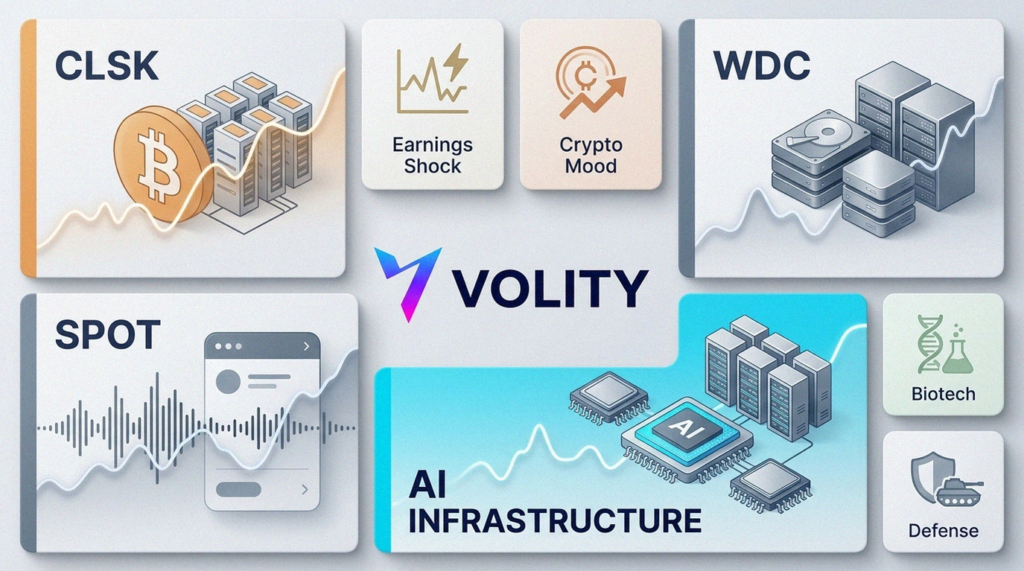
The watchlist for a twitchy tape
Markets are still rewarding clean stories, but they are punishing tired ones faster. Therefore, today’s watchlist belongs to traders living between the headline and the order ticket.
AI infrastructure still sets the tone. However, earnings gaps, crypto sentiment, biotech volatility and defence spending all offer separate sparks. The trick is not guessing the winner. It is knowing which names can still move after the first reaction.
Cleanspark
CleanSpark (CLSK) has a bigger story than bitcoin mining now. Its 20-year, $6.6 billion Sandersville high-performance computing lease with a global tech tenant could reset how investors value the company.
Yet the stock’s first response looked oddly calm. So, traders should treat it as a digestion trade. Volume matters here. A clean break from the post-announcement range would say buyers finally believe the AI-compute angle.
Meanwhile, a failed push would show the market still sees CLSK as a miner first. That distinction matters for position size.
Wayfair
Wayfair (W) gave traders something real to chew on. The company posted adjusted earnings of about $0.95 a share on roughly $3.52 billion in revenue.
That beat helped lift some price targets. However, the stock now faces a cleaner test. Can the move continue, or has the easy post-earnings money already left?
For short-term traders, this is not a furniture thesis. It is a momentum check inside a crowded e-commerce trade.
Enveric
Enveric Biosciences (ENVB) sits in the day-trader zone. The company’s latest preclinical data for EB-003 adds to the non-hallucinogenic psychiatry narrative.
Still, this is a thin, headline-sensitive biotech. Therefore, liquidity matters as much as science. Any regulatory hint or partnership chatter could jolt the tape.
On the other hand, silence can drain bids quickly. Traders should respect both sides.
Spotify
Spotify (SPOT) is back under pressure after a Q2 miss and soft Q3 active-user guidance. Analyst cuts added to the sour mood.
However, this setup is less simple than it looks. Growth funds may keep selling if user trends worry them. Meanwhile, dip-buyers may argue the long-term streaming model remains intact.
The stock now needs proof. Either sellers defend the breakdown, or buyers reclaim lost ground with force.
Bloom
Bloom Energy (BE) is caught between two stories. Bulls see data-centre power demand and AI electricity needs. Bears see financing costs and execution risk.
Post-earnings selling says the cautious view is winning today. Still, the next move depends on support. If sellers pin the stock below recent levels, sentiment could weaken further.
However, value-hunters may step in if they believe grid demand offsets near-term mess.
Circle
Circle Internet Group (CRCL) delivered a mixed Q2 with a revenue miss. That puts the name right in the crypto, payments and regulation triangle.
The company remains structurally interesting. Yet the stock is thinly traded for many US-equity traders. Therefore, this belongs on a sentiment radar, not a heavy-size list.
If crypto risk appetite improves, CRCL could catch a bid. But liquidity is the first risk, not the final footnote.
Western digital
Western Digital (WDC) heads towards Q4 with expectations around mid-$3 earnings per share and $3.6 billion to $3.8 billion in revenue.
Storage demand and AI-related capacity needs remain the core debate. Meanwhile, options pricing should show how much volatility traders expect around the print.
WDC is also a live vote on memory and infrastructure appetite. A strong reaction would help the wider hardware complex.
Spacex sympathy trades
SpaceX remains private, but its influence keeps spilling into public markets. Reports of a $1.6 billion multi-year Pentagon deal underline its national-security role.
There is no public SpaceX ticker. Therefore, the action moves through sympathy trades. Launch suppliers, defence primes and satellite-communications names may react first.
Meanwhile, Elon Musk’s comments about Nvidia GPUs at SpaceX reinforce another crowded theme. Nvidia (NVDA) stays the benchmark for AI-compute sentiment.
The numbers may not change a model today. However, the narrative gets another high-profile customer stamp.
Spacex revenue theme
Musk’s talk of a possible $100 billion revenue path for SpaceX is not directly tradable. Still, it shapes investor imagination.
Launch, satellites, communications and defence infrastructure now sit inside one growth complex. Therefore, public suppliers can move when private-market ambition gets louder.
Traders should separate inspiration from execution. But they should not ignore the sympathy pulse.
Momentum stretch watch
Snap (SNAP), Stagwell (STGW) and EchoStar (SATS) screen as stretched names in tech and telecom. Strong RSI readings can invite late buyers.
However, extended charts also create failed-breakout setups. Intraday traders should watch whether buyers hold highs or retreat towards short-term moving averages.
This is not a call to fade everything. It is a reminder that crowded momentum needs fresh fuel.
Macro tape
SPY, QQQ and DIA remain near elevated levels. Meanwhile, GLD is showing unusual strength.
That mix says risk appetite still exists, but hedging demand has not disappeared. Bitcoin in the mid-$60,000s adds another speculative gauge.
Therefore, rotation matters more than index direction alone. AI infrastructure and high-beta tech still lead, but disappointment now has less room.
Chip complex
AMD (AMD) remains the beta-heavy companion to Nvidia. Traders use it to judge second-tier AI demand.
If AMD holds firm as QQQ tests highs, chip risk remains healthy. However, weakness would show buyers are narrowing their exposure.
Lattice Semiconductor (LSCC) offers a different read. It beat with $0.53 non-GAAP EPS on $201.1 million in revenue. Yet the stock traded lower.
That numbers-up, price-down reaction deserves attention. Either investors fear the next leg of growth, or the tape is creating an entry point.
Astera Labs (ALAB) has the cleaner momentum profile. A Q2 beat, raised Q3 guidance and fresh target hikes keep the AI-infrastructure trade alive.
Still, traders should watch volume after the first surge. Strong names can stall when expectations become too neat.
Fintech and software
Upstart (UPST) beat on earnings and revenue, then jumped by double digits. That move suits the stock’s personality.
It trades on credit-cycle fear and AI-lending optimism at the same time. Therefore, continuation depends on aggressive buyers staying present.
However, mean reversion can arrive quickly if the rally outruns macro reality.
Toast (TOST) remains on institutional screens after appearing in top analyst forecast upgrades. Traders should watch analyst-driven flows and intraday volume.
A push through nearby resistance would support the upgrade trade. A fade would make it another crowded software chart.
Teradata (TDC) sits on the pre-market loser list. The open will tell the story. Either the gap-down extends, or dip-buyers hunt for a gap-fill reversal.
Pinterest (PINS) also shows pre-market weakness. That puts ad-driven social media back under the lens.
If selling extends after the bell, sentiment may spread across communications names. If it stabilises, contrarian traders may step in.
Key takeaways
- CLSK needs volume confirmation after its $6.6 billion HPC lease news.
- WDC options can provide a clean read on storage and AI-infrastructure expectations.
- SPOT is a sentiment battle between growth sellers and dip-buyers.
- ALAB, AMD and NVDA remain the heart of the AI-risk tape.
- SNDK should be folded into the Western Digital angle, not tracked separately.
Related coverage on Volity
- What Is a P/E Ratio and How to Use It
- Fundamental Analysis in Stock Trading: A Working Definition
- Growth Investing vs Value Investing: Which Style Fits You?
- Fractional Shares Explained: How to Start Investing With $50
- How to Start Stock Trading: A 2026 Beginner Guide
- Dividend Investing for Beginners: How to Start