Morning brief
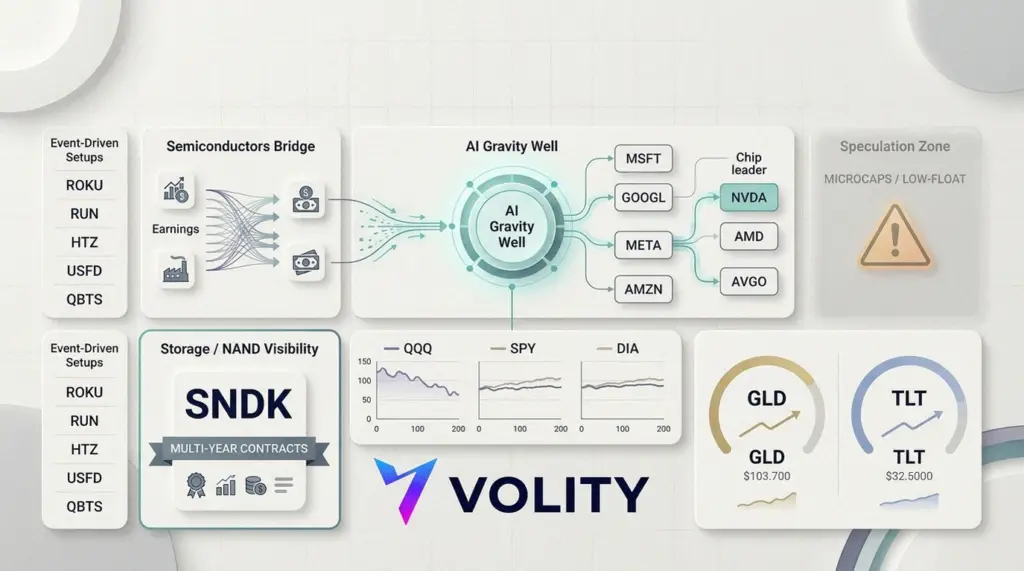
AI remains the market’s gravity well, even when the Nasdaq starts the day looking tired.
That matters because traders are not merely chasing the most glamorous ticker. They are following the spending trail. Hyperscaler capital expenditure keeps cloud, data centres, chips and storage in demand. MSFT, GOOGL, META, AMZN, NVDA, AMD and AVGO stay near the top of serious watchlists.
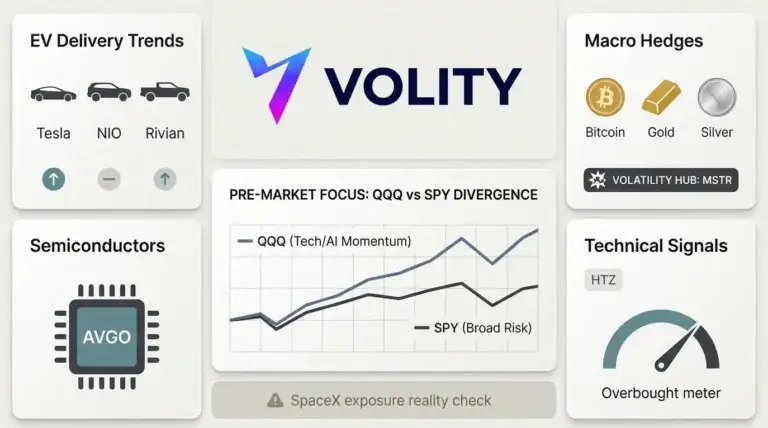
However, the tape now looks less one-way than it did during the cleanest AI melt-ups. Softer QQQ action against firmer SPY and DIA points to rotation rather than panic. Meanwhile, GLD and TLT are the mood gauges. If gold and Treasuries catch bids while QQQ fades, the market is whispering before it shouts.
That makes the first hour important. A strong Dow with a flat Nasdaq says investors want earnings and cash flow, not just dreams. However, a fast rebound in QQQ would put the AI complex back in charge.
Where the money is moving
The core trade remains simple, but not easy. AI infrastructure is still buyable on clean pullbacks. It is also tradable on sharp momentum bursts. Yet it is no longer a free pass to chase every green candle.
Semiconductors provide the clearest bridge between theme and numbers. NVDA still defines the AI chip trade. AMD remains the challenger story. AVGO gives traders exposure to custom silicon and networking, where AI workloads keep raising the bar.
Meanwhile, storage is becoming more interesting. SanDisk, ticker SNDK, has leaned into multi-year NAND agreements. That gives investors unusual demand visibility in a business once defined by savage boom-bust cycles. SNDK belongs in the longer-duration semiconductor basket, not the morning scalp bin.
The bull case is not that memory has become risk-free. It has not. Rather, AI storage demand may be turning the cycle more structural. Traders should watch for trend continuation, orderly pullbacks and any fresh talk of supply tightness.
Rotation and macro pressure
Tariff chatter remains the tax nobody enjoys modelling. Escalation would hit consumers, autos, industrials, semiconductors and imported goods. So it is a broad headwind, not a neat one-stock short signal.
That matters most in consumer discretionary. Several stretched names already show exhaustion through RSI and price extension. Fresh longs at highs need stricter discipline. Pullbacks and selective mean-reversion shorts look cleaner than late entries.
Still, the Dow and S&P can grind higher while megacap tech rests. Defensive earnings, industrial strength and dividend demand can carry indices for a while. However, if QQQ keeps slipping while GLD and TLT rise, traders should respect the message.
Ai model wars
Inside tech, the model wars are getting cheaper and nastier. META is pushing low-cost AI models with the usual land-grab energy. That makes the stock a sentiment proxy, not just an earnings story.
When headlines arrive on aggressive pricing or new releases, META can trade on narrative first. Later, investors ask what it means for margins. Meanwhile, MSFT and GOOGL sit on the other side of the ecosystem, where cloud usage and enterprise adoption matter more than the latest splash.
For traders, this is one theme with several instruments. META captures consumer-scale AI ambition. MSFT captures enterprise distribution. GOOGL captures search, cloud and model competition. NVDA captures the picks and shovels.
Event stocks on the desk
The most active single-name setups sit well away from the calmest index trades.
- QBTS – D-Wave Quantum is digesting a post-earnings miss and selloff. This is high-risk small-cap volatility, not portfolio ballast.
- HTZ – Hertz offers a gap-continuation versus rejection setup after earnings strength. Resistance matters more than opinion.
- USFD – US Foods has the cleaner continuation profile. Follow-through needs volume, with prior highs and gap zones as reference points.
- RUN – Sunrun beat the quarter but cut guidance. Goldman’s price-target trim adds pressure, while rates and policy remain key.
- ROKU – Roku is an earnings volatility machine. Guidance and analyst revisions can move the stock violently.
That list is not one risk bucket. USFD and HTZ are conventional earnings trades. RUN is a rates-sensitive turnaround argument. ROKU is a high-beta event. QBTS is closer to a trading ticket than an investment case.
Meanwhile, WEN sits in a quieter corner. Wendy’s brings dividend appeal and an upcoming earnings catalyst. It will not satisfy adrenaline seekers. However, income investors often prefer that kind of boredom.
Software and estimates
Software remains a Street-reaction trade. HUBS has strong recent results, but lowered long-term guidance invites multiple compression. That is the key risk when a high-quality company loses its growth halo.
By contrast, PAYC can catch short-term momentum when analysts lift targets or revive upside cases. However, payroll and human capital software still faces scrutiny around growth durability. Traders should separate price-target excitement from sustained institutional demand.
Speculation corner
The frontier names need bright warning tape around them.
IONQ gives traders quantum computing with a cybersecurity wrapper. Customer interest around quantum protection gives the story a cleaner enterprise angle. Still, current cash flows do not carry the valuation alone.
JOBY remains a long-duration bet on eVTOL and alternative propulsion, including hydrogen narratives. It can move quickly when funding, certification or partnership headlines arrive. However, it belongs firmly in the disruption basket.
Then come the true wild cards. CLRO has already shown a 200% plus move, which says everything about both opportunity and danger. Low float names can halt, squeeze and collapse before slower traders finish reading the tape.
USEA is more muted, but still speculative. Shipping microcaps can wake up on fleet news, dividends, buybacks or dry-bulk sentiment. Liquidity is the risk, even when the story sounds tidy.
By the numbers
- 200% plus – the kind of CLRO move that marks lottery-ticket momentum.
- Multi-year – the NAND agreement horizon supporting the SNDK storage thesis.
- 5 core ETFs – SPY, QQQ, DIA, GLD and TLT define the macro dashboard.
- 7 AI infrastructure names – MSFT, GOOGL, META, AMZN, NVDA, AMD and AVGO anchor the secular trade.
- 3 risk tiers – liquid core, event-driven swings and illiquid speculation.
Key takeaways
- Start with QQQ. If tech weakness persists while SPY and DIA firm, rotation is the trade.
- Use GLD and TLT. Strength there alongside weak tech signals nerves beneath the surface.
- Keep AI core liquid. Megacaps and chip leaders offer cleaner execution than thin thematic plays.
- Respect event risk. ROKU, RUN, QBTS and HTZ need smaller size and defined exits.
- Quarantine microcaps. CLRO, SNOA and USEA are for nimble traders, not core portfolios.
The bedrock remains SPY, QQQ, DIA, GLD and TLT, plus AAPL, MSFT, NVDA, GOOGL, META and TSLA. Those instruments give traders depth, tighter spreads and constant catalysts. Around them, the day’s earnings names and speculative runners can orbit without taking over the whole book.
Related coverage on Volity
- What Is a P/E Ratio and How to Use It
- Fundamental Analysis in Stock Trading: A Working Definition
- Growth Investing vs Value Investing: Which Style Fits You?
- Fractional Shares Explained: How to Start Investing With $50
- How to Start Stock Trading: A 2026 Beginner Guide
- Dividend Investing for Beginners: How to Start