Weak jobs data gives tech another opening
The latest weak jobs data gave Wall Street a familiar gift: permission to stop fearing the Fed.
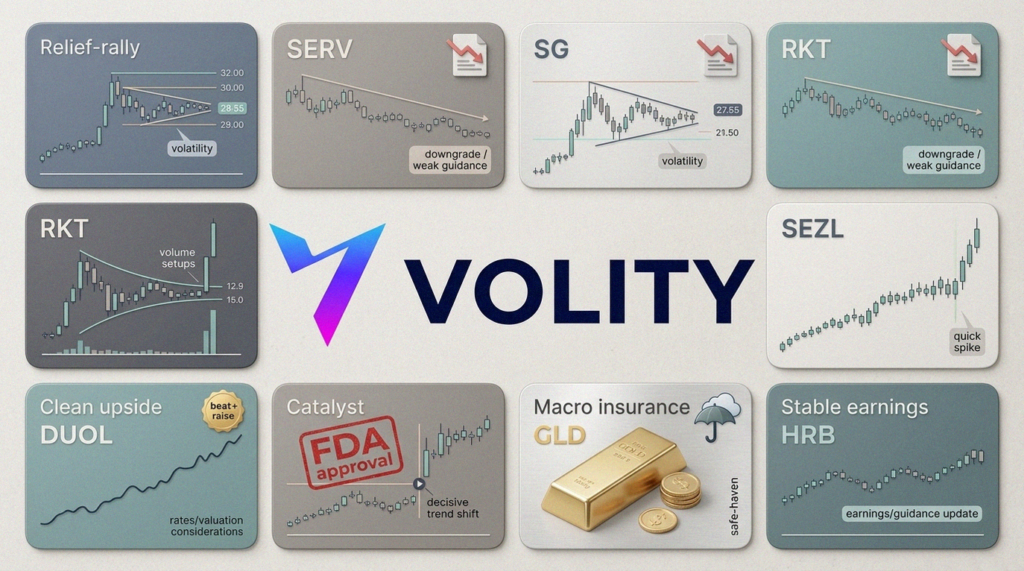
Traders quickly leaned back into Fed-pause hopes, and the tone turned friendlier for AI, chips and higher-beta tech. However, the rally did not feel like a blanket invitation to buy every moving ticker. It looked more selective, more tactical and more dependent on clean catalysts.
That distinction matters. When the macro backdrop softens, fast money often reaches first for growth. Meanwhile, the better trades usually come from stocks with fresh news, visible volume and a reason to move beyond sympathy buying.
So the day’s watchlist splits into two camps. One camp has real catalysts: earnings, guidance, approvals and analyst support. The other camp merely has noise, which tends to punish late buyers when the tape cools.
Volatility names stay front and centre
Trade Desk (TTD) remains one of the cleaner battlegrounds on the board.
The stock has the classic ingredients of an earnings-miss and guidance-cut trade. It gapped sharply lower, then kept carrying the weight of a longer downtrend. Traders now face a simple question. Was the sell-off too harsh, or did it mark another leg lower?
For short-term traders, TTD works best as a level-to-level name rather than a conviction story. If buyers defend the post-gap range, an oversold bounce can develop quickly. However, failed rebounds may invite fresh selling, especially from funds reducing exposure to advertising technology.
Serve Robotics (SERV) fits a similar downside pattern, though with a different flavour.
Weaker guidance has placed the stock in a momentum-breakdown setup. In names like SERV, the first bounce often says less than the second failure. Traders will watch whether volume fades on rebounds or expands on sell-offs.
Still, speculative robotics names can move violently without much warning. Buyers may try to defend the “future delivery network” story. Sellers, meanwhile, will argue that guidance now matters more than imagination.
Sweetgreen (SG) has a simpler problem.
Weak earnings and a downgrade create a straightforward bearish catalyst. That combination usually keeps pressure on a consumer growth stock until investors decide estimates have fallen far enough. However, restaurant shares can also stabilise if traffic trends show any early improvement.
For now, SG trades like a prove-it stock. The brand still has loyal customers, but the market wants operating leverage, not salad-bar poetry.
Relief rallies need confirmation
Rocket Companies (RKT) looks more interesting as a mixed-results relief-rally candidate.
Mortgage-linked stocks already carry plenty of bad news. High rates hurt demand, refinancing activity remains patchy and housing affordability has stayed tight. However, that also means bearish expectations can become crowded.
When a stock absorbs bad news without breaking, traders often start hunting for a squeeze. RKT fits that mould, but price and volume need to confirm it. A rally on thin volume would not say much. A strong move through recent resistance would say more.
Meanwhile, any shift in rate expectations can add fuel. Lower expected rates help the mortgage story, even before the fundamentals turn decisively. That makes RKT both an earnings reaction trade and a macro-rate trade.
Sezzle (SEZL) remains a high-volatility watch after a beat-and-raise update.
The company has attracted traders because growth and profitability debates collide in one thin, fast-moving stock. Mixed analyst reactions do not dull the setup. Instead, they can make the tape even choppier.
If bulls stay in control, SEZL can keep drawing momentum buyers. However, after large moves, the stock can hand back gains with little ceremony. Traders should avoid treating analyst disagreement as weakness by itself. Sometimes disagreement is what keeps a stock alive.
Growth stories with cleaner tailwinds
Duolingo, ticker DUOL, deserves attention on the stronger side of the tape.
The language-learning group posted stronger quarterly results and gave upbeat guidance. That is the kind of combination growth investors still reward, especially when the broader market wants software exposure again.
Recent analyst support also helps the story. However, DUOL is not a cheap stock, and that matters when rates wobble. The setup works best if buyers continue paying for durable growth and expanding engagement.
In plain English, the owl has the market’s attention again. Still, momentum needs fresh sponsorship once the first earnings reaction passes.
Atlassian (TEAM) offers a less explosive, but still workable, setup.
The stock does not have the same clean single-event spark as an approval or a huge earnings surprise. Instead, TEAM trades more on analyst-upside narratives, software sentiment and appetite for profitable growth.
That can be enough in the right tape. If investors keep rotating into established cloud software, Atlassian can benefit. However, sentiment-driven trades need broad market cooperation. A risk-off turn would blunt the move quickly.
Biotech catalyst stands apart
Replimune (REPL) has the cleanest catalyst in this group: FDA approval.
In biotech, approval changes the conversation at once. The market stops valuing only promise and starts pricing commercial execution. That shift can matter more than the chart, especially when specialist funds rework their models.
Still, approval does not remove risk. Investors will now focus on launch timing, market size, reimbursement and trial expansion. REPL may trade in waves as the first relief move gives way to revenue questions.
For active traders, the key is whether buyers defend higher levels after the initial catalyst. For longer-horizon investors, the question becomes whether approval opens a broader platform story.
Macro hedge stays in the frame
Gold, tracked by GLD, remains relevant as a macro hedge.
The metal’s appeal rises when traders rethink rates, growth and risk appetite. Weak jobs data can support that demand, particularly if it lowers expectations for tighter policy. However, gold rarely trades on one input alone.
The dollar, real yields and geopolitical risk all matter. So does positioning, which can turn crowded near major highs. Technical levels should also stay current because support and resistance shift quickly.
For equity traders, GLD works less like a stock pick and more like portfolio weather insurance. It may not thrill the room, but it often earns its place when confidence cracks.
H&R block needs fresh numbers
H&R Block (HRB) is the name that most needs clean handling.
The company recently reported a strong fiscal third quarter. Adjusted earnings came in at $6.02 a share, while revenue reached $2.4 billion. Management also raised full-year guidance and declared a $0.42 quarterly dividend payable in July.
Those figures matter because older references can mislead traders. A stale $2.21 EPS framing or outdated yield snapshot no longer captures the current setup. HRB should be discussed from the new earnings base and updated guidance path.
The stock is not a meme candidate, and it will not trade like a small-cap biotech. However, better guidance, dividend support and steady tax-season cash generation make it a cleaner quality screen than many louder names.
By the numbers
- TTD: Earnings miss and guidance cut keep volatility elevated.
- SERV: Weaker guidance leaves the stock in a momentum-breakdown setup.
- DUOL: Stronger quarterly results and upbeat guidance support continuation buying.
- REPL: FDA approval shifts the debate from potential to commercial execution.
- HRB: Fiscal Q3 adjusted EPS were $6.02 on $2.4 billion of revenue.
Trading map
- Chase less: Fed-pause hopes help growth, but weak names still need real catalysts.
- Respect levels: TTD, SERV and SG remain vulnerable if rebounds fail quickly.
- Watch volume: RKT needs confirmation before traders can trust a relief rally.
- Separate catalysts: REPL’s FDA approval is stronger than ordinary sentiment flow.
- Update figures: HRB should be analysed using its latest earnings and guidance.
The market has a fresh macro excuse, but not every chart deserves a second chance. In this tape, the best trades carry a date, a number or a decision behind them.
Related coverage on Volity
- What Is a P/E Ratio and How to Use It
- Fundamental Analysis in Stock Trading: A Working Definition
- Growth Investing vs Value Investing: Which Style Fits You?
- Fractional Shares Explained: How to Start Investing With $50
- How to Start Stock Trading: A 2026 Beginner Guide
- Dividend Investing for Beginners: How to Start