Markets hold their breath: crypto waits on the Fed, the law and the bond market
On Tuesday, September 15, crypto feels less like a casino and more like a waiting room. Prices remain elevated and volatility remains plentiful. However, the decisive signals sit beyond the charts.
US Treasury yields are climbing, oil has jumped, and Washington is debating market rules. Meanwhile, fresh platforms and funding rounds continue to reshape digital finance. Price draws attention, but macroeconomics and regulation set the mood.
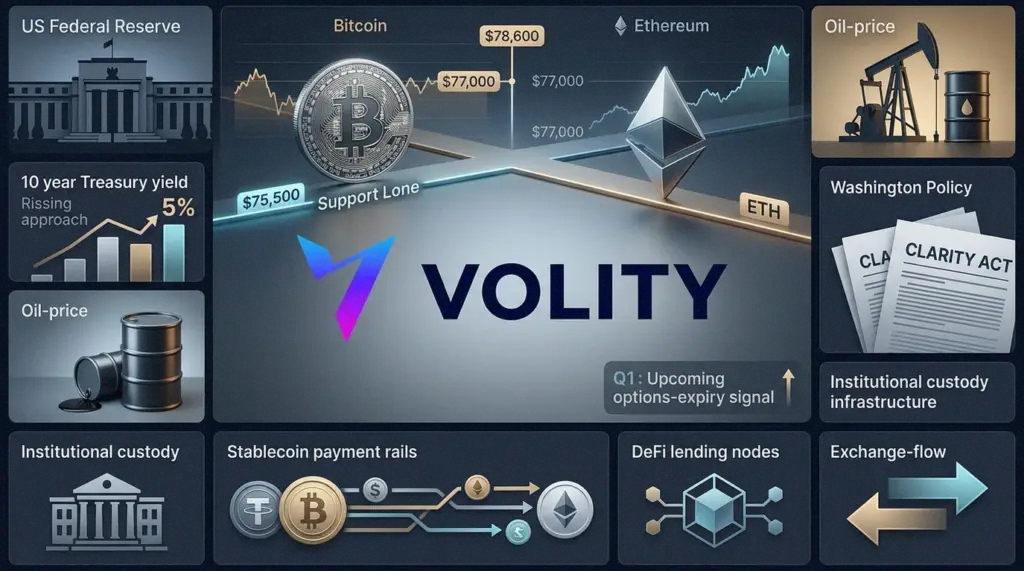
Bitcoin: high, nervous and watching $75,500
Bitcoin traded near $77,000 after touching roughly $76,700. Yet traders have focused on $75,500, a support level that could define this week’s tone.
A break below $75,500 to $76,000 could invite a sharper washout. Conversely, a recovery above $78,300 to $78,600 would ease immediate concerns.
Bitcoin has slipped below its 50-week exponential moving average, now sitting in the low-$78,000s. That signal does not guarantee a sell-off. However, it puts bulls under pressure to reclaim lost ground.
Politics adds another layer. Traders are reducing risk before the Senate’s CLARITY Act vote, a House debate on a Strategic Bitcoin Reserve, and Wednesday’s Federal Reserve decision.
That restraint matters. Investors appear unwilling to chase a breakout before they know whether rates, legislation, or both will change the market’s footing.
Ethereum: above trend, below conviction
Ethereum’s position looks steadier, although hardly comfortable. ETH failed to sustain a move above $2,600 and fell below the closely watched $2,500 mark.
It has since moved between the mid-$2,400s and low-$2,500s. The broader trend remains positive, yet short-term momentum has weakened noticeably.
- MACD: The daily MACD has turned bearish, with its main line below the signal line.
- Trend strength: ADX readings in the high teens suggest a market without a firm directional impulse.
- Support: Buyers have clustered around $2,469 to $2,485.
- Resistance: Sellers remain active near $2,537 to $2,550, then at $2,600.
Medium-term support still sits well below current prices. Ethereum’s key moving averages lie between roughly $2,120 and $2,220.
The setup remains constructive but fragile. A sustained move below $2,500 would expose $2,485 and then $2,450. A return above $2,550 would give buyers a more credible opening.
The bond market takes centre stage
The day’s most important crypto chart may be the US 10-year Treasury yield. It reached an intraday high near 5.012% before slipping modestly below that threshold.
That level tightens financial conditions across markets. Higher yields raise borrowing costs and reduce the appeal of distant, riskier returns. Technology shares usually feel that shift first. Crypto often follows.
Meanwhile, Brent crude briefly rose about 5%, approaching $109 to $110 a barrel. Supply concerns and geopolitical tension drove the move, before prices retreated.
Higher oil prices complicate the Federal Reserve’s task. They can revive inflation worries just as traders seek easier financial conditions.
- Higher long-term yields increase the discount rate used to value future cash flows.
- That pressure often weakens growth equities and highly valued risk assets.
- Crypto then faces reduced leverage, lower liquidity and more defensive positioning.
Bitcoin’s ability to hold near $77,000 during that move has drawn attention. Still, resilience is not the same as immunity. A lasting yield move above 5% would test risk appetite across digital assets.
Rules written in real time
Regulation remains an immediate trading issue rather than a distant policy concern. Fine print in Washington, Sofia and Moscow could affect listings, liquidity and product design.
- CLARITY Act: Banks and state attorneys general have challenged parts of the proposed US market-structure legislation. Democrats have also offered a counterproposal ahead of the Senate vote.
- XRP classification: Debate over whether XRP fits a commodity definition shows how much value can rest on legal wording.
- Bulgaria: The country has passed rules requiring crypto businesses to report customer transactions to authorities.
- Russia: The Bank of Russia has again identified cryptoassets and stablecoins as potential systemic risks.
For investors, jurisdiction is becoming a portfolio variable. So are custody arrangements, exchange access and token classifications. Rules can shift quickly, particularly for assets with uncertain legal status.
Wall Street keeps building bridges
Regulatory uncertainty has not stopped institutional infrastructure from expanding. Instead, firms continue to build products that make crypto resemble conventional finance.
Binance has launched an 11-ETF wealth product, bundling diversified exposure into one offering. The product further blurs the lines between exchange, broker and asset manager.
Broadridge is preparing a crypto platform for US wealth managers. Its arrival matters because Broadridge’s systems already support much of Wall Street’s routine back-office work.
Elsewhere, Fin.com has raised $20 million for stablecoin payments infrastructure. Heleket is developing payment, conversion and payout tools for businesses. Both are betting on stablecoins as a settlement rail, not merely a trading instrument.
Flows, leverage and an expensive expiry
Market plumbing remains active despite the caution. Binance has recorded more than 31,800 altcoin inflows ahead of the Fed decision, suggesting repositioning rather than wholesale flight.
Aave’s total value locked has risen 13.7% to $27.4 billion. Its outstanding loans stand near $11.7 billion, keeping on-chain credit firmly in play.
Bitcoin options also dominate a $16.6 billion third-quarter expiry. That event could amplify moves around major support levels, especially if spot prices approach large options strikes.
Mining promotions have also returned, including claims of $7,700 monthly Bitcoin income. Such figures depend heavily on electricity costs, machine efficiency, uptime and bitcoin’s price. They deserve scepticism, not envy.
Levels that matter today
- Bitcoin: $75,500 to $76,000 is immediate support. Reclaiming $78,300 to $78,600 would improve momentum.
- Ethereum: $2,485 to $2,500 remains the near-term floor. Resistance begins around $2,537.
- Treasuries: A sustained 10-year yield above 5% would argue for smaller risk budgets.
- Oil: Brent holding above $100 would keep inflation concerns close to every trade.
- Policy: The Fed decision and CLARITY Act developments may matter more than a routine technical signal.
For now, this market offers neither a clean bullish case nor a decisive collapse. Traders have infrastructure growth on one side, and yields, oil and legal uncertainty on the other. The next move may begin at $75,500 for Bitcoin and $2,500 for Ethereum. Its durability will probably depend on Washington and the bond market.
Related coverage on Volity
- How to Avoid Crypto Scams: A Beginner Safety Checklist
- How to Choose a Trading Platform: A 10-Point Checklist
- Demo vs Live Trading Account: A 7-Step Checklist Before You Go Live
- How to Size a Trade: Position Sizing and Risk Per Trade for Beginners
- Risk-Reward Ratio Explained: How to Set It and Why It Matters
- ETF vs Index Fund: The Difference and Which to Pick