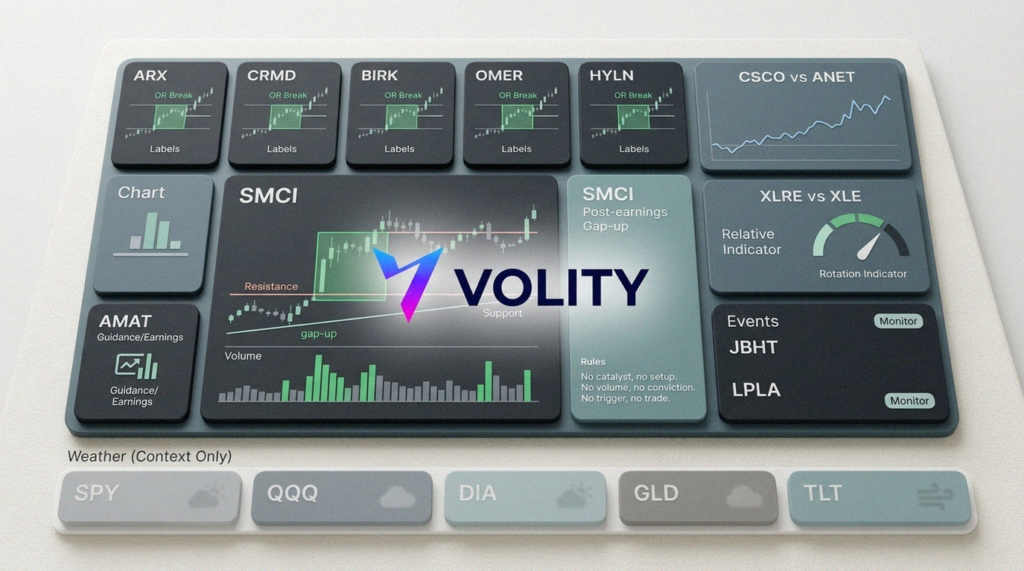
Watchlist favours catalysts over market chatter
Traders do not need another broad sermon on risk appetite today. They need cleaner setups.
The better daily list has a simple discipline: catalyst, momentum and volume. If one leg is missing, the idea belongs in the background, not in the blotter.
That matters on 13 August 2026 because several names have real reasons to move. However, the index snapshot can mislead more than it helps. SPY, QQQ, DIA, GLD and TLT still matter, of course. Yet they should frame the tape, not masquerade as trades without fresh triggers.
The sharper watchlist starts with single-stock catalysts. It then uses sector rotation and pair behaviour as confirmation. That keeps traders away from vague narratives and closer to observable buying or selling.
Setups to watch
Earnings momentum
SMCI remains the cleanest momentum test on the board. The setup is not “buy the story”. It is whether the stock can defend its post-earnings gap after the open.
For bulls, the first confirmation should be simple. SMCI needs to hold above its early weakness, reclaim opening-range resistance and trade with expanding volume. Without that, the earnings reaction risks becoming a fade.
Meanwhile, sellers will watch for a failure back into the gap. That would show profit-taking, not fresh institutional demand. In a stock this quick, that distinction matters by mid-morning.
Momentum candidates
ARX, CRMD, BIRK, OMER and HYLN belong in the follow-through bucket. These are not automatic trades. They are names that deserve a screen only if they prove demand after the bell.
The useful trigger is a clean push through the opening range on real volume. Chasing a pre-market headline without that confirmation invites poor entries. However, if one of these names clears early resistance and holds pullbacks, momentum funds may join.
That is especially important in thinner or more reactive stocks. A sharp first print can look impressive. Yet the second and third waves of buying tell the real story.
Relative strength
CSCO versus ANET gives traders a better networking read than broad technology chatter. This is a relative-strength setup, not a market forecast.
Cisco offers a steadier, cash-generating networking profile. Arista remains more tied to high-growth data-centre spending and artificial-intelligence infrastructure. Their price behaviour can reveal where investors prefer exposure today.
If CSCO rises while ANET stalls, traders may favour defensive networking exposure. Conversely, if ANET leads on strong volume, investors may be rewarding faster growth again. The trade only works if price confirms the thesis.
Earnings volatility
AMAT is an earnings-volatility watch rather than a simple directional call. The key issue is guidance, not yesterday’s chart poetry.
Applied Materials can also move chip-equipment peers through sympathy buying or selling. However, traders should wait for the market’s first verdict on margins, orders and management tone.
A strong open followed by heavy selling would warn that expectations already ran too hot. Meanwhile, a gap that holds through the first pullback would suggest buyers accept the valuation after guidance.
Rotation context
XLRE versus XLE belongs in the rotation file. It is useful, but it should not stand alone as a trade idea.
Real estate and energy often say different things about rates, inflation and growth. Relative performance between XLRE and XLE can help traders understand leadership. Still, the signal needs confirmation from the underlying stocks.
If XLRE improves while yields ease, rate-sensitive buyers may be returning. If XLE outperforms with crude firming, energy may retain leadership. Either way, the ETFs provide context first and execution second.
Event-driven names
JBHT and LPLA should stay on the monitor, but only as watchlist candidates. Each needs price confirmation before becoming actionable.
J.B. Hunt can react to freight demand, pricing commentary and margin expectations. LPL Financial can trade on adviser growth, cash balances and rate assumptions. However, the catalyst must show up in the tape.
For both names, the cleaner signal is a sustained move beyond early resistance with volume. A headline pop that fades within the opening range does not deserve much trust.
What to cut
The broad market snapshot still has a role. However, it should sit at the top as weather, not as a map. SPY, QQQ, DIA, GLD and TLT can reveal risk tone, rates pressure and haven demand. They do not create a trade without fresh levels or clear triggers.
The “AI memory boom” theme also needs restraint. It may explain sentiment across chips and hardware. Yet it remains too abstract unless attached to specific stocks, guidance or order commentary.
Likewise, “industrial stocks flagged as sells” says too little. Traders need names, failure points and volume behaviour. Without those, the phrase sounds busy but offers no edge.
Generic technical lists of mega-cap stocks and index ETFs should also go. A chart without levels, patterns or triggers is just decoration. Traders can admire it after hours.
Earnings-call watchlists deserve a higher bar as well. Include only companies with unusual post-earnings volume, clear gap behaviour or guidance surprises. Otherwise, the list becomes noise with tickers attached.
By the numbers
- 3 filters matter most today: catalyst, momentum and volume.
- 72 hours is the practical shelf life for precise trading levels.
- 6 core areas remain: SMCI, momentum names, CSCO versus ANET, AMAT, XLRE versus XLE, JBHT and LPLA.
- 5 broad tickers stay as context: SPY, QQQ, DIA, GLD and TLT.
Trading implications
- Use SMCI as an earnings-gap durability test, not a blind momentum chase.
- Trade ARX, CRMD, BIRK, OMER and HYLN only after opening-range breaks with volume.
- Watch CSCO and ANET for networking positioning, especially if one leads decisively.
- Treat AMAT as a guidance reaction and semiconductor sympathy read.
- Keep XLRE and XLE as rotation evidence, not standalone conviction.
The rule is plain enough for a sticky note beside the keyboard: no catalyst, no setup; no volume, no conviction; no trigger, no trade.
Related coverage on Volity
- What Is a P/E Ratio and How to Use It
- Fundamental Analysis in Stock Trading: A Working Definition
- Growth Investing vs Value Investing: Which Style Fits You?
- Fractional Shares Explained: How to Start Investing With $50
- How to Start Stock Trading: A 2026 Beginner Guide
- Dividend Investing for Beginners: How to Start