Tokenization reaches the trading desk
Crypto’s weekend trading tape centred on a question once reserved for lawyers and market plumbers.
Can stocks, private-company claims and derivatives trade continuously on blockchain rails without losing basic investor protections?
Several firms are betting that they can.
Binance Wallet has opened access to tokenised pre-IPO products, bringing private-market exposure closer to retail crypto users.
Meanwhile, Coinbase has sought United States approval for more than 50 single-stock perpetual futures products.
Kalshi has also asked the Commodity Futures Trading Commission to permit stock perpetuals on its prediction-market platform.
Those filings matter because they blur a stubborn line between securities markets and crypto venues.
For decades, equities traded during fixed sessions through tightly controlled intermediaries.
Now, platforms want stock-linked instruments that can trade around the clock with stablecoin settlement.
However, the structure remains far from settled.
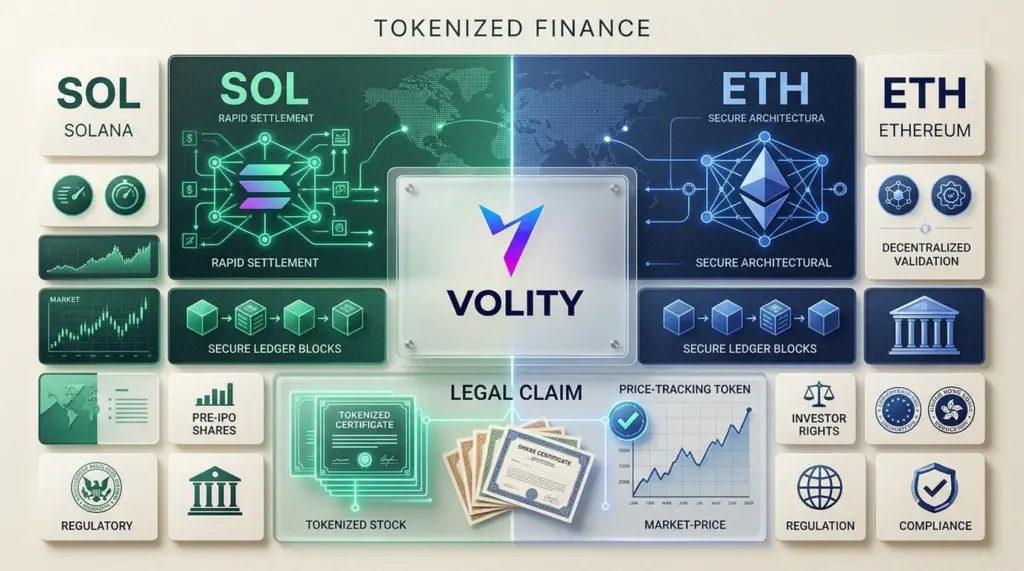
A token that tracks a share is not necessarily a share.
Its holder may lack voting rights, dividends, custody protections or a direct legal claim on underlying assets.
Regulators have therefore focused less on blockchain speed and more on what investors actually own.
The Securities and Exchange Commission’s emerging approach stresses one-for-one backing and preserved shareholder rights.
That could make tokenised equities more credible, although it may also raise operating costs.
Issuers would need robust custody, reconciliations, transfer controls and clear treatment during corporate actions.
A stock split looks easy on a spreadsheet.
It becomes more complicated when tokens sit across wallets, platforms and different legal jurisdictions.
Solana gains ground in real-world assets
Solana has become the clearest market beneficiary of the tokenisation push.
The network held roughly $465 million of tokenised stocks during the second half of 2025.
That represented almost half of a market that moved above $1 billion.
Equities-linked activity in the broader real-world asset sector also rose 390.4%, according to sector estimates.
The total real-world asset market was valued at about $34.18 billion.
That figure includes tokenised funds, Treasuries, credit products, commodities and stock-linked instruments.
Solana’s appeal is practical rather than mystical.
It offers low transaction costs, rapid settlement and a growing collection of trading applications.
Those features suit smaller trades that would look uneconomic on more expensive networks.
United States spot Solana exchange-traded funds held about $1.41 billion in net assets in early September.
That pool gives traditional investors a simpler route into the network’s growth story.
Still, fund inflows do not guarantee tokenisation revenue or sustained demand for SOL.
Traders should distinguish between a useful blockchain and an asset already priced for perfection.
Solana remains exposed to speculative trading cycles, technical failures and sudden changes in token incentives.
Yet its position has changed.
It is increasingly viewed as market infrastructure, rather than solely a home for memecoins and fast DeFi trades.
Ethereum defends its institutional territory
Ethereum retains the deeper institutional base in tokenised funds and on-chain financial applications.
However, its response has become more operational.
Developers are considering a reduction in block times to 10 seconds.
Faster blocks could improve trading responsiveness and reduce delays for settlement-heavy applications.
Ethereum still prioritises decentralisation and security over raw transaction speed.
That trade-off attracts institutions that value a long operating history and broad developer support.
The contest is no longer Ethereum against crypto challengers alone.
It is Ethereum and Solana competing for the systems that move conventional financial assets.
Both networks may prosper if tokenised markets expand.
However, issuers will probably choose platforms according to compliance tools, liquidity and distribution.
Transaction speed will matter, but it will not decide every mandate.
Regulation becomes a competitive weapon
Europe is trying to turn clear rules into an advantage.
European banks have doubled their Markets in Crypto-Assets regulation presence to about 80 institutions.
That growth suggests MiCA is drawing banks into the market, rather than merely creating paperwork.
Meanwhile, Hong Kong plans 24-hour central bank digital currency settlement for tokenised deposits by year-end.
Its approach focuses on payments infrastructure and bank-led settlement.
Hong Kong could therefore become an important test of whether regulated token money works at scale.
The United States remains more fragmented.
Its agencies must decide whether stock-linked tokens resemble securities, swaps, futures or something entirely new.
That uncertainty can delay launches.
Yet it can also favour larger firms with legal teams, licences and established compliance systems.
Fraud follows the money
The expansion has also drawn criminals towards familiar weak points.
Hong Kong jailed a former banker over $470,000 in USDT bribes.
Separately, Polymarket faced allegations involving $10 million in fraud linked to stolen payment cards.
Fake artificial-intelligence trading bot tutorials drained 274.6 ETH from 224 victims.
Those scams often rely on urgency, polished branding and promises of effortless returns.
Traders should treat wallet approvals and unfamiliar smart contracts as financial decisions, not routine clicks.
NFT sales fell 15% to $37.5 million, even as Ethereum retained category leadership.
That contrast is telling.
Speculative collectibles are cooling, while products tied to funds, equities and settlement are attracting capital.
Numbers to watch
- $465 million: Tokenised stocks held within Solana’s ecosystem during late 2025.
- $1 billion: Threshold crossed by the tokenised-stock market.
- $1.41 billion: Net assets in United States spot Solana ETFs in early September.
- $34.18 billion: Estimated value of the real-world asset sector.
- 10 seconds: Proposed Ethereum block-time target.
Trading implications
- Watch SOL against ETH when tokenised-equity volumes or issuer announcements accelerate.
- Follow regulatory filings closely, because product approval may move prices faster than technical upgrades.
- Separate regulated tokenised products from synthetic copies with uncertain shareholder rights.
- Expect fraud attempts to rise alongside retail access to private-market and perpetual products.
Tokenisation is no longer a distant promise from conference stages.
It is becoming a live contest over market access, settlement and investor rights.
For now, Solana has the momentum.
However, the eventual winners will need more than fast blocks and louder trading volumes.
They will need rules, liquidity and the trust of investors holding real claims on real assets.
Related coverage on Volity
- How to Avoid Crypto Scams: A Beginner Safety Checklist
- How to Choose a Trading Platform: A 10-Point Checklist
- Demo vs Live Trading Account: A 7-Step Checklist Before You Go Live
- How to Size a Trade: Position Sizing and Risk Per Trade for Beginners
- Risk-Reward Ratio Explained: How to Set It and Why It Matters
- ETF vs Index Fund: The Difference and Which to Pick