Growth still has the wheel, but single-stock risk is louder
The market’s steering wheel still sits in the hands of large-cap growth.
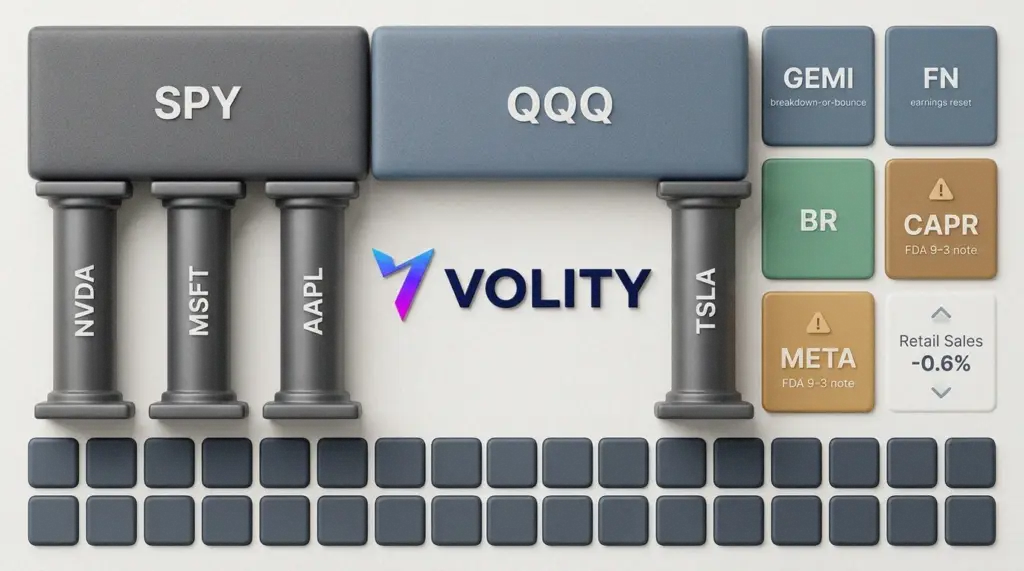
For traders, that keeps SPY and QQQ at the centre of the screen. The index tape still leans heavily on mega-cap technology. Any real change in sentiment must pass through NVDA, MSFT, AAPL, META and TSLA.
That is not a fresh revelation. However, it remains the cleanest map for a market with uneven breadth. When the biggest technology names rise together, the indices can look healthier than the average stock feels. When they stall, dip-buyers suddenly lose their best shelter.
Meanwhile, the day’s more tradable tension sits in event names. GEMI has the post-earnings setup traders tend to like and investors tend to dislike. FN also belongs on the earnings watchlist, especially if expectations keep shifting before the report.
In short, the market offers two different games. One is the index game, led by growth and liquidity. The other is the volatility game, driven by earnings, positioning and fast repricing. Mixing them up can get expensive.
Index focus
SPY and QQQ remain the main tells because mega-cap tech still carries unusual weight. The largest names drive not only index direction, but also earnings confidence. As a result, traders should watch leadership quality, not just the headline close.
If NVDA, MSFT and META hold firm, the market can absorb plenty of noise. If AAPL and TSLA lag badly, however, the tone can sour quickly. Breadth matters, but leadership matters first in this tape.
There is also a useful split inside the growth trade. NVDA still acts as the market’s artificial intelligence thermometer. MSFT offers the steadier cloud and software read. AAPL remains the consumer-hardware gauge. META tracks advertising strength and cost discipline. TSLA, meanwhile, behaves like a risk appetite instrument with wheels.
Traders do not need every member of the group to rally. They do need enough of them to avoid broad index drag. A narrow rally can last for longer than sceptics expect, but it needs its generals upright.
GEMI setup
GEMI looks useful as a volatility trade, not as a clean long idea.
The company reported Q2 revenue of $45.5 million, ahead of expectations. However, EPS missed, and the stock came under pressure after the report. That split creates a familiar battleground.
One side sees better sales and hunts for a relief bounce. The other side sees weaker earnings quality and sells strength. The near-term setup is more about levels than narrative.
The stock now fits a “breakdown or bounce” framework. If buyers defend the post-earnings low, short covering can build quickly. If that level fails, however, sellers may press the miss and force another leg lower.
This is not a name for lazy positioning. GEMI needs defined risk, tight sizing and respect for gaps. The clean trade may come after the first false move, not before it.
FN setup
FN also deserves attention into earnings. The name can draw short-term flow when estimates move and positioning looks unsettled. In that setting, even a small surprise can matter.
Pre-earnings trades require a different discipline from index trades. With SPY or QQQ, traders can lean on liquidity and broad themes. With FN, however, the report itself can reset the chart in one print.
That makes implied volatility important. If options price a huge move, the stock must clear a high bar. If the setup looks less crowded, meanwhile, the reaction can feel sharper than expected.
The better lens is simple. FN is not a broad-market thesis. It is an earnings-watch candidate with enough event risk to justify a place on the screen.
Secondary names
CSCO, NFLX and CRWD sit in the second row, but they still matter.
Each stock is liquid, widely followed and capable of moving on headlines. CSCO gives traders a read on enterprise technology spending. NFLX remains a consumer-subscription and advertising story. CRWD still serves as a high-beta cyber-security barometer.
These names also benefit from television and desk chatter. When they appear in “Final Trades” style discussions, incremental flow can follow. That does not guarantee direction. However, it can improve tradability.
CAPR warning
CAPR needs the most caution on the board.
The bullish regulatory framing has become too strong for the facts. The FDA advisory committee voted 9-3 against the effectiveness of Deramiocel. Later reporting also pointed to a Complete Response Letter, meaning the application was not approvable in its current form.
That does not make CAPR untradeable. In fact, distressed regulatory stories can move violently. However, it changes the script. This is no longer a straightforward approval setup. It is a bearish-to-uncertain overhang with headline risk.
Traders can still watch CAPR for squeezes, fades and sharp relief rallies. Yet they should not describe it as a clean FDA bull case. The bar for confidence is higher now, and the tape should reflect that.
Macro signal
The macro backdrop also argues for balance, not certainty.
A 0.6% drop in retail sales can support a lower-yields or rate-cut argument. Softer spending may cool inflation pressure and flatter long-duration growth stocks. The initial read can help QQQ and high-multiple technology.
However, weaker retail sales also point to consumer strain. That can pressure cyclicals, retailers and travel-linked names. It may also raise questions about earnings resilience beyond the mega-cap complex.
So the number is a mixed signal. It is not a clean bullish input. The bond market may like it, while parts of the equity market quietly wince.
By the numbers
- GEMI: Q2 revenue of $45.5 million, with EPS missing expectations.
- CAPR: FDA advisory vote went 9-3 against Deramiocel’s effectiveness.
- Retail sales: latest cited reading fell 0.6%.
- Core index lens: SPY and QQQ remain the main market gauges.
- Key leaders: NVDA, MSFT, AAPL, META and TSLA.
Trading takeaways
- Keep SPY and QQQ as the primary read on market tone.
- Use mega-cap tech to judge whether strength is durable or narrow.
- Treat GEMI as a post-earnings volatility trade, not a simple momentum call.
- Watch FN for earnings-driven repricing and estimate sensitivity.
- Handle CAPR as a high-risk regulatory overhang, not a clean approval story.
For now, the sharpest watchlist is compact: SPY, QQQ, mega-cap tech, GEMI and FN. CAPR stays on the radar, but under a warning label.
Related coverage on Volity
- What Is a P/E Ratio and How to Use It
- Fundamental Analysis in Stock Trading: A Working Definition
- Growth Investing vs Value Investing: Which Style Fits You?
- Fractional Shares Explained: How to Start Investing With $50
- How to Start Stock Trading: A 2026 Beginner Guide
- Dividend Investing for Beginners: How to Start