Crypto edges into extreme greed as traders eye solana, bitcoin options and a new rulebook
By Wednesday afternoon, crypto trading had acquired a familiar late-cycle energy. Prices were rising, leverage was building and caution looked unfashionable.
CoinMarketCap’s Crypto Fear and Greed Index reached 81, placing the market in “extreme greed”. That was its first such reading since late 2024.
Bitcoin’s recent advance has pulled capital into large altcoins and short-dated derivatives. However, Friday’s $6.4 billion bitcoin options expiry could test that confidence quickly.
Sentiment turns hot
Extreme greed does not automatically signal a top. It does, however, change the market’s mechanics.
Traders tend to add leverage when sentiment reaches the 80s. Both rallies and reversals can become sharper than expected.
- Retail buyers often chase breakouts rather than wait for retracements.
- Perpetual futures funding can rise quickly as long positions accumulate.
- Options dealers must hedge more aggressively near popular strike prices.
- Even healthy bull markets can suffer abrupt 5% to 10% resets.
The current mood rewards momentum. Yet it also leaves little room for a disappointing macro headline or a failed technical breakout.
Bitcoin approaches a derivatives test
About 81,700 BTC of bitcoin options expire on Deribit on Friday, August 28. Their combined notional value is roughly $6.4 billion.
Open interest is concentrated near $75,000 and $80,000. Meanwhile, the put-to-call ratio remains below one, showing a clear bullish tilt.
That positioning can create strange price action. Dealers who sold calls may buy bitcoin as prices rise, strengthening an advance.
Conversely, a slide can prompt the same desks to sell spot or futures. The result may look like a trend reversal, even when underlying demand barely changes.
Estimated max pain sits in the high-$60,000s, below current spot levels. It is not a forecast, but it remains a level worth watching.
- $75,000 to $80,000: The key options strikes and immediate upside battleground.
- High-$60,000s: The estimated max-pain area if selling accelerates.
- Thursday and Friday: The likeliest window for hedging-driven moves.
Short-term traders may prefer smaller positions into expiry. Longer-term holders, meanwhile, should avoid mistaking a derivatives wobble for a change in the wider trend.
Solana’s $96 line grows more important
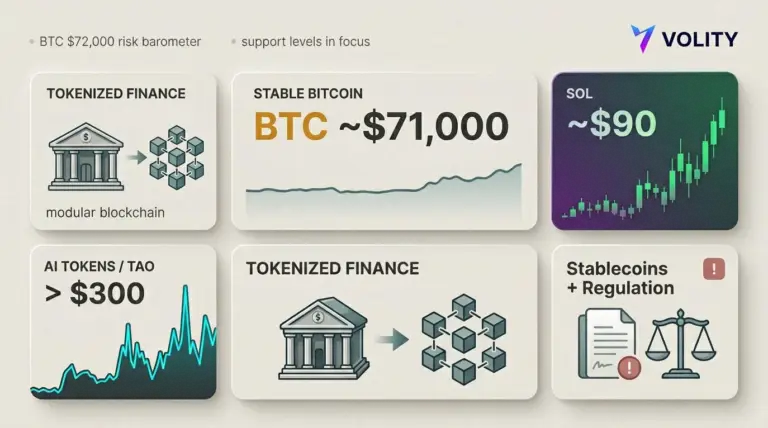
Solana has gained more than 25% over seven days, recently trading around $96 to $99. It briefly reclaimed $100 before sellers pushed it back.
The chart still favours buyers, provided SOL holds its recent breakout area. However, that support band now carries more weight.
The $95 to $97 range marks immediate support. A sustained hold could invite another attempt at $100 and beyond.
Above $100 to $101, traders will watch whether SOL can hold $102 to $104. Acceptance there could open a path towards $110.
On the other hand, a decisive move below $96 could expose $92 to $93. The more consequential support sits around $89 to $90.
Solana remains a strong relative performer. Still, its gains leave it vulnerable if bitcoin loses altitude after the options expiry.
Ethereum’s quieter risk sits in the plumbing
Ethereum has held near $2,450 while traders watch resistance in the mid-$2,500s. The more interesting risk lies beneath the price chart.
Developers have highlighted smart contracts that may face pressure from planned gas-cost changes. Those changes could alter the economics of automated on-chain strategies.
Some vaults depend on narrow spreads and frequent transactions. A higher execution cost could turn an apparently profitable strategy into a loss-maker.
DeFi investors should check whether their protocols have tested upcoming changes. A bullish token chart offers little protection from flawed contract assumptions.
Regulators redraw the map for digital money
Price action dominates daily conversation. Yet the larger story involves tokenised deposits, stablecoins and the rules governing them.
Federal Reserve economists have warned that tokenised bank deposits could raise funding costs. If deposits behave more like tradeable money-market instruments, banks may need to pay more for them.
That could eventually feed into borrowing costs for households and companies. However, the timing and scale would depend on adoption.
In Washington, comprehensive crypto legislation has lost momentum. Regulators are therefore likely to shape the market through rulemaking and enforcement.
Europe is moving on a separate track. The European Central Bank has presented a digital euro with “cash-like” privacy, although the practical limits matter more than the label.
Transaction caps, identity checks and offline-payment rules will determine whether users treat it as cash. They will also affect demand for private stablecoins.
XRP and BNB offer contrasting trades
XRP has fallen about 5% while leverage reached a seven-month high. That combination can produce abrupt liquidations in either direction.
However, XRP exchange-traded funds have recorded cumulative flows near $1.57 billion. Institutional demand has therefore looked firmer than the spot chart suggests.
BNB, meanwhile, has held above $700, with traders watching $725. Its steadier profile may appeal to managers avoiding the market’s more speculative corners.
Elsewhere, “stable yield” pitches are multiplying across cloud-mining schemes and tokenised real-world assets. Traders should examine collateral, liquidity and redemption terms before accepting any promised return.
Levels for the weekend
- Bitcoin: Watch the reaction around $75,000 and $80,000 into Friday’s expiry.
- Solana: A defence of $95 to $97 keeps the near-term bullish structure intact.
- Ethereum: Monitor developer updates on gas costs and affected DeFi contracts.
- XRP: Rising leverage makes ETF-flow data and liquidation levels especially relevant.
Crypto’s confidence has returned with force. However, options hedging, crowded leverage and changing regulations can turn confidence into volatility within hours.
Related coverage on Volity
- How to Avoid Crypto Scams: A Beginner Safety Checklist
- How to Choose a Trading Platform: A 10-Point Checklist
- Demo vs Live Trading Account: A 7-Step Checklist Before You Go Live
- How to Size a Trade: Position Sizing and Risk Per Trade for Beginners
- Risk-Reward Ratio Explained: How to Set It and Why It Matters
- ETF vs Index Fund: The Difference and Which to Pick