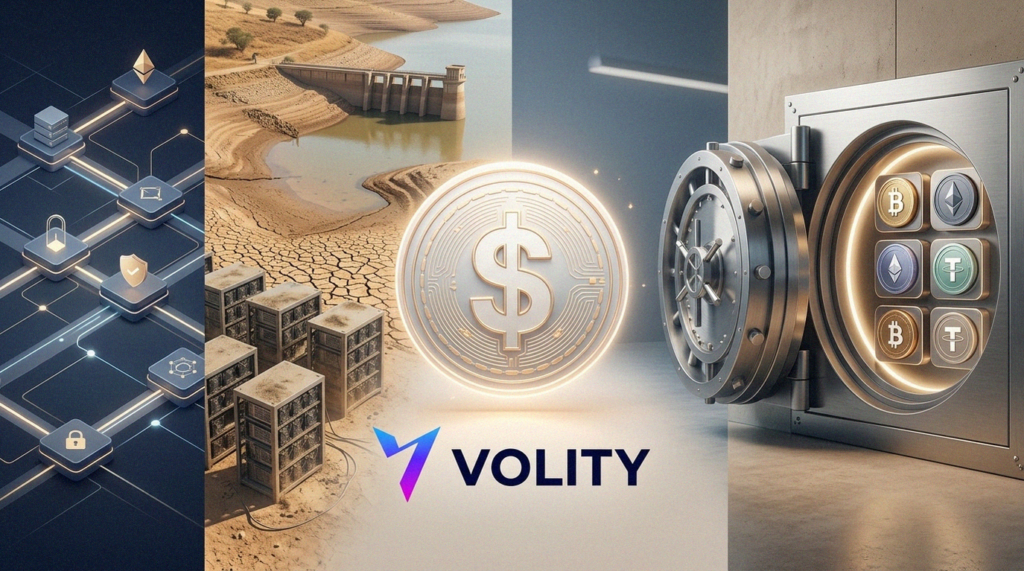
Crypto market morning: dollars on-chain, power cuts in Ethiopia, and banks move closer
Crypto prices remain restless, while the more durable changes are happening underneath the screen.
Circle is putting dollars at the centre of a new blockchain. Meanwhile, Ethiopian miners are confronting hydropower shortages. Deutsche Bank, however, is preparing regulated custody for large clients.
Those developments share a theme: crypto is becoming infrastructure. That shift may prove more important than a volatile afternoon in Bitcoin.
Circle puts USDC in the driver’s seat
Circle’s Arc mainnet has launched with an unusual choice: USDC serves as its native gas token.
Users pay transaction fees in dollars, rather than in a separate volatile network coin. Institutions can therefore estimate settlement costs without watching another token swing wildly.
Arc targets stablecoin payments, capital-markets settlement and institutional decentralised finance. It uses the Tendermint-derived Malachite consensus engine and provides sub-second transaction finality.
The chain also supports Ethereum-compatible applications. Developers can move EVM-based software without rebuilding every smart contract.
Its founding validator roster gives the project a distinctly traditional-finance flavour. BlackRock, DTCC, ICE, Mastercard, Visa, Standard Chartered, SBI Group and MoneyGram feature on the list.
Galaxy, Global Payments and Sumitomo Corporation also appear among the early validators. That does not guarantee meaningful volumes, of course.
Still, such firms rarely lend their operational names to experiments without commercial intent. Arc looks less like a retail token launch and more like payments plumbing.
Circle has separated transaction economics from chain governance. USDC handles fees and settlement, while ARC is reserved for staking and governance.
The company initially issued 10 billion ARC tokens. However, it has not committed to a public token launch.
That restraint matters. Circle appears to be pursuing regulated usage before inviting speculative demand into the system.
Existing USDC holders need not take action. Balances on Ethereum, Solana, Base and Arbitrum remain unchanged.
Arc represents another network for USDC, not a replacement version. Any supposed USDC “upgrade” request therefore deserves immediate suspicion.
Ethiopia’s cheap power gets expensive
Ethiopia’s Bitcoin miners are learning that low electricity tariffs can conceal a brutal risk premium.
An El Niño-linked dry period has reduced reservoir inflows by roughly 20%. As a result, the hydropower-heavy grid has less energy to distribute.
State-owned Ethiopian Electric Power has cut miners to 23% of contracted electricity levels. That follows earlier reductions to 75%, then 50%.
The figures expose the scale of the industry’s local footprint. Miners consume nearly one-third of Ethiopia’s 9,730 megawatts of generation.
They also supplied about 35% of EEP’s revenue during the last financial year. Yet revenue loses the argument when households and factories need power.
The utility has made its hierarchy clear. Residential users and manufacturers come first, while Bitcoin mining becomes the grid’s flexible load.
Officials plan another assessment in October. However, further cuts remain possible if water levels fail to recover.
Restrictions on regional power exports could also follow. That would widen a local weather event into a broader energy-market problem.
For listed miners, Ethiopia is a useful warning. Cheap energy is not simply a spreadsheet input.
It depends on rainfall, reservoirs, politics and public tolerance. When those conditions change, a long-term power contract can become a very short-term comfort.
Deutsche Bank chooses custody over spectacle
Deutsche Bank is taking a more measured route into digital assets. It plans a regulated custody service for institutional and corporate clients later this year.
The first asset list is intentionally narrow: Bitcoin, Ether, USDC, EURC and EURAU.
Clients will be able to safeguard assets and transfer them to third parties. Meanwhile, Deutsche Bank will manage the wallets and private-key infrastructure.
That arrangement addresses a familiar institutional problem. Investment committees may accept Bitcoin exposure, yet few want staff holding seed phrases.
Tokenised financial instruments should arrive later. However, the bank wants custody workflows and regulatory permissions established first.
The timetable depends on approval under the European Union’s MiCA framework. Deutsche Bank expects its licence around October, although scope and timing may still change.
This is not a call to chase bank shares or crypto tokens. Instead, it signals where institutional demand is heading.
Large investors want digital assets within familiar controls: custody, audits, authorised transfers and accountable counterparties. The old financial system is not replacing crypto’s rails.
It is gradually attaching its own handrails.
What traders should watch
- Stablecoins: Arc could strengthen USDC’s role in institutional settlement, particularly where predictable fees matter.
- Mining equities: Watch power concentration, contract flexibility and weather exposure alongside hash-rate forecasts.
- BTC and ETH: Deutsche Bank’s custody plans support longer-term access, rather than immediate price momentum.
- ARC: A 10 billion initial supply exists, but Circle has not confirmed a public launch.
Today’s market story is not really about a candle on a chart. Rather, it is about dollar rails, electricity constraints and regulated custody.
Prices may take their time to reflect that shift. The infrastructure, meanwhile, is already being built.
Related coverage on Volity
- How to Avoid Crypto Scams: A Beginner Safety Checklist
- How to Choose a Trading Platform: A 10-Point Checklist
- Demo vs Live Trading Account: A 7-Step Checklist Before You Go Live
- How to Size a Trade: Position Sizing and Risk Per Trade for Beginners
- Risk-Reward Ratio Explained: How to Set It and Why It Matters
- ETF vs Index Fund: The Difference and Which to Pick