Investing in financial products involves risk. Losses may exceed the value of your original investment.
Ironclad stoploss volatile is a core topic for traders in 2026. The complete guide follows.
Trading alert: why fresh data and ironclad stops are your edge in volatile markets
Tuesday premarket has a way of turning grown adults into button mashers. A stock like DigitalOcean (DOCN) gaps 18% after earnings, and the “gap-and-go” itch starts. Meanwhile, oil refuses to flinch, Nvidia (NVDA) anchors the Nasdaq, and every feed fills with hot takes.
However, the market does not pay you for excitement. It pays you for process. Any trade idea that arrives without timestamps, sizing and a real stop is not an idea. It is entertainment.
What these pitches get right
Momentum traders have made a living for decades on post-news drift. So the instinct to stalk DOCN after earnings, or Roblox (RBLX) after a guidance reset, sits on solid ground. News creates attention, attention creates volume, and volume creates tradable ranges.
Meanwhile, “confirmation” language, like waiting for support to hold or a break to clear, is closer to professional thinking than most social posts. A momentum entry that triggers on strength, rather than hope, reduces the number of times you catch a falling piano.
Relative strength and weakness framing also helps. If crude remains firm and energy refuses to break, then laggards in that complex can become clean short ideas. Conversely, leaders can offer dip buys, but only when they respect levels on the tape.
Where they fall apart, and where accounts get damaged
First, a level you “watch” is not a stop. It is a mood. However, markets do not care about your mood by lunchtime.
Second, risk and reward cannot be implied. It must be written down before entry. Otherwise, you will take small profits out of fear, then wear full losses out of stubbornness. That is the most common retail pattern in choppy markets.
Third, data freshness matters more than people admit. A “today” move without a timestamp is a tell. In fast tapes, an earnings gap from three sessions ago is not the same trade. If you cannot place the catalyst in time, you do not have an edge.
Fourth, the “16 names to watch” list is usually a way to sound busy. Yet it often guarantees sloppy execution. A watchlist is only useful when each ticker has a trigger, a stop, and a first target. Without that trio, it is background noise.
Finally, speculative buzz, like loose M&A chatter around meme names, tends to pull in uninformed money. If financing is not committed, the stock can whipsaw both ways on nothing. So the correct response is either smaller size or no trade.
A cleaner framework for the same market
Start with the macro tape, but trade the chart. Oil strength can support energy swings, while megacap stability can keep Nasdaq dips buyable. However, neither backdrop replaces risk control.
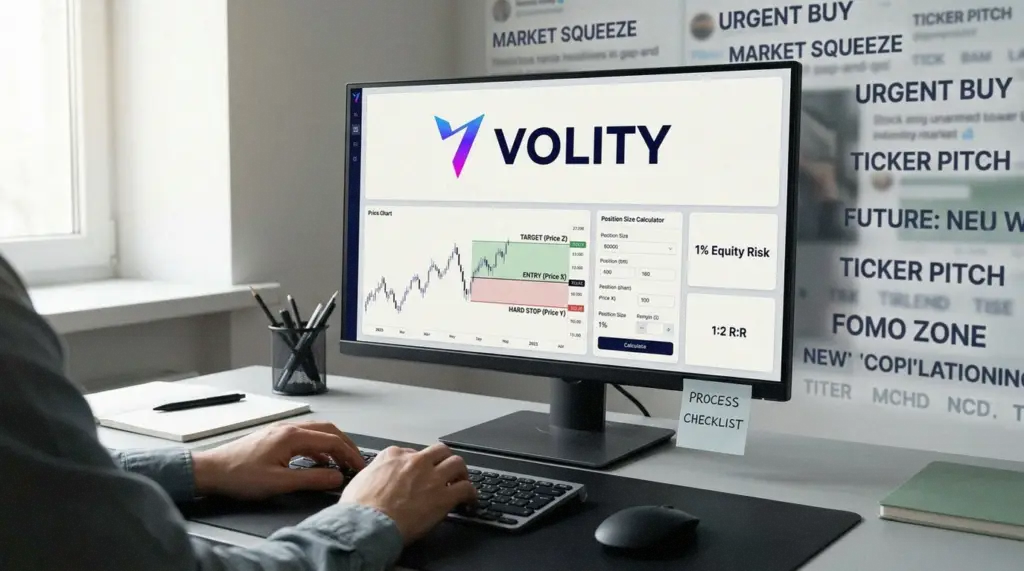
If you insist on trading a DOCN-style gap, write the trade like a pilot runs a checklist. Entry, stop, target, size. Then execute, or stand down.
By the numbers
- Hard stop rule: cap single-trade loss at 5-8% on the position, or tighter if volatility demands it.
- Risk budget: risk about 1% of portfolio equity per trade, then adjust for correlation.
- Minimum R/R: aim for at least 1:2 before fees and slippage.
- Freshness: treat catalysts older than three sessions as a different setup.
- Focus: keep an active slate to 3-5 defined setups, not 15 tickers and vibes.
Key takeaways
- Define the exit first. A stop is a price, not a feeling, and not “near support”.
- Force the maths. If the target does not justify the risk, pass, even if the chart looks pretty.
- Timestamp catalysts. “Premarket today” should include the date and the session context.
- Trade fewer names. Concentrate on the setups you can execute well, not the ones you can mention.
- Respect the tape. When vol rises, size falls, and your stop discipline must tighten.
The edge in this market is not access to ideas. Everybody has ideas. The edge is insisting that every idea arrives with fresh information and an ironclad stop, and then having the discipline to honour it.
For more on this topic see our deep-dives on Crypto and Investment Playbook: How Active Traders Read Cleared Trades, Stock Market Guide: Earnings, Analyst Moves and Breakouts, and NVDA Forecast: Predictions, Risks and Where Profits Are Heading.
By Volity Editorial, Volity Markets Desk
What our desk watches in volatile tape: Three signals govern whether we add risk or pull it. Realised versus implied volatility tells us if option markets are pricing the same regime our charts are showing.
The VIX term structure flips matter: when front-month overshoots back-month, intraday whips usually follow, so stops widen and size shrinks. And correlation across the day’s leaders, oil, megacap tech, semis, reveals whether a single macro variable is driving every position.
When those three line up, we either trade smaller or stand down.
Frequently asked questions
Where should I actually place a stop-loss in a volatile market?
Anchor the stop to structure, not to a round number. For breakout entries, place it just below the prior swing low or the volume shelf that produced the move. For mean-reversion entries, use a multiple of the average true range (ATR), commonly 1.5x to 2x ATR, so noise does not knock you out. The U.S. Securities and Exchange Commission notes that stop orders trigger at market and may fill below the stop price during fast tape, so size with that slippage in mind.
Are stop-loss orders guaranteed to fill at my chosen price?
No. A standard stop becomes a market order once triggered, so in gaps or thin tape it can fill several percent below the stop price.
Stop-limit orders cap the fill but may not execute at all in a gap-down. The UK Financial Conduct Authority consistently flags slippage as a top retail-trader misconception.
The defence is sizing: assume the worst plausible fill, then position so even that fill keeps the loss inside your risk budget.
How does position sizing connect to stop placement?
Sizing and stops are one decision, not two. Pick the stop based on chart structure, then derive size from the formula: position size equals risk budget divided by per-share stop distance. If the stop is wider than the chart will tolerate without hitting your dollar limit, the trade is too large or the structure is too loose, so pass. The Investopedia primer on stop orders covers the mechanics in detail.
Should I use a hard stop or a mental stop?
For most traders, a hard stop wins. Mental stops only work if you can execute without hesitation under stress, which is rare.
The behavioural research is unambiguous: traders extend losses far more readily than they let winners run. A resting order in the book removes the negotiation.
Reserve mental stops for thin overnight markets where a resting order would be picked off, and even then write the level down before the session.
Related guides
- Risk management in forex trading
- Risk and reward ratio explained
- Best forex trading strategies
- Day trading platforms
- Swing trading platforms
Volity operates a trading platform and also publishes educational and analytical content about trading. The content on this page is for educational purposes only and should not be considered financial advice. Volity may benefit commercially when readers open trading accounts through links on this site.
Our content is produced and reviewed under documented editorial standards; see our comparison and review methodology.