Investing in financial products involves risk. Losses may exceed the value of your original investment.
Stock market earnings is a core topic for traders in 2026. The complete guide follows.
Market catalysts heat up in late April as earnings, analysts and charts fight for control
Late April trading has turned jumpy again. Meanwhile, that restlessness has a simple source.
Companies are reporting, analysts are adjusting, and price levels are breaking. Traders face a familiar choice.
You can chase headlines, or you can map the handful of catalysts that reliably move money.
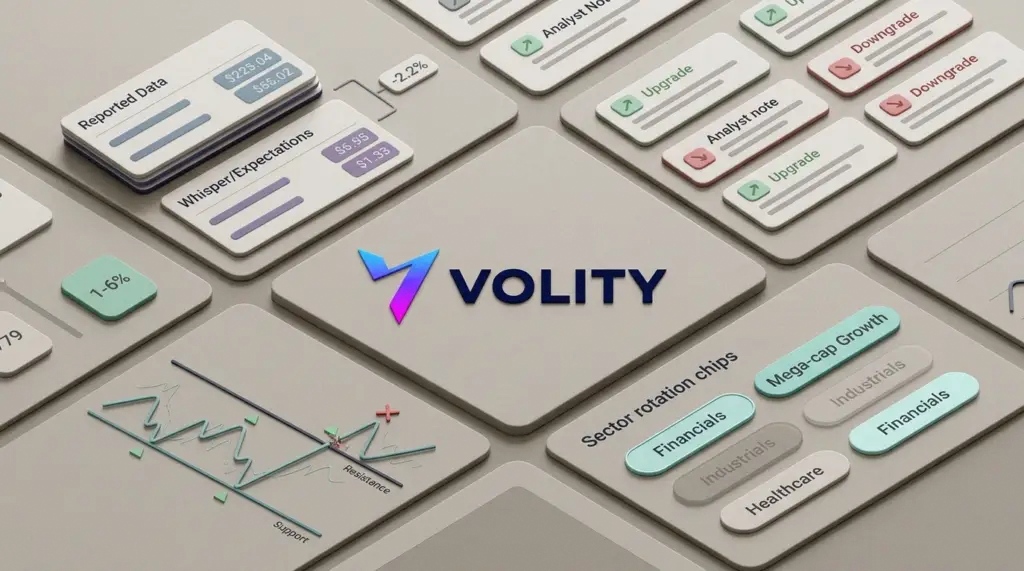
Earnings sit at the centre of the board. However, the market is not pricing “good” or “bad” quarters in isolation. It is pricing surprise versus fear, guidance versus positioning, and cash flow versus stories. The cleanest edge comes from understanding what the market expected, not what a company “should” have done.
Earnings: still the heavyweight catalyst
Every earnings season produces the same optical illusion. A company “beats” and the stock falls.
Another “misses” and rallies. Yet the logic is straightforward.
Investors trade the gap between results and the whisper, then they trade the forward view. If management guides margins down or demand softens, the quarter quickly stops mattering.
That is why late April feels tense. Many desks already carry profitable year-to-date positions. They use earnings to de-risk, rotate, or press winners. Meanwhile, systematic funds respond to volatility and trend signals, which can amplify moves once key levels break.
Analyst actions and breaking news: fast money’s accelerant
Upgrades, downgrades and target changes look cosmetic until they hit a crowded tape. However, they can become the day’s permission slip for funds that needed a narrative to add or trim. Product launches, regulatory decisions and litigation updates work the same way. The first hour after a credible headline often sets the day’s range.
Speed matters, but structure matters more. Traders should know which names have imminent catalysts, heavy short interest, or thin liquidity. Those features decide whether news becomes a drift or a lurch.
Technical breakouts: where positioning becomes visible
Charts do not predict the future. However, they reveal where investors placed risk. When price pushes through a well-watched moving average or a prior high, stops trigger and new buyers appear. Meanwhile, failed breakouts can be even sharper, because late buyers rush for the exit.
Before an earnings print, support and resistance levels offer a practical framework. After the print, they help you judge whether the move is digestion or a new trend. Even fundamental investors end up watching the same lines as the fastest traders.
How traders are playing earnings volatility right now
Different styles keep winning for different reasons. Yet they share one trait. Each approach defines risk before the headline hits.
- Directional equity traders lean on estimate dispersion, prior reaction patterns, and recent price action. However, they size smaller when positioning looks crowded.
- Volatility traders focus on the expected move priced into options. They buy or sell volatility when implied looks wrong versus realised.
- Day traders often fade the first impulse move, especially after gap opens. Meanwhile, they take profits into pre-marked levels, not feelings.
- Swing traders look for earnings as turning points. However, they wait for confirmation, such as a reclaim of a key level after a sell-off.
The critical point is psychological, not mathematical. Guessing direction is seductive. The better habit is to trade around defined zones, with exits that make sense even when you are wrong.
Sector breadth matters more than a single theme
One reason this tape feels tradeable is breadth. Strength is no longer confined to a tiny cluster of mega-cap growth. Meanwhile, traders are increasingly willing to rotate into financials, industrials, healthcare and even utilities when earnings back the move. That rotation softens the risk of one theme breaking the whole index.
Valuations also look less like a mania than a bargain-bin, depending on the patch of the market you trade. However, multiples become fragile when growth expectations get marked down. Guidance season counts as much as results season.
By the numbers
- Street expectations call for roughly 15% earnings growth in 2026, extending a multi-year run of double-digit gains.
- Q4 2025 marked the tenth straight quarter of year-on-year S&P 500 earnings growth, with gains above 8%.
- Profit growth has broadened across 7 of 11 S&P 500 sectors, not just technology.
Key takeaways for traders
- Trade expectations, not headlines. A “miss” can rally if it beats fear and improves the forward path.
- Mark your levels before the print. Support and resistance decide whether a gap becomes a trend.
- Watch analyst notes as positioning signals. They often validate what funds already wanted to do.
- Respect breadth. Rotation can keep indices stable while single names whip around.
- Size for volatility. Late April rewards discipline, then punishes bravado.
None of this guarantees easy money. However, it does offer a clean roadmap. Track earnings, monitor analyst shifts, and treat breakouts as positioning events. You stop reacting to noise and start trading the few forces that keep moving markets.
For more on this topic see our deep-dives on Nvidia and AMD AI Chips: Outlook, Targets and Risks for Investors, Oil Shock Trading: Hormuz Risk, WTI Spikes and Cross-Asset Plays, and BATL, DXYZ and SpaceX Buzz: Trading Thin Floats and Oil Volatility.
What our analysts watch: Three readings filter signal from earnings noise. The first is estimate dispersion: when sell-side estimates for the same name spread wide, the realised reaction tends to be larger because there is no consensus to anchor positioning.
The second is the implied move priced into the option chain versus the prior eight-quarter realised move; a wide gap rewards volatility-selling, a tight gap rewards directional gamma. The third is breadth across sectors, because rotation between defensives, cyclicals, and rate-sensitives can keep the index print stable while individual names whip 8% to 12% on results.
When dispersion is high, implied is rich, and breadth is wide, the post-earnings setup is genuinely tradeable rather than a coin flip.
Editorial FAQ
Why does a beat sometimes sell off and a miss rally?
The market never trades the headline number alone. It trades the gap between the print and the buy-side whisper, the change in forward guide, and the existing positioning into the date.
A beat against a higher whisper, with softer guidance, is functionally a downgrade, regardless of the press-release framing. The ESMA investor protection EDGAR archive holds every 10-Q and 8-K filing where the actual guidance language is recorded.
How does the macro discount rate change post-earnings reactions?
Real yields and the policy path set the discount rate every multiple-expansion story is measured against. When the Fed pauses with real yields above 1.5%, even strong earnings struggle to lift multiples, because the cost of holding equities versus risk-free duration has risen. The Bank of England monetary policy publishes the FOMC statement, dot plot, and Summary of Economic Projections that anchor those expectations.
How should I use analyst upgrades and downgrades around earnings?
Treat them as positioning signals rather than trade ideas. An upgrade after a stock has rallied 30% is often a permission slip for funds that wanted to add anyway, and offers asymmetric downside if the next print disappoints. Downgrades after a 30% drawdown can mark capitulation rather than continuation. ECB Economic Bulletin covers analyst-rating mechanics, target-price methodology, and the typical sell-side incentive structure.
Frequently asked questions
How much weight should retail traders give analyst upgrades?
Analyst rating changes move stocks on the day of the call but the alpha decays quickly when the upgrade is consensus-driven. The signal that matters is divergence: a single firm cutting price targets while peers raise them often precedes earnings disappointments. Track the dispersion, not the headline. The FINRA research analyst rules explain why disclosed conflicts shape the credibility of any rating.
What separates a real breakout from a fakeout on the daily chart?
Volume confirmation and the close relative to the breakout level matter more than the intraday high. A breakout that closes back inside the prior range on average volume is usually a trap, while one that closes near session highs on 1.5x average volume tends to follow through. Pair the price action with sector breadth before sizing up.
Why do earnings beats sometimes trigger sell-offs?
The market prices the buyside whisper number, not the published consensus. When a company beats published estimates but misses the buyside expectation embedded in pre-earnings options pricing, shares fall. Forward guidance and segment-level commentary often matter more than the headline EPS print, especially in mega-caps. The SEC EDGAR filings remain the authoritative source for the actual numbers and language.
Should retail traders fade or follow large analyst price target moves?
Follow when the upgrade or downgrade is fundamentally driven and contrarian to consensus, fade when it merely confirms what is already in the price. The size of the target change relative to the implied volatility move tells you whether the analyst is signalling new information or just catching up. The Investopedia primer on price targets covers the methodology nuances.
Related guides
- Stocks investing for beginners
- Best stock trading platforms in Europe
- Swing trading platforms
- Day trading platforms
- Best trading platforms
Volity operates a trading platform and also publishes educational and analytical content about trading. The content on this page is for educational purposes only and should not be considered financial advice. Volity may benefit commercially when readers open trading accounts through links on this site.
Our content is produced and reviewed under documented editorial standards; see our comparison and review methodology.