Risk returns, but the market is charging different prices
Thursday’s market carries a deceptively cheerful message: risk appetite has returned.
However, that appetite looks nothing alike across small caps, energy, technology and post-earnings names.
Tenon Medical is sprinting after a balance-sheet repair. Meanwhile, oil investors are staring at America’s depleted emergency reserves.
At the same time, producer inflation has accelerated, putting fresh pressure on expensive technology shares.
The result is a market that rewards selectivity rather than broad enthusiasm.
Traders can find momentum, reversals and longer-term themes. However, each requires a different holding period and a different stomach.
Tenon’s dilution cloud lifts
Tenon Medical repaid about $5.16 million of senior convertible notes before their September 11, 2026 maturity.
Crucially, the repayment removes a potential source of discounted share issuance and dilution.
That detail matters greatly for a micro-cap stock, where financing structures often dictate the entire chart.
Shares jumped sharply as traders absorbed the news. Therefore, Tenon has become a momentum vehicle rather than a conventional value proposition.
The easy part of this trade may already have passed.
After a 50% to 70% surge, late buyers risk providing exit liquidity for earlier holders.
Active traders should watch the opening range, the previous day’s high and bursts of turnover.
Meanwhile, longer-term investors should remember that one cleaned-up liability does not create recurring profits.
- Ticker: TENX
- Debt repaid: roughly $5.16 million
- Trading focus: volume, opening range and prior-day resistance
- Main danger: a violent reversal after an extended intraday move
Energy finds support in an empty reserve
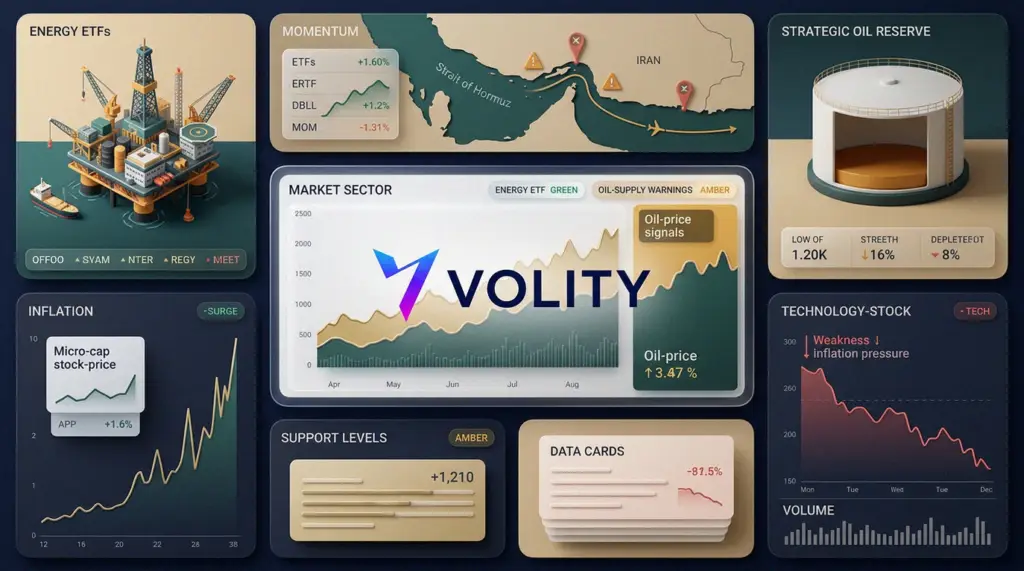
The Strategic Petroleum Reserve now sits near its lowest level since the early 1980s.
Emergency drawdowns during the Iran conflict left Washington with a much thinner oil cushion.
Reserve holdings near 280 million to 300 million barrels represent roughly 40% of capacity.
That leaves less room to blunt another supply shock.
Meanwhile, disruption risks around the Strait of Hormuz keep a durable premium embedded in crude prices.
Oil’s gains may pause on any diplomatic progress. However, the underlying supply-security equation has become more supportive for energy.
Integrated producers, refiners and oil-service companies stand to benefit from a sustained higher-price environment.
Exchange-traded funds including XLE, XOP and OIH offer broad exposure without single-company drilling risk.
Therefore, orderly pullbacks in energy appear more attractive than indiscriminate dips in the wider market.
Producer prices complicate the Nasdaq trade
August producer prices rose 5.4% from a year earlier, the strongest reading of 2026.
Headline PPI increased 0.4% during the month, led in part by higher energy costs.
That figure complicates hopes for easier Federal Reserve policy.
Higher wholesale costs can filter into consumer prices, even if the pass-through arrives unevenly.
Consequently, investors may demand lower valuations from high-duration technology shares.
That is particularly relevant for QQQ and richly priced software businesses.
Those shares rely heavily on distant earnings, which lose appeal when yields stay elevated.
Energy, by contrast, receives support from both supply anxiety and fuel-driven inflation.
However, traders should avoid treating every oil producer as interchangeable.
Refiners need favourable crack spreads, while explorers need disciplined spending and reliable reserves.
Strong earnings meet sceptical charts
Academy Sports & Outdoors delivered one of the cleaner reports.
GAAP earnings per share rose about 17%, while adjusted earnings increased around 19%.
The retailer beat expectations and raised its full-year earnings outlook.
Therefore, ASO has a credible post-earnings momentum case if it clears its report-day high.
An orderly retreat that holds the earnings-day range would also preserve the bullish setup.
By contrast, a swift break below that range would signal that sellers have seized control.
Navan offered the opposite lesson. The company posted strong second-quarter figures and lifted its fiscal 2027 outlook.
It also announced the acquisition of BoomPop. However, NAVN shares fell as investors reassessed guidance and the transaction.
For now, price action matters more than the headline beat.
A recovery above the post-sell-off low could invite a mean-reversion trade.
Conversely, a heavy-volume break below that level would favour a continuation short.
Core & Main also beat estimates and reaffirmed fiscal 2026 sales guidance.
Yet subsequent price-target reductions revealed the market’s concern about limited upside.
CNM needs time to build a base and retake key moving averages. Until then, it remains a prove-it story.
Sunbelt Rentals raised full-year guidance after first-quarter profit growth. Still, its shares slipped in pre-market dealings.
That reaction looked like sell-the-news behaviour after a substantial advance.
Therefore, a stable hold above established support could create a better swing entry than chasing the original rally.
Oversold does not mean safe
Royal Caribbean has fallen more than 20% and now sits near a closely watched support area.
Technical oversold readings can spark sharp rallies. However, they do not guarantee a bottom.
Traders should wait for the shares to hold support and reclaim nearby resistance.
A clean failure would keep RCL in falling-knife territory and point to further downside.
Ocugen presents a different problem. Disappointing interim clinical data have left the biotech largely rangebound.
Without a clinical or regulatory catalyst, the shares offer limited reason to move decisively.
Meanwhile, unexpected trial news can still produce abrupt gaps in either direction.
That makes OCGN a catalyst trade, not a patient compounding investment.
What matters for traders
- TENX: Treat strength as an intraday momentum event, with strict exits after the debt-repayment surge.
- Energy: Favour pullbacks in XLE, XOP and OIH while reserve depletion and supply risks persist.
- QQQ: Respect inflation risk, especially in high-multiple technology names sensitive to yields.
- ASO and NAVN: Let post-earnings price levels decide the trade, rather than earnings headlines alone.
- RCL and OCGN: Demand confirmation, because oversold charts and biotech ranges can stay hostile longer than expected.
The market is offering plenty of trades, but not one easy narrative.
Momentum belongs in short-term accounts. Energy belongs in a medium-term theme. Inflation demands caution in expensive growth.
That separation may matter more than finding Thursday’s loudest ticker.
Related coverage on Volity
- What Is a P/E Ratio and How to Use It
- Fundamental Analysis in Stock Trading: A Working Definition
- Growth Investing vs Value Investing: Which Style Fits You?
- Fractional Shares Explained: How to Start Investing With $50
- How to Start Stock Trading: A 2026 Beginner Guide
- Dividend Investing for Beginners: How to Start