Crypto’s next act: faster rails, tighter rules and a market seeking lift
Wednesday, October 21, 2026. Crypto markets have returned to their familiar split screen. Bitcoin is trying to settle above $80,000, while Ether remains under pressure. Meanwhile, developers are promising faster networks and more practical payment systems.
Investors have heard the promises before. This time, they want evidence in ETF flows, transaction volumes and operating results.
Bitcoin finds support, but not a breakout
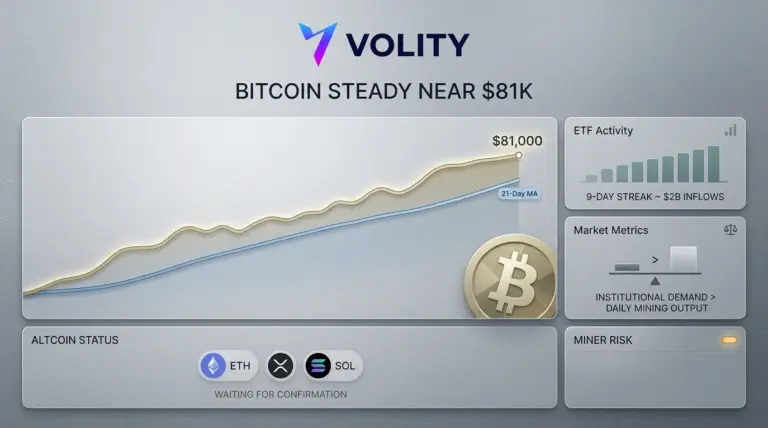
Bitcoin recently traded near $83,000 after rising with US equities. Sellers, however, remain active around $84,200. The next test sits between $85,000 and $90,000, where a failed rally could quickly revive range-trading habits.
ETF flows remain the market’s cleanest institutional signal. Bitcoin funds have drawn intermittent demand, although purchases slowed after a stronger start to the week. That leaves the market supported, rather than convincingly bid.
Ether faces a harsher calculation. US spot Ether ETFs have posted about $1.08 billion of October outflows, the largest monthly withdrawal this year. Traders still value Ethereum’s staking economy and extensive developer base, yet fund investors have not followed with fresh cash.
Bitmine has staked another 159,728 ETH, valued near $390 million. That move signals long-term confidence, even as yields decline. More Ether is now locked across the network, so rewards must stretch over a larger pool.
Solana prepares its biggest engineering test
Solana’s Alpenglow upgrade could become one of the year’s most closely watched launches. It replaces TowerBFT, the consensus system that has underpinned the chain since 2020. The new Votor mechanism aims for transaction finality of roughly 150 milliseconds.
That would be a sharp change from today’s approximate 12.8-second confirmation time. Faster finality could help exchanges, payments firms and consumer applications. It could also make Solana a more serious rival for high-volume financial activity.
SOL has not received a pre-upgrade rally. The token fell more than 9% over seven days amid ETF outflows and weaker technical signals. In addition, co-founder Anatoly Yakovenko has challenged parts of the design, including its treatment of vote transactions.
Such debate is healthy, but it raises the stakes. A consensus upgrade succeeds only when it handles volatile markets and heavy traffic without surprises. Holders are buying exposure to both a technical advance and a live operational test.
Stablecoins become payment plumbing
Stablecoins increasingly offer crypto’s most tangible adoption case. Adjusted transfer volumes reached $891 billion during the third quarter. About 73% of screened activity occurred outside normal US banking hours, including weekends and public holidays.
That pattern matters because cross-border commerce rarely follows Wall Street’s clock. Companies can move funds on a Sunday night without waiting for a bank branch. Banks have noticed, too.
Seven of America’s ten largest banks have tested stablecoins or tokenised deposits. Around 30% of mid-market companies with cross-border operations use, or pilot, stablecoin payments. Those figures suggest the technology has moved beyond the speculative fringe.
Asia is adding practical experiments. Shinhan Card and Japan’s SBI plan yen stablecoin payments for travellers between Japan and South Korea. Malaysia’s central bank has also launched a tokenised bond platform with round-the-clock settlement.
Yet stablecoin supply has not expanded at the same pace. Sector market value stood near $301.4 billion, slightly below year-earlier levels. Existing tokens are circulating faster, rather than attracting a broad surge of new capital.
Rules narrow the room for manoeuvre
Regulators are now setting boundaries around the industry’s faster-moving corners. France has proposed liability for crypto platforms affected by decentralised-finance security failures. The proposal could make exchanges answer for protocols they do not directly control.
US Securities and Exchange Commission staff have issued non-binding guidance on staking receipt tokens, decentralised systems and issuer buybacks. Congress still has not passed the CLARITY Act. Agencies are therefore filling gaps with practical interpretations.
Ripple has supported the SEC’s proposed crypto framework after its long dispute with the agency. The company wants clearer lines around token classifications, issuer obligations and trading venues. Cardano Foundation has urged Europe to improve MiCA instead of extending broad new rules to staking and DeFi.
The direction of travel is plain. Legal uncertainty may be shrinking, while compliance costs rise. Businesses with clear controls, audited custody and documented customer protections should gain ground.
Security remains an expensive distraction
Better infrastructure has not removed familiar vulnerabilities. The wallet linked to the Drift exploit moved $109 million into Tornado Cash. It still held roughly $138 million in Ether after those transfers.
A North Korea-linked group known as SquidSquad is suspected of stealing $2.84 million from BNB Chain users. Qubic restarted its blockchain after a $1.4 million hack and opened recovery claims until May 2027.
Trading venues are responding with more specialised defences. Decibel has activated an encrypted mempool on Aptos. The system hides transaction details until execution, which may curb front-running by automated bots.
For traders, execution quality is not a technical footnote. A visible order can become an invitation for faster participants to move ahead of it. That hidden cost often matters more than a chain’s advertised throughput.
Prediction markets and AI wallets seek fresh users
With spot trading cooler, exchanges are searching for other sources of activity. Blockchain.com and Binance US are entering prediction markets. Kalshi, meanwhile, faces a Utah lawsuit seeking up to $61 million over alleged illegal betting contracts.
Artificial intelligence provides the other fashionable growth story. Tether led a $15 million round for Mural, which builds payment tools for AI agents. It also joined Tenstorrent’s $1.5 billion financing round.
Binance is promoting named Agent IDs for AI wallets. The idea is simple: make machine-controlled accounts easier to identify and monitor. The harder questions concern accountability when an automated wallet spends money badly.
Trading watchlist
- Bitcoin: Watch $84,200 to $85,000. A sustained move above that band would improve short-term momentum.
- Ether: ETF outflows and falling staking yields remain headwinds despite continued large-scale staking.
- Solana: Alpenglow offers a powerful catalyst, though implementation risk deserves the same attention.
- Stablecoins: Payments and settlement remain the clearest institutional adoption theme.
- Risk: Custody, liquidity, sanctions exposure and smart-contract security still shape every trade.
Crypto is not short of catalysts. It lacks a broad willingness to reward them before results arrive. Faster chains must remain reliable, stablecoins must settle real commerce, and rulemakers must produce workable standards. Until then, the market will keep rewarding proof and discounting slogans.