Stock market opening times are set by each exchange in its own local time. The NYSE and Nasdaq in New York trade 09:30 to 16:00, and London 08:00 to 16:30. Frankfurt, Paris and Zurich run 09:00 to 17:30. Hong Kong trades 09:30 to 16:00 and Tokyo 09:00 to 15:30, both with a midday break. Below are the official hours of 13 exchanges, the same sessions in UTC for winter and summer, the auctions and the December 2026 closures. Use them to pick the sessions that fit your day.
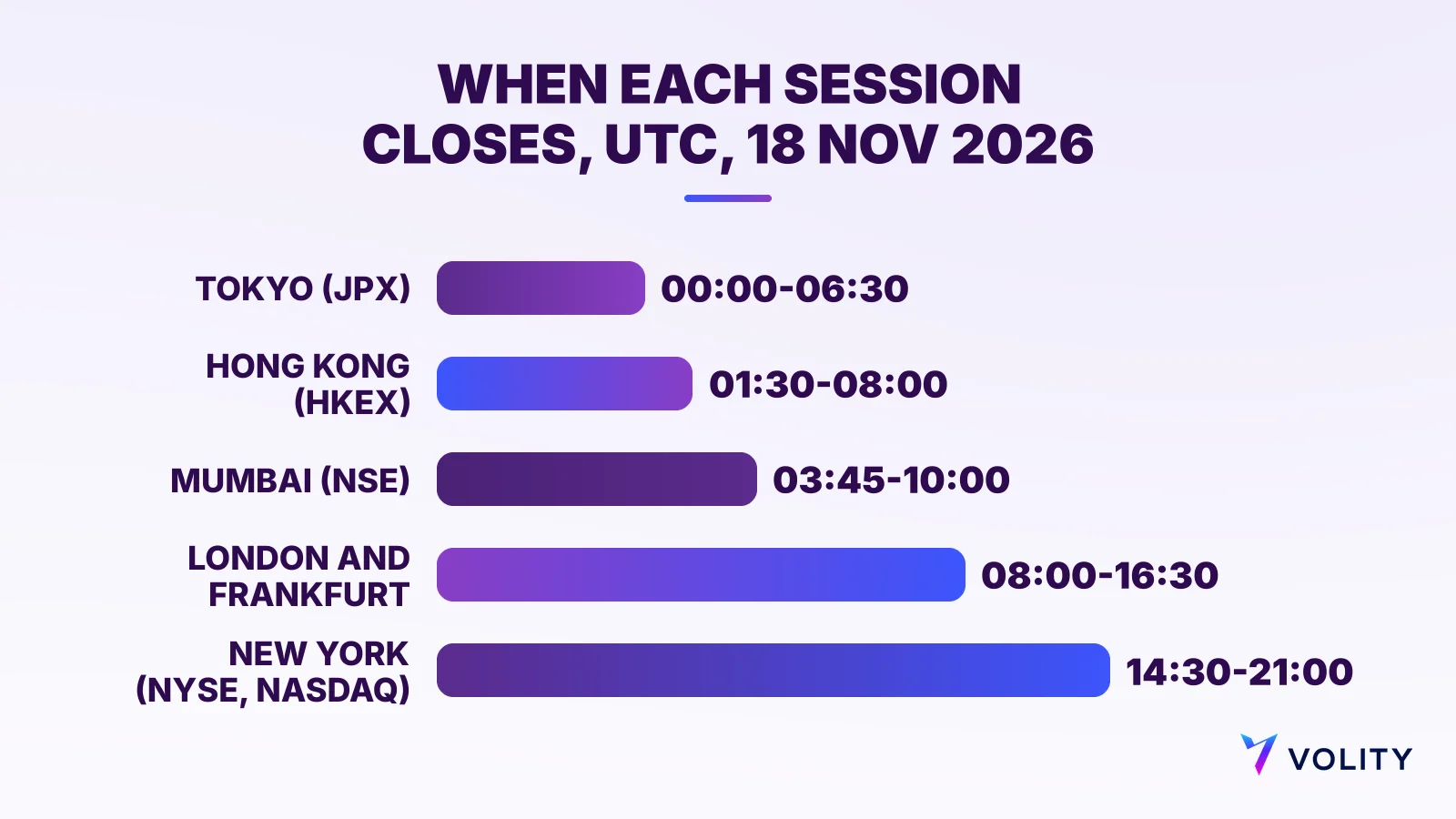
TL;DR: Exchanges publish their hours in local time, so convert with the offset in force on the day. On 18 November 2026 (northern winter), Tokyo trades 00:00 to 06:30 UTC and Hong Kong 01:30 to 08:00. London and Frankfurt trade 08:00 to 16:30 and New York 14:30 to 21:00. London and New York overlap for two hours. In the northern summer, London, Frankfurt and New York each trade one hour earlier in UTC, while Tokyo and Hong Kong keep the same UTC times all year. Between 24 and 31 December 2026 many exchanges close or trade half days, so check the exchange’s own calendar first.
Every session time below comes from the exchange’s own page or rulebook, read on 10 November 2026. Conversions to UTC (Coordinated Universal Time, equal to London’s winter time) are our own arithmetic, dated.
How exchange sessions work
An exchange runs its day in phases. Two words cover most of them. In continuous trading, orders match one by one as they arrive; this is what most people mean by “open”. In an auction, orders gather for a few minutes without trading, and then the exchange sets one price for all of them.
Most exchanges open and close with an auction around the continuous session. London shows the pattern, with an auction on each side of its main session. For private investors, the London Stock Exchange keeps it to one line: “London Stock Exchange trading hours are from 8:00 to 16:30.”
Some exchanges also stop for lunch. Hours do change, so confirm on the exchange’s page before an order that depends on the clock.
Main exchange hours at a glance
The table gives each exchange’s main continuous session in the time zone it publishes, with a link to the page it comes from.
| Exchange | Time zone used | Main session | Midday break |
|---|---|---|---|
| NYSE, New York | ET | 09:30-16:00 | None |
| Nasdaq, New York | ET | 09:30-16:00 | None |
| TSX, Toronto | ET | 09:30-16:00 | None |
| London Stock Exchange | GMT or BST | 08:00-16:30 | None |
| Euronext Paris, Amsterdam, Brussels | CET or CEST | 09:00-17:30 | None |
| Xetra, Frankfurt | CET or CEST | 09:00-17:30 | None |
| SIX Swiss Exchange | CET or CEST | 09:00-17:30 | None |
| JSE, Johannesburg | SAST, UTC+2 | 09:00-17:00 | None |
| NSE India, Mumbai | IST, UTC+5:30 | 09:15-15:30 | None |
| SGX, Singapore | SGT, UTC+8 | 09:00-17:00 | 12:00-13:00 |
| HKEX, Hong Kong | HKT, UTC+8 | 09:30-16:00 | 12:00-13:00 |
| Japan Exchange Group, Tokyo | JST, UTC+9 | 09:00-15:30 | 11:30-12:30 |
| ASX, Sydney | AEST or AEDT | About 10:00-16:00 | None |
ET is New York time. GMT and BST are UK winter and summer time, CET and CEST the Central European pair, and AEST and AEDT Sydney’s standard and daylight time. The other zones keep one offset all year.
A few rows need context. Hong Kong’s midday break is set in its Rule 501. ASX normal trading starts at 09:59:45, after the opening auction. The JSE document reads “Market Open 09h00, Market Close 17h00”, with continuous trading to 16:50 and then a closing auction. JSE and NSE hours come from archived copies of their official pages (JSE December 2025 and July 2026, NSE 1 October 2026).
For Frankfurt in more depth, see the DAX trading hours guide. ASX, Tokyo and NSE India each get a session-by-session guide in this series.
How the sessions overlap
An exchange’s local hours stay fixed, but their UTC time moves when its country changes the clocks. So convert with the offset in force on the date you trade, never one figure for the whole year.
US Eastern time, which TSX also uses, ran on daylight saving from 8 March to 1 November 2026, according to NIST. The UK kept British Summer Time from 29 March to 25 October (GOV.UK), and the EU switches on the same last Sundays of March and October (European Commission). Sydney moved to daylight time on 4 October 2026 and moves back on 4 April 2027 (NSW Government). Hong Kong, Singapore, Japan, India and South Africa keep one offset all year in the IANA time-zone database.
Here are the main sessions in UTC on two sample days (our conversion of the exchanges’ local hours):
| Market | Wed 18 Nov 2026, UTC | Wed 15 Jul 2026, UTC |
|---|---|---|
| New York, Toronto | 14:30-21:00 (UTC-5) | 13:30-20:00 (UTC-4) |
| London | 08:00-16:30 (UTC+0) | 07:00-15:30 (UTC+1) |
| Frankfurt, Paris, Zurich | 08:00-16:30 (UTC+1) | 07:00-15:30 (UTC+2) |
| Johannesburg | 07:00-15:00 | 07:00-15:00 |
| Mumbai | 03:45-10:00 | 03:45-10:00 |
| Singapore | 01:00-09:00 | 01:00-09:00 |
| Hong Kong | 01:30-08:00 | 01:30-08:00 |
| Tokyo | 00:00-06:30 | 00:00-06:30 |
| Sydney | 23:00 on 17 Nov to 05:00 (UTC+11) | 00:00-06:00 (UTC+10) |
On the November day, London and New York are both open from 14:30 to 16:30 UTC, two hours. Europe opens at 08:00 UTC, the moment Hong Kong closes. Singapore overlaps Europe from 08:00 to 09:00 UTC, Mumbai until 10:00 and Johannesburg until 15:00. Tokyo and Sydney overlap from 00:00 to 05:00 UTC. In July the London and New York overlap is still two hours, from 13:30 to 15:30 UTC.
Two windows break the pattern, because the US and Europe change clocks on different Sundays. From 25 October to 1 November 2026, London was back on GMT while New York was still on daylight time. Their overlap grew to three hours, 13:30 to 16:30 UTC. By our calculation, the same happens from 14 to 28 March 2027.
To turn any exchange’s hours into your own clock time:
- Take the session times from the exchange’s own page, in its local time.
- Note the exchange’s time zone and whether it uses daylight saving.
- Find the UTC offset in force on your trading date. In March, April, October and November, check both cities, since they may change on different Sundays.
- Subtract the offset to get UTC. New York’s 09:30 at UTC-5 becomes 14:30 UTC, and Tokyo’s 09:00 at UTC+9 becomes 00:00 UTC.
- Add your own city’s offset for the same date, not the one you remember from last season.
- Check the exchange’s holiday calendar for that date before you place the order.
Currencies keep a different clock from stock exchanges. See forex trading sessions and the best time to trade forex. A demo account lets you practise orders at the times you have worked out, with no money at risk.
Pre-market, auctions and closing prices
On most exchanges here, auctions set the opening and closing prices. During the call, orders build up without trading, and then one price is set for all matched orders. Several exchanges end the call at a random moment within a short window.
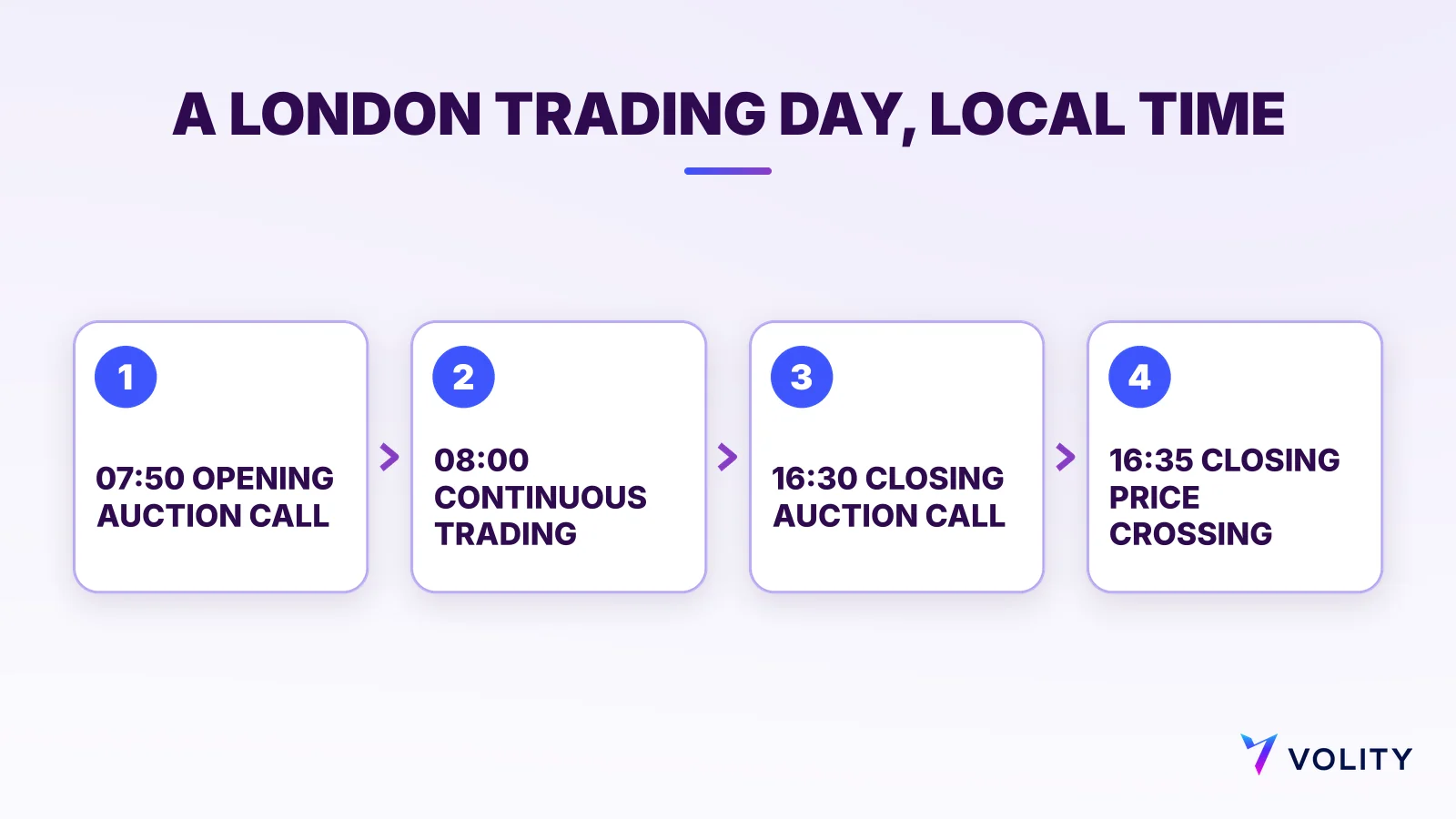
London’s business parameters workbook sets out the full sequence. The opening auction call runs 07:50 to 08:00, continuous trading 08:00 to 16:30 and the closing auction call 16:30 to 16:35. The closing price crossing session then runs to about 16:40, and the post-close phase lasts until 17:15. On early-close days, regular trading ends at 12:30. Other exchanges, from the pages linked in the hours table:
| Exchange | Opening phase (local) | Closing phase (local) |
|---|---|---|
| NYSE | Orders queue from 06:30; open auction 09:30 | Imbalance period from 15:50; auction 16:00 |
| Xetra | Auction from 08:50 | Auction from 17:30 |
| Euronext | Uncrossing at about 09:00 | Call from 17:30; trading at last to 17:40 |
| SIX | 09:00, random within two minutes | Auction 17:20-17:30; trading at last to 17:40 |
| HKEX | Pre-opening 09:00-09:30 | Auction from 16:00, random close 16:08-16:10 |
| SGX | Opening routine 08:30-09:00 | Closing routine 17:00-17:06; trade at close to 17:16 |
| ASX | Pre-open from 07:00; auction from 09:59 | Pre-close 16:00-16:10; auction 16:10-16:11 |
| JSE | Auction call 08:30-09:00 | Auction call 16:50-17:00 |
“Trading at last” means orders keep matching at the closing price for a few minutes after the auction. Xetra runs a similar phase. Deutsche Boerse describes three auctions a day: at the start, around midday to early afternoon, and at the end of main trading. For DAX, MDAX and SDAX shares a Trade-at-Close phase of at most five minutes follows the closing auction, so trading can run to 17:35 or 17:40.
Some exchanges stretch the day. Nasdaq lists pre-market trading from 04:00 to 09:30 ET and after hours from 16:00 to 20:00 ET. TSX runs an extended session from 16:15 to 17:00 at the last sale price only. Nasdaq warns that brokers may use different extended-hours times, and that these sessions carry higher volatility (larger, faster price moves) and lower liquidity (fewer buyers and sellers).
Public holidays and early closes
Each exchange follows its own national holidays, so a quiet day in one city can be a normal one in another. The year-end stretch, 24 to 31 December 2026, is when the calendars split. The grid comes from each exchange’s 2026 calendar.
| Exchange | Thu 24 Dec | Fri 25 Dec | Mon 28 Dec | Thu 31 Dec |
|---|---|---|---|---|
| NYSE and Nasdaq | Close 13:00 ET | Closed | Open | Open |
| TSX | Close 13:00 ET | Closed | Closed | Open |
| London | Half day | Closed | Closed | Half day |
| Euronext Paris, Amsterdam, Brussels | Half day | Closed | Open | Half day |
| Xetra | No trading | No trading | Open | No trading |
| SIX | Closed | Closed | Open | Closed |
| Tokyo | Open | Open | Open | Closed |
| HKEX | Half day | Closed | Open | Half day |
| ASX | Normal trading to 14:10 | Closed | Closed | Normal trading to 14:10 |
Half days work differently in each city. London says its “Markets closing process commences from 12:30 London time”. Euronext will publish the exact half-day hours in an end-of-year appendix; Dublin also closes on 28 December, and Milan and Oslo on 24 and 31 December. On Hong Kong half days there is no afternoon session: the closing auction starts at 12:00 and ends at random between 12:08 and 12:10. The ASX footnotes for 24 and 31 December both read “Normal trading ceases at 14:10 (Sydney time)”.
On Friday 1 January 2027 the NYSE, TSX, London Stock Exchange and Xetra are closed, and Tokyo stays shut from 1 to 3 January. SGX, the JSE and NSE India publish their own holiday lists, so check those directly before a year-end order. For more markets, see the trading holidays calendar.
Trade across sessions from one account
Exchange hours tie shares to one city’s clock. On Volity, crypto and a growing range of other markets, including gold, silver, US500, US100 and WTI, trade 24/7, and forex trades 24/5. A trader in Sydney, Johannesburg or Toronto can follow those markets on their own schedule. For crypto in more depth, see crypto trading hours.
One Volity account holds real shares, fractional shares, crypto and CFDs, with 10,000+ instruments in total and 350+ CFD instruments. A CFD (contract for difference) lets you trade a price move without owning the asset; its leverage magnifies losses as well as gains. Every account tier comes with a free demo, and the full cost schedule is on the charges and fees page.
Fact check: Hours and holidays come from the exchanges’ own pages: NYSE, Nasdaq, TMX (TSX), the London Stock Exchange, Euronext, Deutsche Boerse, SIX, Japan Exchange Group, HKEX, the SGX rulebook and ASX, plus archived JSE and NSE documents. Clock-change dates come from GOV.UK, the European Commission, NIST and the NSW Government, and fixed offsets from the IANA time-zone database. UTC conversions are ours. All sources were read on 10 November 2026.
Frequently asked questions
What time does the stock market open?
It depends on the exchange. In local time, the NYSE and Nasdaq open at 09:30 ET and the London Stock Exchange at 08:00 UK time. Xetra, Euronext and SIX open at 09:00 Central European time. Hong Kong opens at 09:30 and Tokyo at 09:00. On 18 November 2026 that puts New York at 14:30 UTC and London at 08:00 UTC.
Which stock markets are open at the same time?
From November to mid-March, London and New York overlap from 14:30 to 16:30 UTC, and London and Frankfurt open together at 08:00 UTC. Tokyo and Sydney share 00:00 to 05:00 UTC. In the northern summer the London and New York overlap moves to 13:30 to 15:30 UTC.
What is a closing auction?
It is a short phase after the main session. Orders gather without trading, then the exchange sets one closing price for all of them. In London the closing auction call runs 16:30 to 16:35. In Hong Kong it starts at 16:00 and ends at random between 16:08 and 16:10.
Do stock markets close for lunch?
Some do. Tokyo pauses from 11:30 to 12:30 local time, and Hong Kong and Singapore from 12:00 to 13:00. London, Frankfurt, Paris and New York trade through the middle of the day without a break.
When are the main exchanges closed for Christmas and New Year?
In 2026 most exchanges in this guide close on Friday 25 December, and several trade half days or close early on 24 and 31 December. Tokyo stays open on 25 December but closes from 31 December to 3 January. Check each exchange’s own calendar before you trade.
Can you trade outside exchange hours?
On some exchanges, yes. Nasdaq lists pre-market trading from 04:00 to 09:30 ET and after hours from 16:00 to 20:00 ET, with lower liquidity than the main session. On Volity, crypto and a growing range of markets such as gold, silver, US500, US100 and WTI trade 24/7, and forex trades 24/5.