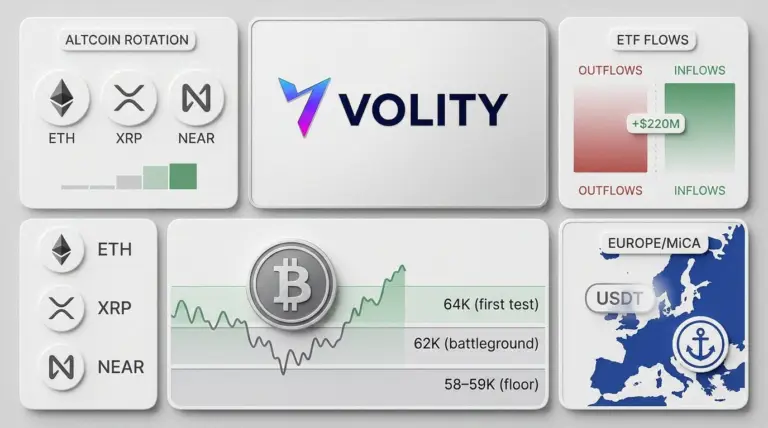
Wednesday, November 18, 2026. Crypto markets are facing a hard test of conviction. Bitcoin remains below $65,000, exchange-traded funds are shedding assets, and large holders are moving coins towards exchanges.
Meanwhile, fresh wallet and DeFi breaches have made security a market issue rather than a technical afterthought. Investors are reducing risk just as banks and payment companies build new crypto settlement systems.
Bitcoin loses its institutional cushion
US spot Bitcoin ETFs recorded $239.9 million in net outflows on November 17. BlackRock’s iShares Bitcoin Trust, IBIT, accounted for roughly $209.5 million of that figure.
November ETF withdrawals have reached about $2.58 billion. Ether funds have also suffered persistent redemptions, leaving little room for buyers to absorb sudden selling.
Large Bitcoin holders reportedly transferred around $540 million of BTC to exchanges. Such movements do not guarantee sales, yet they increase immediately tradable supply.
That signal matters more when prices sit near contested support. Bitcoin has repeatedly failed to establish a durable foothold above $65,000.
Buyers who entered near $80,000 now face losses of about 19%, according to Bitfinex analysis. Many came through regulated products, rather than offshore exchanges or private wallets.
The ETF route gave institutions simpler exposure. It also gave them a fast route out when portfolio managers wanted less volatility.
Still, institutional demand has not disappeared. Third-quarter filings showed substantial crypto holdings among banks, asset managers and sovereign-linked investors.
Tudor Investment nearly doubled its IBIT position to about $65 million. Goldman Sachs reported roughly $1.28 billion in Bitcoin ETF holdings and increased Ether exposure.
Those positions suggest strategic interest remains intact. Yet long-term interest does not force investors to defend every price level.
- Bitcoin: Below $65,000 after failing to regain momentum.
- Bitcoin ETF flows: $239.9 million left US spot funds on November 17.
- IBIT: BlackRock’s fund saw about $209.5 million in daily outflows.
- Whale transfers: About $540 million in BTC reportedly moved towards exchanges.
Security failures add to selling pressure
Crypto’s security headlines brought another layer of caution. Etherscan warned users following an attempted breach involving Freshworks, its customer-support software provider.
Attackers increasingly target support teams, vendors and account-recovery processes. They do not always need to break a blockchain’s cryptography.
Two DeFi exploits involving K3 Capital and Reental reportedly caused losses near $3.9 million. Curve Finance’s fee burner also suffered an attack, with about $38,200 stolen.
Paytaca, a Bitcoin Cash wallet, reported two cyberattacks within 48 hours. In Dubai, two users said they lost roughly $604,000 amid concerns around Ledger hardware-wallet tampering.
Each incident looks modest beside Bitcoin’s market value. Together, they remind traders that custody risks extend far beyond a lost seed phrase.
Browser extensions, support tickets, signing devices and deployment tools can all become entry points. Poor operational controls can turn a small breach into a costly liquidation.
Trust Wallet’s chief executive also warned banks about autonomous AI-led attacks. Automated systems can scan targets, imitate staff and generate convincing phishing messages at unusual speed.
Hong Kong’s central bank is exploring agentic AI for anti-money-laundering work. The same technology may sharpen defences, while giving criminals more efficient tools.
Stablecoins enter the payment machinery
Crypto prices may be sliding, but stablecoin infrastructure continues to spread through conventional finance. Visa plans to let eligible Asia-Pacific clients prefund cross-border Visa Direct payouts with stablecoins.
Recipients would still receive local fiat currency. Businesses could gain faster settlement without asking customers to hold volatile digital assets.
Visa is testing the arrangement with Singapore-based dtcpay. The company is also expanding its Agentic Ready programme for payments initiated by AI agents.
More than 100 card issuers across Asia-Pacific participate in that broader programme. The effort points to payments that run continuously, even when banks do not.
DBS Bank and Circle are moving towards round-the-clock USDC settlement in Asia. Hong Kong and SWIFT are also studying tokenised-deposit payments.
Monument Bank has launched a tokenised-deposit initiative targeting £250 million. These projects favour regulated settlement systems, rather than the freewheeling token launches of earlier cycles.
The customer may only see a card payment or local-currency transfer. Underneath, stablecoins could provide liquidity between banks, payment firms and foreign-exchange providers.
Tokenisation expands, but frictions remain
Regulators are steadily drawing crypto closer to mainstream market rules. Russia expects its first crypto investment funds from 2027 as its central bank considers a new framework.
In the United States, the Commodity Futures Trading Commission will discuss tokenisation, margin and round-the-clock trading on December 15.
Exchanges are moving quickly ahead of final rulebooks. Binance plans a US stock-options trading API, while Coinbase now offers Morpho-backed loans in all 50 states.
Binance Wallet is also running a tokenised-stock campaign linked to a possible Anthropic initial public offering. Such wrappers may widen access, though ownership rights remain the harder question.
MEXC closed its Visa-linked crypto card less than three months after launch. The exchange cited restrictions associated with US financial-crime rules.
JPYC, Japan’s yen stablecoin issuer, extended an application outage without a restoration date. The episode offered an awkward reminder about always-on finance.
Markets can trade at any hour. Systems, compliance teams and customer support still have limits.
Altcoins struggle to find firmer ground
Bitcoin’s weakness has spread through much of the altcoin market. XRP briefly slipped below $1 before recovering, as Ripple advanced lending plans.
BNB remains below $600, while PEPE has lost almost 30% in a week. A broad group of tokens now trades more than 50% below recent highs.
TRX has held above $0.30 during the decline. NEAR has drawn buyers after a sharp rebound, although thin markets can exaggerate such moves.
Zcash has also attracted speculation around a potential move towards $1,000. That target remains distant, particularly while Bitcoin struggles to attract steady bids.
Monero provided a rare constructive development after its FCMP++ upgrade cleared a zkSecurity audit without major findings. Injective released a new white paper following the first US INJ ETF launch.
For traders, the immediate checklist remains short. Watch ETF flows, exchange deposits and Bitcoin’s response around $65,000.
Until those signals improve, rallies may reflect short-covering rather than durable demand. Smaller positions and stricter custody checks look wiser than heroic dip-buying.
The industry’s plumbing keeps expanding beneath a bruised market. Yet builders can work through a downturn while token prices continue to fall.
Related coverage on Volity
- How to Avoid Crypto Scams: A Beginner Safety Checklist
- How to Choose a Trading Platform: A 10-Point Checklist
- Demo vs Live Trading Account: A 7-Step Checklist Before You Go Live
- How to Size a Trade: Position Sizing and Risk Per Trade for Beginners
- Risk-Reward Ratio Explained: How to Set It and Why It Matters
- ETF vs Index Fund: The Difference and Which to Pick