Crypto’s $60,000 rebound meets a harsher reality
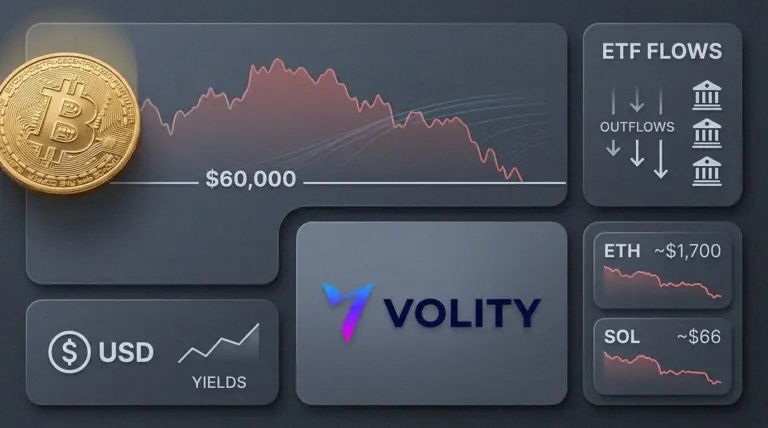
Sunday, November 22, 2026 – Bitcoin’s weekend rebound above $60,000 has steadied nerves, but it has not repaired a battered crypto market.
ETF withdrawals, corporate sales and a $12 million cross-chain theft have kept risk firmly in view. Traders saw relief after a brutal washout. They did not see much evidence of renewed conviction.
Bitcoin bounces as leverage burns
Bitcoin fell to roughly $55,100 during the weekend, its weakest price since 2024. It then climbed more than 9%, briefly restoring the $60,000 level.
The move followed thin weekend trading and a wave of derivatives liquidations. Leveraged positions amplified each decline, while forced sales pushed prices through obvious support levels.
Macro anxiety also weighed on the market. Uncertainty around Federal Reserve policy coincided with weakness in artificial-intelligence shares and other speculative assets.
Yet the rebound did not arrive alongside broad institutional buying. Bitcoin and Ether exchange-traded funds lost a reported $1.47 billion during the November 16 to 20 week.
That figure matters because ETFs have become crypto’s most visible channel for professional demand. When fund holders withdraw cash, spot-market buyers must absorb the additional supply.
Bitcoin now faces a simple test. Buyers must turn $60,000 into durable support without relying on borrowed money and short-covering.
If the level fails quickly, traders may revisit the $55,000 area. If flows improve, however, the weekend low could become an important reference point.
Altcoins find selective buyers
Solana showed more resilience than several large-cap rivals. SOL rebounded towards $70 after its ETF products ended a six-week stretch of outflows.
Still, that improvement followed erratic fund activity. Earlier inflows had faded quickly, suggesting investors remain tactical rather than committed.
XRP has faced a less forgiving backdrop. Its ETFs recorded reported November outflows of $30.8 million as the token traded below $0.90.
ETF listings can widen access, but they also make selling easier during a risk-off spell. Regulated wrappers do not guarantee a permanent bid.
Elsewhere, Pi Network rebounded and VVV gained about 20% during weekend trading. Such moves can be eye-catching, although they say little about wider demand.
Altcoins usually need a stable Bitcoin before their rallies become durable. For now, many buyers appear willing to trade weakness but unwilling to chase it.
Chainflip’s costly bargain
Security risk delivered the weekend’s clearest warning. Cross-chain swap network Chainflip said an attacker removed about $12 million from its vaults.
The reported haul included 122.86 Bitcoin, 520.22 Ether, $3.25 million in USDC and 758,141 USDT. Chainflip linked the breach to a suspected compromised signing key.
The protocol entered full Safe Mode, halting deposits, withdrawals, swaps and quotes. Its FLIP token fell roughly 42.9% in 24 hours.
Chainflip offered the attacker an unusual deal. Return 90% of the assets by 18:38 UTC on November 23, and keep 10%.
At the reported loss value, the bounty would amount to about $1.2 million. The project said it would withdraw law-enforcement complaints if the terms were met.
The offer may prove commercially sensible, especially if it restores user funds quickly. Yet it exposes the uncomfortable arithmetic behind decentralised finance.
A single compromised key can turn fast, global settlement into fast, global extraction. Users now await a technical post-mortem and details on compensation.
Compliance becomes a trading issue
Regulatory changes increasingly affect how traders move assets, not just how exchanges market them. Upbit and Bithumb suspended CYBER transfers amid a suspected bridge exploit.
Meanwhile, Coins.ph halted transfers to self-custody wallets under Travel Rule requirements. The decision highlights the growing overlap between compliance systems and daily crypto activity.
Hong Kong is advancing licensing rules for virtual-asset dealers, advisers, asset managers and custodians. Officials also proposed prison penalties for false claims about crypto licences.
Europe is moving in a different, though related, direction. The European Central Bank seeks partners for tests involving tokenised deposits and securities.
That work favours blockchain systems built for settlement, custody and regulated market infrastructure. It offers less comfort to tokens dependent on retail speculation.
Corporate holders split on bitcoin
Corporate treasury activity has added to the market’s tension. Bitdeer sold 281.1 Bitcoin, leaving its reported Bitcoin holdings at zero.
Public companies collectively sold more than 108,000 Bitcoin during 2026, according to the latest market roundup. Some sales reflect operating needs, especially among miners.
Others may signal reduced appetite for balance-sheet volatility. By contrast, Michael Saylor indicated that Strategy could buy more Bitcoin after the sell-off.
The contrast is useful for investors. A miner selling to pay bills differs sharply from a treasury company abandoning a long-term strategy.
Levels to watch
- Bitcoin: $60,000 must hold before traders can treat the recovery as more than a reflex bounce.
- Support: Roughly $55,100 marks the weekend low and the nearest major downside reference point.
- ETF flows: Fresh daily data will show whether institutional withdrawals have begun to slow.
- Chainflip: The November 23 deadline may determine whether users recover most of the stolen funds.
Crypto has moved off its lows, but the market remains fragile. The next few sessions will show whether Bitcoin found a floor or merely paused on the way down.
Related coverage on Volity
- How to Avoid Crypto Scams: A Beginner Safety Checklist
- How to Choose a Trading Platform: A 10-Point Checklist
- Demo vs Live Trading Account: A 7-Step Checklist Before You Go Live
- How to Size a Trade: Position Sizing and Risk Per Trade for Beginners
- Risk-Reward Ratio Explained: How to Set It and Why It Matters
- ETF vs Index Fund: The Difference and Which to Pick