A CFD broker gives you access to Contracts for Difference, which let you trade rising and falling prices on forex, shares, indices, crypto, and commodities with leverage, without owning the underlying asset. The right CFD broker is regulated, prices tightly, executes fast, and tells you the full cost before you fund. Volity does all four across 10,000+ instruments on the Volity MT platform.
What is a CFD broker?
A CFD broker is the provider that lets you open a Contract for Difference, an agreement to exchange the change in an asset’s price between the moment you open a position and the moment you close it. In a broker CFD relationship you never own the share, the coin, or the barrel of oil. You trade the price movement instead. A CFD trading broker gives you what a plain investing app cannot: you can go short as easily as long, use leverage so a small deposit controls a larger position, and trade many asset classes from one account instead of opening a separate service for each.
Because a CFD is a leveraged product, the broker matters more here than with ordinary share dealing. Fair pricing, fast fills, protected client funds, and honest fee disclosure are what separate a serious CFD broker from a flashy sign-up screen. Get those right and the rest is detail.
What does CFD trading actually mean?
The CFD trading meaning comes down to one idea: you are speculating on price, not buying an asset. That changes how you trade in two ways.
- You can trade in both directions. If you think a market will fall, you can short a CFD and profit from the drop, which you cannot do by simply buying shares.
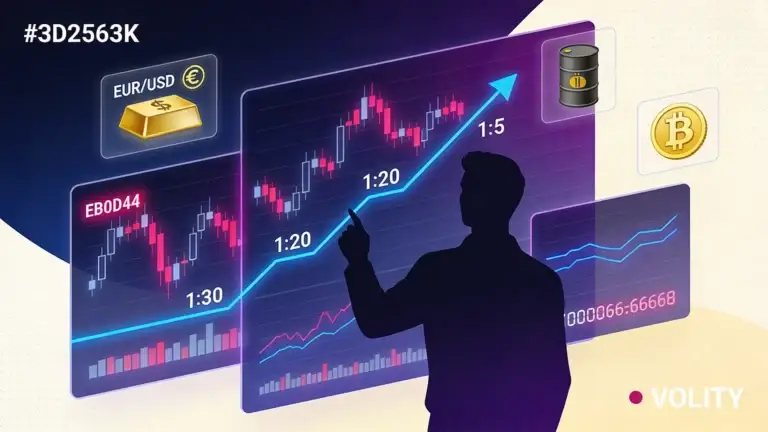
- You trade on leverage. You post margin, a fraction of the full position value, rather than the whole amount. Volity offers up to 1:500 on selected forex pairs, 1:100 on commodities, and 1:50 on crypto. Leverage magnifies your profit and your loss in equal measure, so it asks for discipline.
That combination is why active traders like CFDs: one account that works in both directions, with size you can scale across markets. The trade-off is the spread on every trade and overnight financing on leveraged positions held past 22:00 GMT.
A worked CFD trading example
Here is a simple CFD trading example. Say gold trades at 2,400 and you open a long CFD on 10 ounces. If gold rises to 2,430, your position gains 300 before costs, that is 30 points times 10. If gold falls to 2,370 instead, you lose 300. Because leverage let you post only a fraction of the 24,000 position value as margin, both the gain and the loss are large next to your deposit. That is the mechanism in one paragraph: leverage works exactly as hard against you as it does for you, which is why a stop-loss on every trade is standard practice rather than an optional extra.

How is a CFD broker different from a stock broker?
A stock broker sells you the asset. You buy shares, you own them, and you profit if the price rises or the company pays a dividend. A CFD broker sells you exposure to the price. You never own the share, you can trade it long or short, and you use leverage, posting margin instead of the full value. In practice a CFD broker lets you profit from falling markets and trade with less capital up front, while you pay overnight financing on positions held past 22:00 GMT and your losses are amplified by the same leverage that amplifies gains. Neither model is better in the abstract. They suit different goals, and plenty of traders use both, holding long-term positions while trading shorter moves with CFDs.
What should you look for in a CFD broker?
Whether you want the best broker for CFD trading in general or specifically a UK CFD broker, the checklist is the same. These criteria decide the best broker CFD trading experience, and the best CFD trading platform UK traders should shortlist.
| What to check | Why it matters | What Volity offers |
| Regulation | A regulated broker must segregate client funds and follow conduct rules. | Execution regulated by CySEC under UBK Markets, licence 186/12, with client funds held in segregated accounts under trustee arrangements. |
| Spreads and fees | The spread is your cost on every CFD, and overnight swap adds up on multi-day trades. | Spreads from 0.6 pips, a commission-free Markets account, and the full schedule set out on the charges and fees page. |
| Execution | Requotes and slippage cost you the price you clicked. | 99.6% of trades filled in under one second, 100% execution rate, and strictly no requotes. |
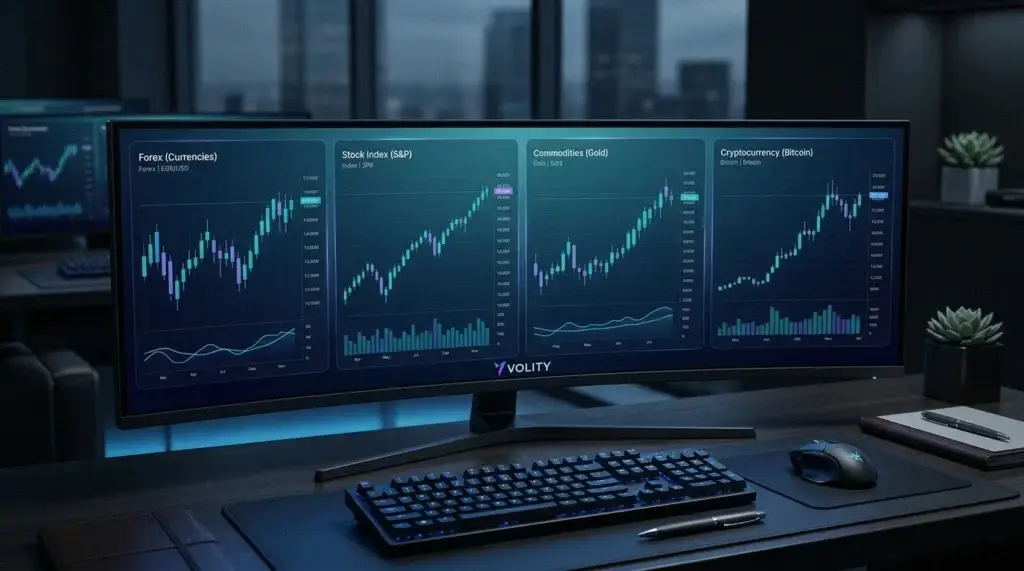
| Market range | A narrow broker forces you into a second account for other assets. | 10,000+ instruments across forex, shares, indices, crypto, and commodities. |
| Risk controls | Leverage can drain an account fast without guardrails. | Negative balance protection, stop-loss, take-profit, and trailing stops. |
Is CFD trading halal?
Whether CFD trading is halal is a question individual scholars answer differently, and it depends on how the account is structured. A common concern is riba, or interest, which shows up in the overnight swap charged on positions held past 22:00 GMT. A swap-free Islamic account removes that overnight interest, which is why Volity offers a swap-free structure under its standard terms. If you need a Sharia-compliant setup, review the specific account conditions and, where it helps, seek guidance from a qualified scholar before you trade.
What is a CFD on platforms like Trading 212?
If you have wondered what a CFD is in Trading 212, the answer clears up a common point of confusion. On platforms that split their offering, such as Trading 212, “Invest” and “CFD” are two different products. The Invest account buys real shares that you own. The CFD account is the leveraged product: you trade the price movement, you can go long or short, and you post margin rather than the full value. The same distinction runs across the industry. Owning a share and trading a share CFD are different activities, with different risks and different tax treatment depending on where you live.
Volity focuses on the CFD side, giving you leveraged, two-way access to thousands of markets from one account, with the money-movement layer built in.
CFD trading for beginners: how to start on Volity
CFD trading for beginners works best when you learn the mechanics before you risk money. Here is a sensible order:
- Open a free Volity wallet with your email. Holding it costs nothing.
- Start on the free, unlimited demo. Place practice CFD trades with a stop-loss on each.
- Complete KYC when you are ready for live trading, then fund with card, SEPA, or crypto.
- Trade the smallest sensible size at first, and scale up only as your results justify it.
Learn the concept first on the advantages of CFD trading guide, then open a CFD account and practise on the demo before you go live.
What are the risks of trading with a CFD broker?
CFDs are leveraged products with a high risk of loss, and being straight about that is part of choosing a broker well. Three risks stand out.
- Leverage can wipe your margin on a small adverse move, the same force that can multiply a gain. Position sizing is your main defence, which is why the FCA and ESMA treat retail leverage as high-risk and restrict how it is sold.
- Overnight costs eat into multi-day trades. Swap on positions held past 22:00 GMT reflects the interest rate backdrop, so factor it into any longer hold.
- Gapping and volatility can jump a price through your level. Negative balance protection means you cannot lose more than you deposit, but you can still lose the full amount you put at risk, and IOSCO has documented how often retail traders lose on leveraged products.
A good CFD broker gives you the tools to manage all three: stop-loss, take-profit, and trailing stops, margin shown before every order, and negative balance protection as a backstop. The tools only help if you use them, so build a plan, cap your risk per trade, and treat leverage with respect.
Frequently asked questions
Is Volity a regulated CFD broker?
Volity’s trading execution is regulated by CySEC under UBK Markets, licence 186/12, with client funds held in segregated accounts under trustee arrangements. Volity is more than a CFD broker, though. It is an all-in-one money hub whose trading layer gives you everything a strong CFD broker provides, alongside a multi-currency wallet and free money movement.
How much does a CFD broker cost?
Most of the cost is the spread, plus overnight swap on leveraged positions held past 22:00 GMT, and any funding or conversion charge. Volity keeps spreads from 0.6 pips, the Markets account commission-free, the wallet free, and currency conversion at 1%. The full schedule is published, so your total cost is clear before you fund.
Is CFD trading for beginners a good idea?
CFDs are leveraged, so they carry a high risk of loss and are not a casual product. Beginners can approach them sensibly by starting on a free demo, learning to attach stop-losses, and trading small when they go live. The chance to trade in both directions is real, and so is the risk, so risk management comes first.
Can I try a CFD broker for free?
Yes. Volity offers a free, unlimited demo that mirrors the live CFD environment, with real spreads and real execution against virtual capital. It is the best way to test a CFD broker before you commit any money, and you can keep it open alongside your live account to try new strategies.