Investing in financial products involves risk. Losses may exceed the value of your original investment.
Arthur hayes bitcoin is a core topic for traders in 2026. The complete guide follows.
Arthur Hayes: Fed Liquidity, “QE in Disguise,” and the $200K Bitcoin Map
BitMEX co-founder and Maelstrom CIO Arthur Hayes is revving up his predictions. In his recent essay “Love Language” and interviews, he evaluates the Federal Reserve’s new initiative. Specifically, he examines Reserve Management Purchases (RMP). He brands it as “QE in disguise.”According to him, the RMP is technically framed as “liquidity management.” Yet practically, the Fed is purchasing around $40 billion in treasuries each month. Consequently, this expands its balance sheet. Moreover, it injects fuel into the markets.Hayes Outlines Key Predictions
By the end of 2025: He expects Bitcoin to languish between $80,000 and $100,000. This applies as long as the market perceives RMP as not true monetary easing.Once investors equate RMP with QE: BTC could swiftly reclaim $124,000. Then, it could target $200,000.Looking further ahead: Hayes hints at a $500,000 potential by the end of 2026. This requires global liquidity and political cycles to align favorably towards risk.For traders, this isn’t just hyperbole. It’s a scenario rooted in liquidity cycles. Consider holding long positions in BTC. Additionally, look at quality DeFi projects. Do this against a backdrop of increasing hidden monetary supply. However, remain prepared to endure a prolonged range. This lasts until perceptions of RMP change.Macro: Japan and the Fed Break the Old Liquidity Map
On the other side of the globe, developments are significant. The Bank of Japan has lifted its rate to 0.75%. This prompts markets to recall something important. Cheap yen carry has long been a cornerstone of global financing. A stronger yen threatens the low-cost dollar liquidity. Consequently, this puts high-risk assets under strain. Bitcoin is included.In the US, aside from RMP discussions, key investors and officials are signaling something. The era of “hard QT at any cost” is winding down. Why? Because economic and geopolitical priorities necessitate new trillions.For the crypto market, this creates a complex mix. Rising money supply and yield-seeking behavior buoy BTC. They also support top altcoins. However, any misstep on interest rates could trigger consequences. Specifically, a classic late-cycle shakeout might occur.Regulatory Front: Digital Euro, Pro-Crypto CFTC, and Pressure on Coinbase
Digital Euro: Europe Sketches Outlines
EU governments have finalized their common stance on the digital euro. Effectively, they’re giving a green light to the retail CBDC project. While design details remain pending, the direction is clear:First: Strengthening control over the payment infrastructure in the eurozone.Second: Competing for the transactional layer against private stablecoins.Third: Simultaneously tightening KYC/AML requirements for crypto platforms.This suggests a long game for the market. CBDCs typically do not eliminate crypto. Rather, they build a tighter regulatory perimeter around on-/off-ramps.USA: CFTC Shifts Towards Crypto-Friendly Leadership
The US Senate has approved Michael Selig as the 15th Chairman of the CFTC. He’s a figure known for being a pro-crypto lawyer and regulator. This boosts prospects for clearer rules. Specifically, this applies to derivatives and DeFi representations. Additionally, it could legalize aspects of prediction markets under CFTC oversight.However, on the other side, Coinbase faces a setback in Europe. The Irish regulator has issued the exchange a €21.5 million fine. This stems from its “ineffective” transaction monitoring. Additionally, AML controls were insufficient. Meanwhile, Coinbase finds itself embroiled in a dispute. This concerns jurisdiction in prediction markets and derivatives oversight.In summary, institutional advantages exist. These come from crypto-friendly CFTC leadership. However, they contrast with tightening regulations. Specifically, these affect centralized “gates” into the crypto economy.Institutions Are Digging Deeper: BlackRock, ICE, and Crypto Infrastructure
Amid the institutional tide, two notable stories emerge:BlackRock is posting several job openings. These are in crypto divisions across the US, Europe, and Asia. They’re expanding teams for digital asset products. Additionally, they’re building infrastructure capabilities.ICE, owner of the New York Stock Exchange, contemplates something significant. It’s considering a stake of up to $5 billion in MoonPay. MoonPay provides payments and on-ramp infrastructure for crypto products.Both moves reflect a clear intention. Major players aim to control access layers. These include custody, payments, and derivatives. The retail entry point is likely to gradually shift. It’s moving from the “wild” CEXs of 2017. Instead, it’s heading to the financial superstores on Wall Street.Retail Stories and Niches: From Solo Mining to Privacy
Solo Miner and Block Worth $271K
Network statistics have revealed yet another “lottery” tale. A lone Bitcoin miner struck gold. They located a block. Moreover, they claimed a reward of approximately $271,000. This includes subsidies and fees.Although the odds are astronomically low for smaller players, the psychological effect is immense. It reminds everyone of something important. Even amidst industrial farms, retail miners can still score a lucky shot.Zcash: Privacy Makes a Comeback
Zcash’s price surged amid rising demand. Specifically, demand for shielded coins increased. Additionally, renewed interest in privacy emerged. For years, ZEC has been viewed as a “crypto veteran without a driver.” However, increased regulatory scrutiny changed things. Demand for anonymity grew. Consequently, private transactions are back in the spotlight. They serve as a hedge against pervasive tracking.Investors must tread carefully. Enhanced privacy prompts greater regulatory scrutiny. Additionally, delisting risks exist. This requires a cool-headed approach towards jurisdictions. Moreover, liquidity considerations matter.NFT and Art: Quiet Recovery
Despite the media silence, the NFT market is stirring. Sales surged around 12% to $67.7 million. Additionally, Ethereum volumes spiked 45%. Simultaneously, the Tezos art ecosystem reports something encouraging. Rising institutional interest is evident. Moreover, increased artist participation is heading into 2025.This isn’t a return to the frenzy of 2021. Rather, it represents the development of a more resilient layer. Specifically, a professional layer of digital art is emerging. There’s less speculative activity. Instead, there are more long-term collaborations. These involve museums, foundations, and brands.XRP and the Alt Market: ETF, Staking, and Delayed Season
The narrative surrounding XRP is complex. It’s a tangled web of contradictions:Spot and other XRP ETFs have seen over $60 million AUM. Institutional interest is growing. However, the token’s price faces corrections.Some investors are shifting into high-yield staking sectors. Certain platforms report returns of up to $5,000 per day. This is a typical sign of overheating. Additionally, it indicates rising counterparty risks.The spot price of XRP flickers between breaking down $2 and bullish patterns. Analysts debate whether the token will hold key levels. Alternatively, it might deepen its correction.Broader altcoin performance presents challenges. Many tokens linger below the 200-day SMA. Meanwhile, Bitcoin’s share of total market capitalization rises. The anticipated “alt season” appears postponed. Capital is cautiously shifting towards quality assets. These include SOL, ETH, and infrastructure tokens. Additionally, select DeFi beneficiaries are seeing institutional backing.Practical Guidance: How Traders and Investors Should Read the Market
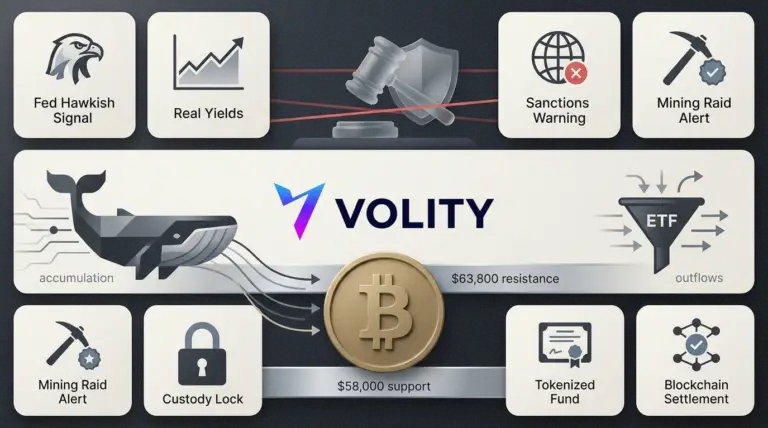
Monitor RMP programs. Also watch BoJ decisions and Fed rhetoric. These set the corridor for BTC at $80,000-$100,000. Additionally, they indicate the potential surge towards $124,000. Hayes envisions this scenario.Utilize futures and perpetual contracts as a hedging tool. Use them for leveraged positions. However, don’t view them as a “highway to profits” late in the cycle. Why? Because late-cycle shakeouts primarily hit over-leveraged traders first.
2. Separate Infrastructure from Speculative Layers
Interest from BlackRock and ICE signals a bet on infrastructure. This includes custody, on-ramp, and payments. Long-term capital is better placed in assets central to this infrastructure.Aggressive plays like exotic staking yielding “$5,000 per day” should be viewed differently. Treat them as high-risk options. They’re not reliable “passive income.”3. Account for Regulatory Landscapes Across Jurisdictions
The digital euro and pro-crypto CFTC are simultaneously tightening on-ramps. At the same time, they’re unveiling clearer rules for derivatives.Coinbase’s AML fine in Ireland and disputes over prediction markets illustrate something. Even “white” giants face scrutiny. Therefore, diversify exchanges and custody solutions.4. Don’t Underestimate “Old” Narratives
Privacy (Zcash), digital art (Tezos, Ethereum-NFTs), and solo mining aren’t relics. These niches could thrive under new regulatory and macro landscapes.However, entering these stories demands acute awareness. Specifically, consider liquidity, listings, and legal risks in specific jurisdictions.The Key Takeaway
Ultimately, the key takeaway from the current cycle is clear. The market is shifting. It’s moving from an era of “tokens for the sake of tokens.” Instead, it’s moving to one governed by infrastructure and macro dynamics. Where once hype ruled the day, survival now depends on different skills.Success requires interpreting central bank balances. Additionally, it means understanding regulatory releases. Furthermore, Wall Street’s product plans matter. These insights are as valuable as meme-trading strategies on Crypto Twitter.Volity: Powering Your Global Financial Ambitions
Modern finance demands infrastructure that operates seamlessly across borders. Volity delivers one unified account for comprehensive global access. You can invest, hold, and pay internationally with complete confidence. It’s an innovative financial platform engineered for borderless opportunity.Volity champions regulatory excellence and cutting-edge functionality. These pillars enable effortless participation in international markets. Moreover, Volity transforms intricate cross-border operations into streamlined experiences. The platform provides complete financial command with sophistication and ease. With Volity, borderless finance becomes powerful, accessible, and secure for visionary users worldwide.For more on this topic see our deep-dives on Bitcoin Reacts to Fed Politics as NFT Sales Slide: Reading Crypto Sentiment, Crypto ETFs, Meme Coin Volatility and Bitcoin Drawdowns Explained, and Bitcoin Price, ETF Flows and the CLARITY Act: Crypto Volatility Drivers.
What our analysts watch: Three macro reads anchor the Hayes thesis on the Volity desk. The Fed balance-sheet trajectory, where weekly H.4.1 release data is the cleanest record of how fast reserves are actually expanding versus the official narrative. The Treasury bill issuance mix, since heavy bill issuance combined with RMP buying compresses term premia and frees risk capital toward longer-duration assets including crypto. And the dollar index, where a softening dollar amplifies the BTC re-rating mechanically because crypto is dollar-denominated. The Bank of England H.4.1 release publishes balance-sheet detail every Thursday, the Bank for International Settlements working papers on global liquidity transmission frame the spillover mechanic, and the CoinDesk coverage of Hayes essays and ETF flow data track the narrative in real time. Volity offers BTC, ETH, and major altcoin CFD access under CySEC oversight via UBK Markets (licence 186/12).
Related coverage on Volity
- How to Avoid Crypto Scams: A Beginner Safety Checklist
- How to Choose a Trading Platform: A 10-Point Checklist
- Demo vs Live Trading Account: A 7-Step Checklist Before You Go Live
- How to Size a Trade: Position Sizing and Risk Per Trade for Beginners
- Risk-Reward Ratio Explained: How to Set It and Why It Matters
- ETF vs Index Fund: The Difference and Which to Pick
Frequently asked questions
What separates RMP from formal quantitative easing?
Quantitative easing is announced as a policy stance designed to compress long-term yields and stimulate aggregate demand. Reserve Management Purchases are framed as a technical operation to maintain ample reserves in the banking system. The mechanical effect on bank reserves is similar; the political and signalling effects differ, which is why the market debates whether to price the operation as easing or as plumbing.
Why does Bitcoin respond to balance-sheet operations at all?
Bitcoin is a long-duration risk asset with no cash flow, which makes its present value highly sensitive to the discount rate and to the supply of dollar liquidity. Rising reserves loosens the financing constraint on speculative positioning across the risk spectrum, and a meaningful fraction of the marginal flow finds its way into crypto allocations.
What invalidates the Hayes path to $200K and beyond?
A reversal in the Fed posture is the cleanest single invalidator. If RMP is wound down, balance-sheet runoff resumes, or guidance turns hawkish around persistent inflation, the discount-rate compression that underwrites the long-duration crypto trade reverses. A second invalidator is regulatory action that fragments the spot ETF wrapper market and impairs the demand backstop that has absorbed post-halving issuance.
How should a retail allocator size around macro-driven crypto theses?
Size the position to survive a 50 percent intra-thesis drawdown without forced selling. Macro theses on crypto are typically right in direction and wrong in path, which means the trader who is correct on the destination but ruined by the path captures none of the return. Sizing through the worst plausible drawdown rather than the most likely outcome is the single largest determinant of whether the thesis pays.
Volity operates a trading platform and also publishes educational and analytical content about trading. The content on this page is for educational purposes only and should not be considered financial advice. Volity may benefit commercially when readers open trading accounts through links on this site.
Our content is produced and reviewed under documented editorial standards; see our comparison and review methodology.