Investing in financial products involves risk. Losses may exceed the value of your original investment.
Quick answer
Bitcoin held the $81,000 level as institutional ETF inflows tested the market against Fed policy uncertainty and renewed regulatory scrutiny. Spot Bitcoin ETFs continued absorbing supply, with cumulative inflows providing structural demand. Trader focus turned to the next FOMC decision, the Treasury debt ceiling, and crypto-specific bills moving through Congress.
Crypto markets hold steady as institutions test the weather
Crypto markets entered May with a familiar contradiction. Prices look calm, yet the machinery underneath keeps moving hard.
Bitcoin traded near $81,000, helped by steady money into exchange-traded funds. However, strong labour data and firmer Federal Reserve language kept traders from declaring victory. The market has buyers, but it no longer gets free liquidity on demand.
That tension now defines the week. Institutional investors want regulated exposure. Meanwhile, policymakers want cleaner rules, taxable gains and fewer awkward surprises. Crypto is not outside finance anymore. It is being dragged into the same room as everything else.
Bitcoin steadies near $81,000
Bitcoin’s recovery to roughly $81,000 has not felt like an old-style melt-up. Instead, it has moved in clips, with ETF desks and macro traders steering the tape.
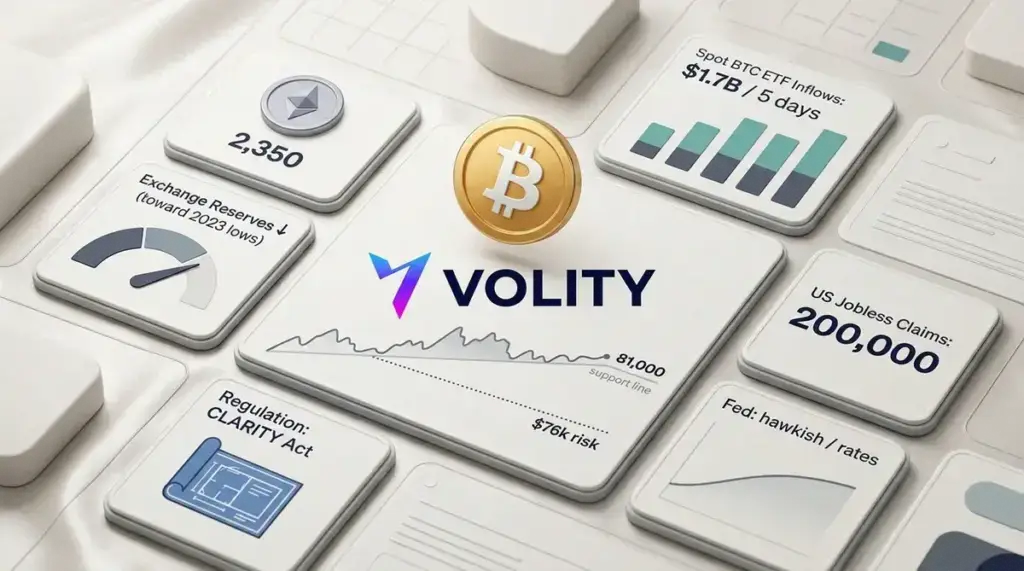
Spot Bitcoin funds drew about $1.7 billion across a five-day inflow streak. Earlier flows showed roughly $350 million in net buying. The bid looks less like retail heat and more like portfolio allocation.
Still, the macro backdrop remains awkward. US jobless claims came in at 200,000, showing a labour market with little visible slack. Meanwhile, Federal Reserve officials have pushed back against quick rate-cut hopes.
That matters because Bitcoin now trades like a high-beta macro asset at stressful moments. When yields rise, the coin usually feels it. However, when ETF flows keep coming, sellers struggle to press their advantage.
Exchange reserves have also fallen toward 2023 lows. That suggests more holders are moving Bitcoin into custody or cold storage. In plain trading terms, less available supply can sharpen both rallies and sell-offs.
The important zone remains simple. Above $81,000, bulls can argue that institutions are defending the market. Below $76,000, the May bounce starts to look less convincing.
Ethereum waits for its own catalyst
Ethereum traded near $2,350, holding its ground but trailing Bitcoin’s confidence. ETH gained about 2 per cent over the week, though the move lacked urgency.
For now, Ethereum still needs a catalyst that does not begin with Bitcoin. Institutional interest remains steady, but investors want proof that network costs and speed can improve further.
Two 2026 upgrades sit on the horizon. Glamsterdam, expected in the first half, aims to improve Layer 2 scaling and rollup costs. Hegotá, expected later in the year, targets transaction parallelisation and higher throughput.
Those upgrades matter because Ethereum’s biggest rival is often its own friction. Developers still like the ecosystem. However, users remember expensive gas fees with unusual clarity.
If the roadmap holds, Ethereum can make a cleaner case to institutions. Until then, ETH remains in a waiting trade, not a leadership trade.
Altcoins split by clarity and appetite
The wider token market showed a sharper divide. Coins with a clear story attracted capital. Others drifted, especially where regulation or liquidity looked thin.
Toncoin stood out after a rally of more than 100 per cent. Demand appeared tied to privacy features and broader interest in the TON ecosystem. Still, such a move demands caution, not applause.
Solana, trading around the $100 area, kept drawing attention from fast-money accounts. Its role in meme coins remains a strange advantage. Meanwhile, developers still prize its speed and low transaction costs.
XRP struggled to clear the $1.45 area. Ripple’s planned settlement tests with JPMorgan and Mastercard could help its case. However, the chart still shows sellers meeting strength.
Dogecoin remained trapped in a narrow band near $0.10. That makes it useful, if not elegant. When DOGE wakes up, retail risk appetite usually follows.
Regulation moves from argument to engineering
The policy story has also changed. Washington is no longer asking whether crypto should exist. It is asking who supervises it, taxes it and sells it.
Senator Tim Scott has targeted May for markup votes on the CLARITY Act. The bill would draw firmer lines between the SEC and the CFTC. It could reduce one of crypto’s longest-running sources of legal fog.
Senator Kirsten Gillibrand has said she expects the framework to pass in 2026. Investors will watch every committee signal because regulatory clarity can alter valuations quickly.
Yet the industry remains divided. Arthur Hayes, the BitMEX founder, criticised the CLARITY Act at the Consensus conference in Miami. He argued that heavy regulation risks smothering innovation.
That split is not cosmetic. One camp wants Wall Street-grade rules. Another fears Wall Street-grade capture. Markets normally prefer clarity, but crypto culture still resists the leash.
Meanwhile, South Korea is moving toward a 22 per cent crypto tax in 2027. Switzerland’s AMINA bank has brought Canton Coin into regulated finance. BNY Mellon is also expanding custody ambitions in Abu Dhabi.
Each move looks technical on its own. Together, they show a sector leaving adolescence. The process is profitable for some firms and deeply uncomfortable for others.
Institutions build the rails
The week’s quieter news may prove more durable than the price action. CME Group’s addition of Avalanche and Sui futures gives professional traders more hedging tools.
That matters for mid-cap tokens. Futures markets add discipline, leverage and short interest. However, they also invite larger capital pools that previously could not trade cleanly.
Grayscale’s fund rebalancing, adding ENA and removing AERO, also showed a more mature pattern. Asset managers now rotate through crypto exposures as they would through equities or credit.
This shift does not make crypto safe. Instead, it makes crypto investable for institutions with committees, risk limits and compliance officers. That is a dull sentence, but a major market change.
By the numbers
- $81,000: Bitcoin’s key near-term level for bulls to defend.
- $1.7 billion: Approximate Bitcoin ETF inflows across a five-day streak.
- 200,000: Latest US jobless claims, keeping Fed caution alive.
- $2,350: Ethereum’s recent trading area as it waits for stronger momentum.
- 22 per cent: South Korea’s planned crypto tax rate for 2027.
What traders should watch
- Bitcoin support: A break below $76,000 would weaken the May recovery.
- ETF flows: Persistent inflows can offset hawkish macro pressure, at least briefly.
- Fed language: Strong labour data keeps rate-cut hopes fragile.
- CLARITY Act headlines: A friendly markup could lift US-linked tokens and exchanges.
- Altcoin futures: New CME contracts may deepen liquidity in AVAX and SUI.
For now, crypto is holding steady because serious buyers keep showing up. However, those buyers are more price-sensitive than the retail crowds of earlier cycles.
That makes May a useful test. If Bitcoin can hold the low $80,000s with yields elevated, the institutional bid deserves respect. If it cannot, traders will discover how thin a quiet market can become.
The market is no longer merely chasing a story. It is weighing custody, regulation, tax, ETF demand and central-bank patience. That is less romantic than the old days, but far more important for prices.
What our analysts watch: Three signals frame the $81k debate. Spot ETF net flows from BlackRock IBIT, Fidelity FBTC, and Ark ARKB show the institutional bid. Real yields (10-year TIPS) move inversely to risk-asset positioning. And the dollar index strength sets the macro backdrop for crypto risk premia. When ETF flows turn net negative for two consecutive sessions while real yields and the dollar are rising, that combination has historically preceded multi-week consolidations.
Related coverage on Volity
- How to Avoid Crypto Scams: A Beginner Safety Checklist
- How to Choose a Trading Platform: A 10-Point Checklist
- Demo vs Live Trading Account: A 7-Step Checklist Before You Go Live
- How to Size a Trade: Position Sizing and Risk Per Trade for Beginners
- Risk-Reward Ratio Explained: How to Set It and Why It Matters
- ETF vs Index Fund: The Difference and Which to Pick
Frequently asked questions
Why does $81k matter as a Bitcoin level?
The $81k zone aligns with the 50-day moving average and the technical support shelf established in late April 2026. It also marks the cost basis for the largest tranche of post-halving spot ETF buyers, which makes it a psychologically important level for holders deciding whether to add or trim. The SEC spot Bitcoin ETF disclosures track the ETF flows that drive marginal price action.
How do ETF inflows test the Federal Reserve?
The Fed cares about Bitcoin only insofar as crypto leverage spills into traditional credit markets or shadow banking. Sustained ETF inflows during a tightening cycle suggest household-balance-sheet appetite for risk that may complicate the central bank rate path. Persistent outflows, conversely, signal balance-sheet repair that the Fed reads as supportive of its tightening agenda.
What regulatory catalysts could break the level?
The active ones are stablecoin legislation, the SEC stance on staking products, and OFAC sanctions on individual mixers or wallets. The FATF Travel Rule guidance shapes how compliant exchanges process transfers and is the indirect channel through which most regulatory shocks transmit to spot prices.
How should retail accounts position around $81k?
The disciplined approach is to define position sizing before the level is tested, not during. A 5 to 10 percent portfolio allocation to Bitcoin works for most diversified accounts; the entry should be staged across multiple price points (dollar-cost averaging) rather than a single-shot decision. The Investopedia reference on portfolio rebalancing covers the mechanics.
Related guides
Volity operates a trading platform and also publishes educational and analytical content about trading. The content on this page is for educational purposes only and should not be considered financial advice. Volity may benefit commercially when readers open trading accounts through links on this site.
Our content is produced and reviewed under documented editorial standards; see our comparison and review methodology.