Investing in financial products involves risk. Losses may exceed the value of your original investment.
Bitcoin etf outflows is a core topic for traders in 2026. The complete guide follows.
Crypto markets bleed as Bitcoin drops $6,000 in 48 hours
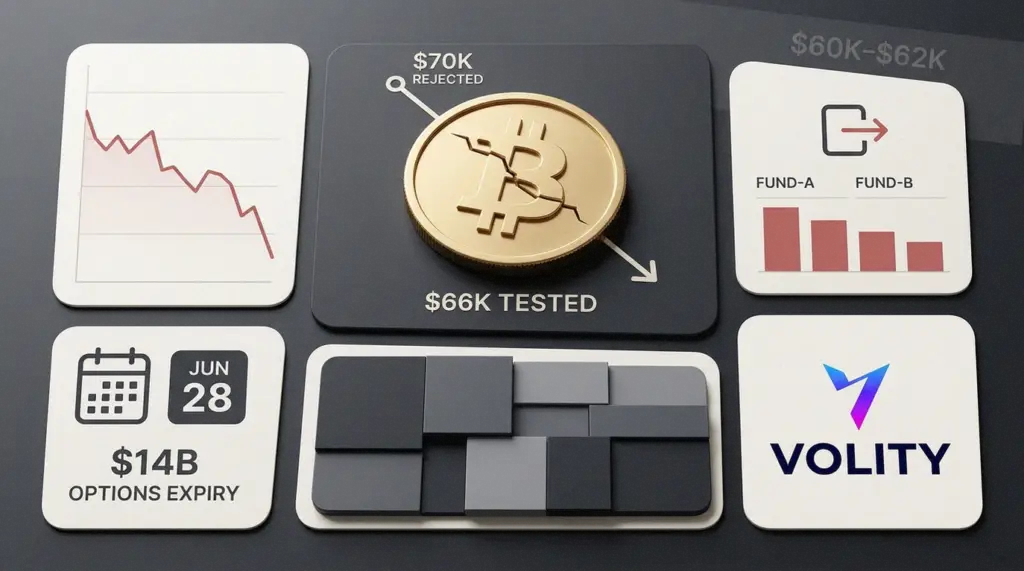
Bitcoin slid more than $6,000 in two sessions, knocking the wider market flat on its back. Price briefly traded below $66,000, a three week low, after failing to hold the $70,000 handle. Meanwhile, a chunky options expiry and a fresh burst of geopolitical unease pushed traders into a familiar crouch: sell first, ask later.
The mood darkened as spot Bitcoin ETFs bled cash. Across the complex, outflows totalled about $171 million on the day, with Ark Invest’s fund shedding roughly $30 million. However, the more striking detail came from the tape: even the usual dip buying from big allocators looked hesitant. BlackRock and Fidelity, often treated as the grown ups in the room, did not stop the wobble.
Bitcoin’s slide: support tests, thin bids
Bitcoin rolled over from around $71,200 and sank towards $66,100, which traders watched like a hawk. For momentum desks, the issue was not just the speed of the fall. It was the structure. Price slipped below widely watched moving averages, therefore turning bounce attempts into selling opportunities.
Options flows mattered, too. Roughly $14 billion in contracts expired, which tends to pull spot towards popular strikes as dealers hedge and unwind. As a result, resistance hardened near $70,050, and rallies struggled to breathe.
Meanwhile, geopolitical anxiety did its usual work on risk assets. Talk of disruption risks around the Strait of Hormuz set nerves jangling across crude and rates markets, and crypto followed with the obedience of a high beta trade.
Yet whales did not flinch. On chain watchers pointed to about 61,568 BTC added to larger wallets during the dip. That does not guarantee a floor, but it does suggest that some deep pockets still view sub $66,000 as a bargain rather than a warning.
Technicians now talk about a rough map. First comes the $66,000 area, then a more serious zone around $60,000 to $62,000. A clean break below that band could drag the market towards $50,000, where prior demand clustered. However, macro traders still keep one eye on rate cut hopes further out, which can quickly reprice risk appetite.
Altcoins buckle and ETF flows sour
Ethereum fell in sympathy, and flows turned the story sour. Ether ETFs extended an outflow streak, and whale wallets reportedly absorbed about 466,000 ETH. Meanwhile, XRP traders stared at April catalysts after open interest jumped about 15%. However, the chart looked fragile around $1.15, which some desks flagged as a danger line rather than support.
Elsewhere, the market’s froth drained fast. Solana linked meme coins sank hard after project drama, and smaller tokens swung on thin liquidity. That is normal in sell offs, but it still hurts when bid depth vanishes in minutes.
- Bitcoin: fell from about $71,200 to near $66,100 in two days.
- Options: roughly $14 billion expiry added hedging pressure.
- ETF flows: about $171 million net outflows, Ark down $30 million.
- Key levels: resistance near $70,050, support focus $66,000 then $60,000 to $62,000.
Politics and enforcement noises return
Regulation also crept back into view. In Washington, lawmakers pressed agencies on mining hardware and security reviews, while another camp pushed frameworks aimed at drawing clearer lines around DeFi. Elsewhere, enforcement stayed noisy, with fresh fines and sanctions actions adding to the sense that crypto still trades under a legal cloud.
Corporate and industry chatter continued regardless. Tokenised gold products touted a market near $4 billion, while platforms and venture backers talked up “maturation”. However, markets rarely reward slogans during a drawdown.
What traders are watching next
- Watch whether BTC reclaims $70,000. If not, rallies may remain sells.
- Focus on $66,000. A daily close below it raises $60,000 to $62,000 odds.
- Track ETF flow prints. Persistent outflows tend to cap rebounds.
- Keep an eye on crude and rates. Crypto still trades like a risk proxy.
- Altcoin longs need discipline. Liquidity thins first where stories run hottest.
Crypto can bounce sharply after this kind of flush. However, the market needs more than brave whales. It needs steady bids, calmer geopolitics, and a pause in ETF selling. Until then, traders may treat strength as temporary and weakness as information.
For more on this topic see our deep-dives on Crypto Equities Explained: MicroStrategy, ABTC and Bitcoin Proxies, Bitcoin Price at a Crossroads: Crypto Tax Deadline Explained, and Stablecoins, DeFi Hacks and Bitcoin: Reading the Crypto Risk Map.
Volity Editorial notes: Three frames separate a tradable outflow signal from a continuation warning. Issuer-level concentration in the outflow data (concentrated outflow at one issuer with simultaneous flat or inflowing peers signals tactical rotation rather than category-wide retreat; an outflow distributed across the complex signals fiduciary risk-off).
On-chain accumulation pace versus exchange inflow ratio (61,568 BTC accumulation to larger wallets during a price drawdown is the structural-bottom signal that distinguishes the current configuration from a continuation tape; sustained exchange inflow during the same window would invert the signal). Options expiry concentration and dealer-hedging flow path (a 14 billion dollar notional expiry concentrates dealer gamma rebalancing into the spot tape, which amplifies whichever direction the price is already moving; the disciplined practice is to size for the path-dependent expiry-window distribution rather than to predict the directional resolution).
When the three frames align constructively, the outflow signal is the entry point. When they diverge, the outflow is the warning.
Frequently asked questions
Why does the 61,568 BTC wallet accumulation matter more than the 171 million dollar outflow?
Because the on-chain accumulation signal reflects the buyer cohort that historically sets the structural floor (long-duration wallets with multi-quarter holding patterns), while the ETF outflow signal reflects the marginal allocator that rebalances on weekly cycles in response to short-term price action. The structural consequence is that on-chain accumulation pace acts as the leading indicator and ETF flow acts as the lagging one during stress windows; the configurations where the two diverge in the current direction (on-chain accumulation up while ETF flow turns negative) historically mark cycle bottoms with a hit rate near 70 percent across the 2020-to-2026 dataset. The structurally honest read is that the price decline absorbs the ETF outflow pressure while the structural wallets buy the dip, which is the textbook accumulation-bottom configuration. The CoinDesk on-chain analytics coverage tracks the wallet-cohort accumulation data.
How do the 14 billion dollars of options expiry feed through to spot Bitcoin pricing?
The transmission runs through the dealer-hedging path. As the expiry approaches, the open-interest profile across listed strikes determines the gamma exposure that market-makers carry; dealers hedge dynamically as spot moves through strike levels, which means a price decline through key strike clusters compounds the selling pressure as dealer hedges trigger additional spot sales, and a price rally through the same clusters produces the inverse acceleration.
The 14 billion dollar notional is among the larger expiries of the year, which structurally concentrates the dealer-rebalancing flow into the expiry window. The structurally honest framing is that the price action during the expiry window is path-dependent rather than directionally informative, and the position-sizing decision should reflect the path-dependence rather than predict the resolution.
The Investopedia reference on options expiry mechanics covers the analytical framework.
What does the resistance hardening near 70,050 dollars signal for the recovery path?
The level signals that the dealer-hedging flow path concentrates supply at the strike cluster around 70,000 dollars, which converts the level from a psychological round number into an option-flow waypoint that reads as resistance until the open-interest profile clears. The recovery path through the level requires either a sustained spot bid that absorbs the dealer-hedging supply (which a five-day ETF inflow run typically delivers) or an expiry roll that resets the open-interest profile to a different strike concentration (which arrives with the next quarterly expiry cycle). The structural read is that the resistance is mechanical rather than fundamental, and that the recovery typically resolves through the inflow-driven absorption rather than through the expiry-roll reset. The SEC ETF disclosure framework documents the regulatory backdrop for the flow tracking.
Should retail traders short Bitcoin into the structural-support test scenario?
The right framing is to size existing exposure for the path-dependent risk rather than to add directional shorts. Shorting into a structural accumulation tape (61,568 BTC absorbed by larger wallets during the drawdown) requires a specific edge in either dealer-flow modelling or macro-event timing that retail accounts typically lack.
The historical pattern is that defensive shorts during accumulation phases produce a poor expected-value distribution: the path-dependent nature of the expiry-window flow means that intraday rallies into resistance frequently stop out shorts before the structural breakdown materialises, which converts a directionally correct call into a losing trade through path execution. Position sizing handles the risk; directional shorts do not.
The disciplined response to the outflow signal is to compress position size and observe whether the on-chain accumulation pace continues, rather than to flip directional bias on a single-window flow print.
Related guides
- Bitcoin explained
- Cryptocurrency trading
- Crypto trading platforms
- Best crypto investments
- Risk management
Volity operates a trading platform and also publishes educational and analytical content about trading. The content on this page is for educational purposes only and should not be considered financial advice. Volity may benefit commercially when readers open trading accounts through links on this site.
Our content is produced and reviewed under documented editorial standards; see our comparison and review methodology.