Investing in financial products involves risk. Losses may exceed the value of your original investment.
Bitcoin us stablecoin is a core topic for traders in 2026. The complete guide follows.
Crypto news digest: Bitcoin keeps its footing as ceasefires and Washington’s stablecoin grind set the mood
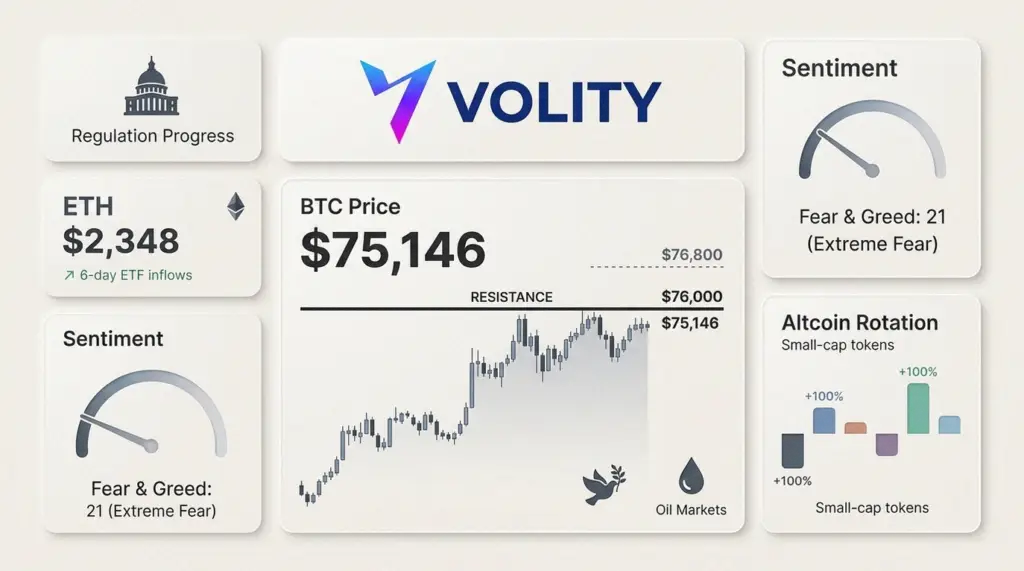
Bitcoin inched up 0.45% to $75,146, yet it still could not clear the $76,000 ceiling. However, the tape felt calmer than the headlines deserved.
Traders leaned into risk as ceasefire hopes surfaced around Israel and Lebanon, while Washington’s stablecoin language crept towards the kind of clarity that finally lets big money stop squinting. Meanwhile, altcoins did what they always do when Bitcoin pauses and the room gets noisy.
They ran.
Market snapshot: BTC stalls, rotation heats up
Bitcoin bounced off the $73,000 area and then met sellers again near $76,000. Dominance slipped as marginal dollars chased higher beta. Ethereum hovered around $2,348, down about 0.5%, even as spot ETH ETFs notched a sixth straight day of inflows. Meanwhile, the small-cap end of the pool turned into a wave machine.
ORDI ripped 178%, SIREN gained 123%, SATS climbed 74%, PNUT rose 48%, and NEIRO added 45%. Those are not tidy, “healthy” moves. However, they are a clean read on positioning. When traders feel they have political cover and policy progress, they buy the names that move the most.
- RAVE jumped 46% after a pullback, while holding $10 support as funding cooled.
- DRIFT gained 15% after $147.5m of Tether-led funding aimed at user recovery post-breach.
- BLESS fell 55% after a reported $3.83m team token sale hit the market.
- Polkadot rallied over 10%, while Pi Network pushed higher on fresh mainnet v22 details.
Sentiment stayed ugly on paper. The Fear and Greed Index sat at 21, or “extreme fear”.
Yet positioning tools told a different story. Polymarket implied an 85% chance Bitcoin ends April 17 higher.
Meanwhile, traders kept one eye on token unlocks, including SPK at $5.83m, ASTER at $109m, and IR at $6.63m.
By the numbers
- BTC: $75,146, up 0.45%, resistance near $76,000
- ETH: $2,348, down 0.5%, ETF inflows: 6-day streak
- Fear and Greed Index: 21
- Token unlocks: ASTER $109m, IR $6.63m, SPK $5.83m
- Oil: $93.27
Geopolitics: less panic, more risk-on
A 10-day Israel-Lebanon ceasefire began today after an announcement by Donald Trump, even as there is no Israeli withdrawal from southern Lebanon. Meanwhile, Trump said the U.S. is “very close” to an Iran deal, with further talks potentially this weekend. Iran repeated that it seeks no nuclear weapons.
Markets took it as a reduction in tail risk, not a lasting peace settlement. Oil held high at $93.27, while the S&P 500 and Nasdaq sat at record highs. Crypto followed equities rather than crude. That alone tells you where traders think the real impulse sits.
Policy: the slow, market-moving part
In Washington, the CLARITY Act talks reportedly narrowed to a short list of remaining issues. However, stablecoin yield language is unlikely to land this week, according to Senator Thom Tillis. JPMorgan flagged the process as late-stage, and a roundtable opened in D.C. Meanwhile, the UK’s FCA launched what it billed as its last crypto consultation before a full rulebook arrives in 2027.
None of this reads like a moonshot. Yet the market often rallies on the boring bits. Traders do not need perfection. They need workable rules, a timetable, and fewer surprises.
Deals and rails: the plumbing keeps changing
Infrastructure news did not wait for Congress. Payward, Kraken’s parent, agreed to buy Bitnomial for $550m, a blunt statement of intent in U.S. crypto derivatives.
Meanwhile, Circle pushed USDC into new settlement layers, even as it faced a lawsuit tied to $230m stolen after the Drift hack. Elsewhere, a French push for euro stablecoins gained another public cheerleader, with Qivalis targeting a 2026 launch.
Hong Kong’s Flow Capital tokenised a $150m credit fund on DigiFT’s blockchain.
- Ripple piloted tokenised bonds in South Korea.
- Plasma climbed to seventh in TVL after a Tether wallet integration.
- Flare flagged MEV capture work and a 40% cut to FLR inflation.
Security and crime: the cost of the casino
A fake Ledger Nano S device was reportedly caught siphoning crypto, the oldest trick still catching new victims. Meanwhile, an Ethereum-funded project said it identified 100 North Korean developers working across crypto. Sanctioned exchange Grinex halted trading after a $14m hack. France also moved towards a tougher stance on crypto kidnappings, with one reported every 2.5 days.
These stories do not move the index today. However, they shape the next cycle’s regulation and custody choices, especially for funds that cannot afford “oops”.
AI, quantum, and flows: the attention trade stays loud
Nvidia’s Ising project released what it called the first open quantum AI models, sending quantum-linked stocks higher. Meanwhile, finance circles flagged fresh risk concerns around the Mythos AI model. On the crypto side, an XRP ETF logged its biggest inflow since February, while ETH ETF inflows extended their streak.
Memecoins and micro dramas: money still wants a story
Foundation’s NFT platform shut down after a failed Blackdove rescue. Meanwhile, a retail trader turned $8.50 into $9,928 on Solana’s BELIEF memecoin, because this market still rewards speed over spreadsheets. Solana-aligned PACs also dropped $8m in Ohio Senate advertising, extending crypto’s experiment with old-school politics. BlockDAG listed on BingX, while JustLend said it burned 13.7% of JST supply, or $21.3m in the first quarter.
Key takeaways
- BTC needs a clean break above $76,000 to stop the range traders from leaning on every rally.
- Alt strength looks like rotation, not broad adoption, so keep sizing tight in small caps.
- Token unlocks, especially ASTER’s $109m, could create sudden supply shocks in thin books.
- Stablecoin wording in the CLARITY Act remains the nearer-term policy catalyst for U.S. flows.
- Security headlines keep raising the value of boring custody, audits, and transparent reserves.
Bitcoin’s next test sits around $76,800, a level traders frame as “breakeven” for the latest push. However, the real tell will be whether alts keep levitating when BTC pauses. If they do, risk appetite is not just back. It is hunting.
For more on this topic see our deep-dives on Crypto Treasury Plays: Forward on Solana, Metaplanet on Bitcoin, Bitcoin Short Squeeze Explained: How ETF Inflows Trigger BTC Rallies, and Bitcoin and Oil-Market Shocks: How Geopolitics and ETF Inflows Move BTC.
What our analysts watch, by Volity Editorial: Three readings shape our take on this tape. Stablecoin policy progress sets the regulatory floor and unlocks slow money that needs paperwork before it commits.
Token unlock calendars (ASTER at $109m this week) tell us where supply pressure could hit thin books. And Bitcoin dominance versus alt rotation flags whether traders feel covered enough to chase higher beta.
When all three lean the same way, the trend tends to extend.
Frequently asked questions
Why did Bitcoin stall below $76,000 even with positive news?
Range traders defended the $76,000 ceiling because three prior pushes failed there, which built thick supply. Marginal dollars rotated into altcoins instead, where percentage moves were cleaner. A clean break needs volume, not just headlines, and the spot ETF tape was steady rather than explosive. The Federal Reserve rate path also kept some macro money on the sidelines until the next CPI print.
What is the CLARITY Act and why does it matter for crypto?
The CLARITY Act is a US framework being negotiated to split jurisdiction between the SEC and CFTC for digital assets and to set rules for stablecoin issuance, reserves, and disclosure. Stablecoins are the largest dollar-denominated layer of crypto liquidity, so workable language unlocks bank settlement and corporate treasury use. The U.S. SEC publishes investor guidance on digital asset risks for retail accounts.
Are large altcoin moves a buy signal or a warning?
Triple-digit moves in small caps like ORDI or SIREN typically reflect positioning and thin order books, not lasting adoption. Treat them as rotation evidence, not a thesis. Traders sizing such names usually keep risk small and exits mechanical. The FATF Travel Rule continues to shape how regulated venues list and surveil thinly traded tokens, which can affect liquidity at the worst moment.
What is the Fear and Greed Index actually telling us at 21?
A reading of 21 sits in extreme fear, which historically marks contrarian buy zones, yet positioning data can disagree. The index blends volatility, momentum, social media, and Bitcoin dominance, so a defensive print plus rising prediction-market odds for a higher close suggests caution at the surface and quiet accumulation underneath. At Volity, regulated by CySEC under licence 186/12 via UBK Markets, we treat sentiment indices as one input, not a trade trigger.
Related guides
- Bitcoin explained
- Ethereum explained
- Cryptocurrency trading
- Crypto trading platforms
- Best crypto investments
Volity operates a trading platform and also publishes educational and analytical content about trading. The content on this page is for educational purposes only and should not be considered financial advice. Volity may benefit commercially when readers open trading accounts through links on this site.
Our content is produced and reviewed under documented editorial standards; see our comparison and review methodology.