Investing in financial products involves risk. Losses may exceed the value of your original investment.
Fedex earnings guidance is a core topic for traders in 2026. The complete guide follows.
FedEx heads into results with a clean chart and a messy backdrop
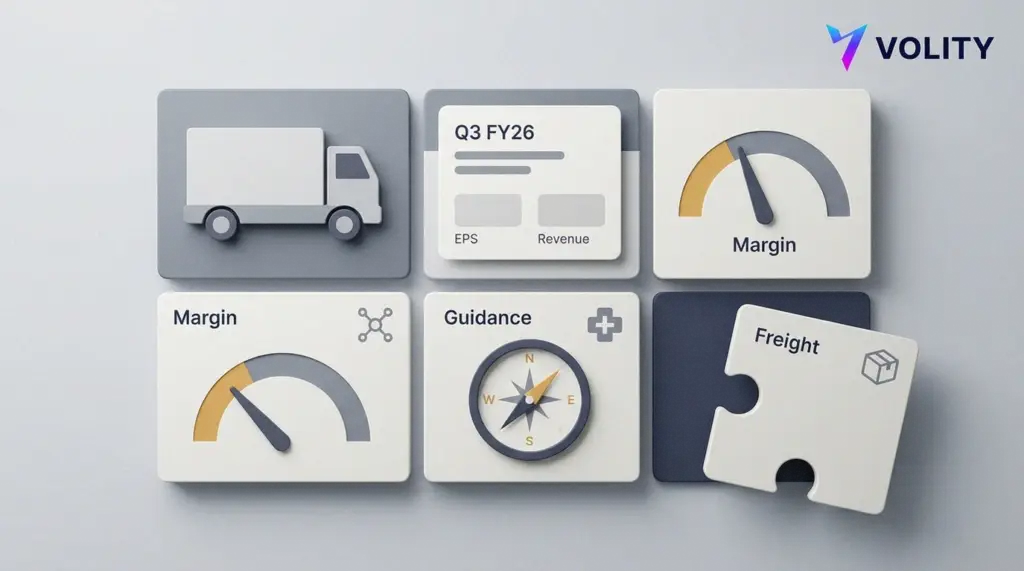
FedEx shares finished a jerky week at about $349 on Wednesday, then sat still in the final hour as traders waited. Tonight, after the bell, the shipper reports fiscal Q3 2026 results. However, the real catalyst will be guidance on costs, demand and the long talked about freight separation.
Expectations have slipped even as revenue trends look better. Analysts cluster around earnings per share of about $4.13 to $4.15, down from $4.51 a year ago. Meanwhile, revenue is forecast at roughly $23.49 to $23.59 billion, up about 6% year on year. The market is signalling a margin story, not a volume story.
That framing matters because FedEx has trained investors to watch execution. Over the prior quarters, it repeatedly cleared the revenue bar and kept delivering EPS beats. Yet the stock has not behaved like a steady compounder. Since a February peak near $388, it has slid back to the high $340s, even as management has talked up efficiency and mix.
Cost discipline will be the first thing traders score. The DRIVE programme has already delivered the sort of levers Wall Street loves: fewer flights, aircraft parked, staffing trims and tighter network planning. Meanwhile, management has leaned into smarter routing and automation, with more AI assisted decisions in the network. January rate increases in parcel and freight also help, although pricing always invites a second question about demand.
Demand is where the call can turn. FedEx has pockets that still look strong, including premium business shipments, consumer e commerce lanes and healthcare. In addition, the new Amazon arrangement for bulky packages offers a tidy narrative: “FedEx is back in the mix”. Still, investors will want to know how much of that is incremental profit rather than just incremental boxes.
Then there is freight. The company’s plans around its freight business and any spinoff mechanics remain a live wire. If management offers a confident timeline and clean separation economics, the stock could rerate quickly. However, if they sound cautious on execution, or if freight volumes soften, traders may treat it as a reason to sell first.
Technically, the set up looks simple enough. Wednesday’s trade opened at $346.81, printed $349.12 at the high and $344.19 at the low. Meanwhile, the share price is down about 5.6% over the month, although transport peers have done worse, off around 9.5%. Some investors will argue FedEx has already “paid” for the fear.
Street positioning looks supportive but not euphoric. Consensus still sits around a Moderate Buy, with an average target near $384.70, or roughly 10% above the tape. However, those higher targets, including $424 from JPMorgan earlier this month, only help if guidance keeps the margin story intact.
By the numbers
- Stock: about $349 close, after peaking near $388 in February
- Q3 EPS view: about $4.13 to $4.15 vs $4.51 last year
- Q3 revenue view: about $23.49 to $23.59bn, up roughly 6%
- Recent range: $344.19 to $349.12 on March 19
- Targets: average $384.70, with some as high as $424
So is this a volatility play or a trap?
It can be both, depending on what you are buying. FedEx has a habit of moving hard on earnings, and the market knows it.
That is why implied volatility tends to lift into the print. Meanwhile, services that track “whispers” point to a modest upside skew, with a Zacks Earnings ESP at +2.30% and a $4.23 read versus a $4.14 consensus area.
Bulls will argue the base case is a beat.
However, volatility trades live and die on guidance. Tariff uncertainty and macro noise have crept back into transport sentiment. UPS remains an obvious yardstick, and any hint that pricing is buying volume the wrong way could spook the tape. In addition, freight strategy missteps can feel existential, even if the quarter itself looks fine.
Options traders will naturally gravitate to a straddle or strangle around the $350 area, aiming to monetise a 5% to 10% move. That move is not fantasy for FedEx, but premiums can be punishing when everyone reaches for the same trade. Timing matters as much as direction, and spreads often make more sense than naked long premium.
Key takeaways
- Watch guidance first: DRIVE progress plus pricing credibility decides the reaction more than the headline EPS.
- Freight is the landmine: clarity on separation economics can lift the multiple, while hesitation can hit it.
- Mix beats volume: premium B2B, healthcare and bulky package wins matter if they expand margin.
- Respect transport sentiment: tariff fog and macro jitters can turn a “beat” into a shrug.
- Options are not free money: implied vol may already price the historic swing, so structure matters.
FedEx can still win the night with clean execution and a confident tone. However, the stock will punish ambiguity, especially on freight and demand. Traders may find the best risk reward not in guessing the numbers, but in how quickly they can react to guidance once the tape starts moving.
For more on this topic see our deep-dives on Trade Ideas AI Trading Tool Review: Holly, Alerts and Pricing, Uranium Energy Stock and Blackstone: Rate-Sensitive Stock Movers, and Toyota and NVIDIA: Inside the Autonomous-Vehicle AI Partnership.
What our analysts watch: Three lenses set our FedEx call. First, the Express segment operating margin, since that is where structural cost programmes (DRIVE, Network 2.0) are meant to land.
Second, B2B volume trends, which lead industrial production by roughly one quarter. Third, capital allocation: stated buyback pace, capex run-rate, and any signal on the Freight spin valuation framework.
If management raises buyback while reaffirming the spin schedule, the stock typically gets re-rated even on a soft top line.
Frequently asked questions
Why is the FedEx Freight spin-off important for the stock?
FedEx Freight is the highest-margin business inside the consolidated company. Spinning it out as a pure-play less-than-truckload carrier creates a structural rerating opportunity: investors price freight LTL peers on different multiples than parcel networks. The spin can therefore unlock value even if combined earnings barely move. Investopedia explains the spin-off mechanics.
How do I read FedEx as a global-economy signal?
FedEx volumes lead trade and industrial-production data because customers book freight before the goods are sold. Watch international export volumes for global trade health and US ground volumes for domestic consumer demand. The IMF World Economic Outlook often cites freight indicators when discussing trade momentum.
Are cost-out programmes a sustainable earnings driver?
Up to a point. DRIVE-style structural cost programmes can support 2 to 3 years of margin expansion, but eventually management has to grow volumes again.
Track the gap between guided savings and what actually shows up in operating income. Persistent slippage is a warning sign.
The Federal Reserve publishes industrial-production data that is useful for separating volume strength from one-off cost wins.
How can I trade FedEx earnings on Volity?
Volity lets you take long or short positions on FDX equity and CFDs through UBK Markets (CySEC licence 186/12) and our Saint Lucia and Cyprus entities. You can pair the FedEx event with currency hedges (USD, EUR) or US transport-sector exposure, all from one regulated account.
Related guides
- Stocks investing for beginners
- Best stock trading platforms in Europe
- Best trading platforms
- Swing trading platforms
- Risk management
Volity operates a trading platform and also publishes educational and analytical content about trading. The content on this page is for educational purposes only and should not be considered financial advice. Volity may benefit commercially when readers open trading accounts through links on this site.
Our content is produced and reviewed under documented editorial standards; see our comparison and review methodology.