Investing in financial products involves risk. Losses may exceed the value of your original investment.
Strait hormuz ai is a core topic for traders in 2026. The complete guide follows.
Traders’ edge: Ai momentum and tanker tailwinds crush energy short traps
Washington, April 15. Traders came in looking for clean hedges after the Strait of Hormuz shock.
Instead, they found a familiar trap. Energy shorts looked clever at Sunday’s open, then crude held its ground.
Meanwhile, the market’s real bid returned to two places: AI momentum and the plumbing of global trade.
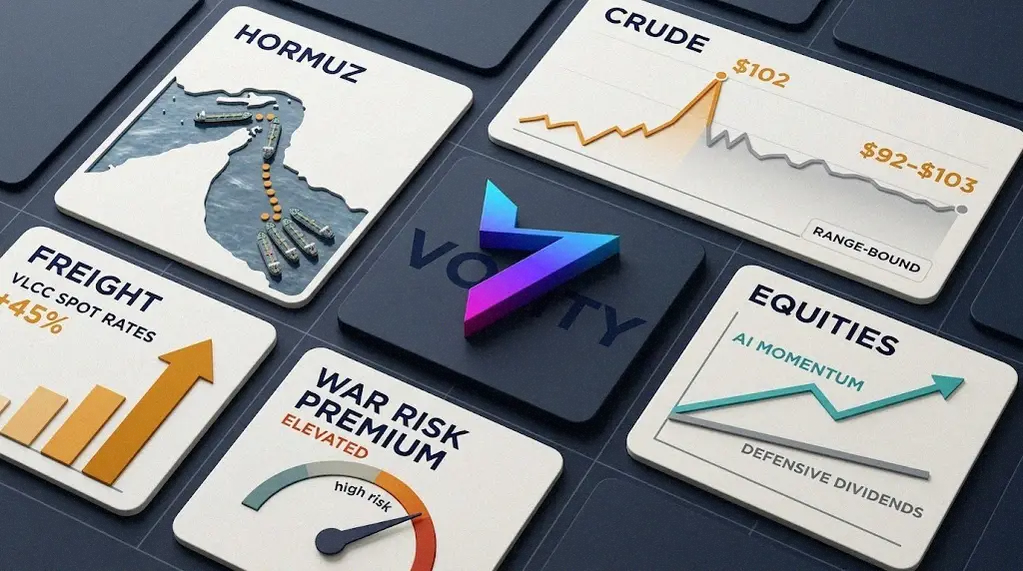
Brent and WTI hovered in a wide $92 to $103 range after a fast jump that briefly printed near $102 on blockade fear. However, the key detail was not the spike. It was the lack of a breakdown once the headlines aged. As soon as prices stopped rising in a straight line, the popular macro trade, short oil for an “inevitable” growth scare, began to look like a crowded door.
Shipping, by contrast, got paid for the mess. Tanker traffic through Hormuz fell roughly 85%, from about 135 ships a day to fewer than 15, while more than 150 vessels sat delayed and a backlog swelled past 500.
Yet the Strait did not go fully dark. Some tankers slipped through, including the US-sanctioned Rich Star I on Tuesday, while others turned back.
The market landed in the awkward middle state that often punishes big-picture bets: enough disruption to reprice logistics, not enough to validate “oil collapse” narratives.
That is why the tape rewarded tankers rather than crude tourists. Frontline, the VLCC and Suezmax heavyweight, rose about 7.5% across five sessions as spot-rate expectations fattened.
Before the crisis, VLCCs were earning around $74,000 a day. Now, even the hint of detours, queueing and war-risk premiums changes the maths.
Meanwhile, Frontline’s year-to-date gain sits near 57%. Its dividend yield around 5% adds another hook for fast money that wants carry with optionality.
On the equity side, traders also rotated away from stale “energy will unwind” arguments and back into the market’s favourite habit: paying up for compute. AI-linked names regained their footing as investors treated Middle East risk as a volatility input, not a reason to sell the future. The day’s most actionable setup was not an oil short. It was a barbell: high-momentum AI on one side, high-yield defensives on the other, with a shipping kicker in the middle.
GitLab, for example, kept momentum on the back of its Google Cloud collaboration talk. Robinhood found a fresh bid as traders gamed the next chapter of retail market structure and day-trading oversight.
Broadcom stayed in the AI hardware conversation via Meta’s custom silicon appetite. IonQ benefited from the market’s recurring taste for DARPA-linked quantum speculation.
None of these are “safe”. However, they fit what this tape keeps rewarding: clear narratives, visible catalysts and enough liquidity for quick exits.
Meanwhile, dividends acted like sandbags. AbbVie and Medtronic remain the sort of names that get quietly accumulated when the VIX rises and nobody wants to admit they want insurance. Viatris also sits in the rotation bucket, since investors keep paying for cash flows when geopolitics makes growth projections look squishy. In a week like this, yield stops being a valuation debate and becomes a seatbelt.
By the numbers
- Crude range: roughly $92 to $103 per barrel after the surge.
- Traffic hit: about 135 ships daily down to under 15.
- Backlog: more than 500 vessels reported waiting.
- Frontline move: about +7.5% in five sessions, +57% year to date.
- VLCC rate marker: around $74,000 per day before the crisis.
Key takeaways
- Energy shorts need a follow-through drop in crude, not just scary headlines.
- Tanker equities can outperform even if oil stops rising, since disruption lifts freight economics.
- AI momentum still attracts capital first, especially when macro fear fails to deepen.
- High-yield defensives provide better hedge behaviour than “short energy” when oil stays bid.
- Watch for Strait flow data and war-risk insurance moves, since they feed rates faster than crude.
The market is not ignoring Hormuz. It is repricing the second-order effects. Traders who want to avoid the next short squeeze may do better owning the bottlenecks, not betting on a clean macro unwind.
For more on this topic see our deep-dives on Stocks to Watch: AAPL, SOFI and the Bank Red Flags Investors Track, Intel Stock and Defensive Rotation: How Investors Position Pre-Earnings, and Trade Ideas AI Trading Tool Review: Holly, Alerts and Pricing.
What our analysts watch: Three readings filter signal from headline risk. VLCC and Aframax day rates published by Baltic Exchange tell us whether tanker freight is genuinely tightening or only repricing on news.
Defence procurement disclosures (Q1 contract awards, AI-specific RFP volumes) measure whether AI defence spend is accelerating or only being announced. Brent-WTI spread direction confirms the underlying oil shock is structural rather than speculative.
When all three confirm, both baskets extend rather than mean-revert; when any diverge, traders take partial profit on the spike rather than chase the next leg.
Frequently asked questions
Routing constraints force shipowners to either pause Hormuz transit (capacity falls) or take longer routes around Africa (effective capacity also falls because each voyage takes more days). Spot day rates spike, which translates directly into earnings for tanker operators because charter contracts re-price quickly. The U.S. Energy Information Administration (EIA) publishes the chokepoint volume data desks reference during these episodes.
Which AI stocks benefit from defence procurement spikes?
Three categories tend to lead. Defence-specific AI platforms (Palantir, C3.ai government segment) capture direct contract flow. Adjacent intelligence and analytics names (Booz Allen, Leidos, Science Applications International) absorb the system-integrator share. Drone and unmanned-systems specialists (AeroVironment, Kratos, BAE) capture the kinetic side. Investopedia covers the defence procurement framework in depth.
How long does the rally typically last?
Both baskets historically peak two to four weeks after the initial event window. Tanker rates fade as the market adjusts routing or the political risk de-escalates.Defence and AI procurement names hold longer because contract awards lag the headline by quarters. Sizing should reflect the duration mismatch.
The Nasdaq publishes sector-level performance data that supports the duration framework.
How should retail traders manage exposure?
Position-size each basket independently rather than treating both as a single trade, use a CySEC-regulated venue for transparent execution, and avoid leveraged single-stock ETPs that decay during volatile periods. Volity research builds dual-basket strategies for clients.
Related guides
- Best AI stocks to invest in
- Stocks investing for beginners
- Best stock trading platforms in Europe
- Indices trading platforms
- Risk management
Volity operates a trading platform and also publishes educational and analytical content about trading. The content on this page is for educational purposes only and should not be considered financial advice. Volity may benefit commercially when readers open trading accounts through links on this site.
Our content is produced and reviewed under documented editorial standards; see our comparison and review methodology.