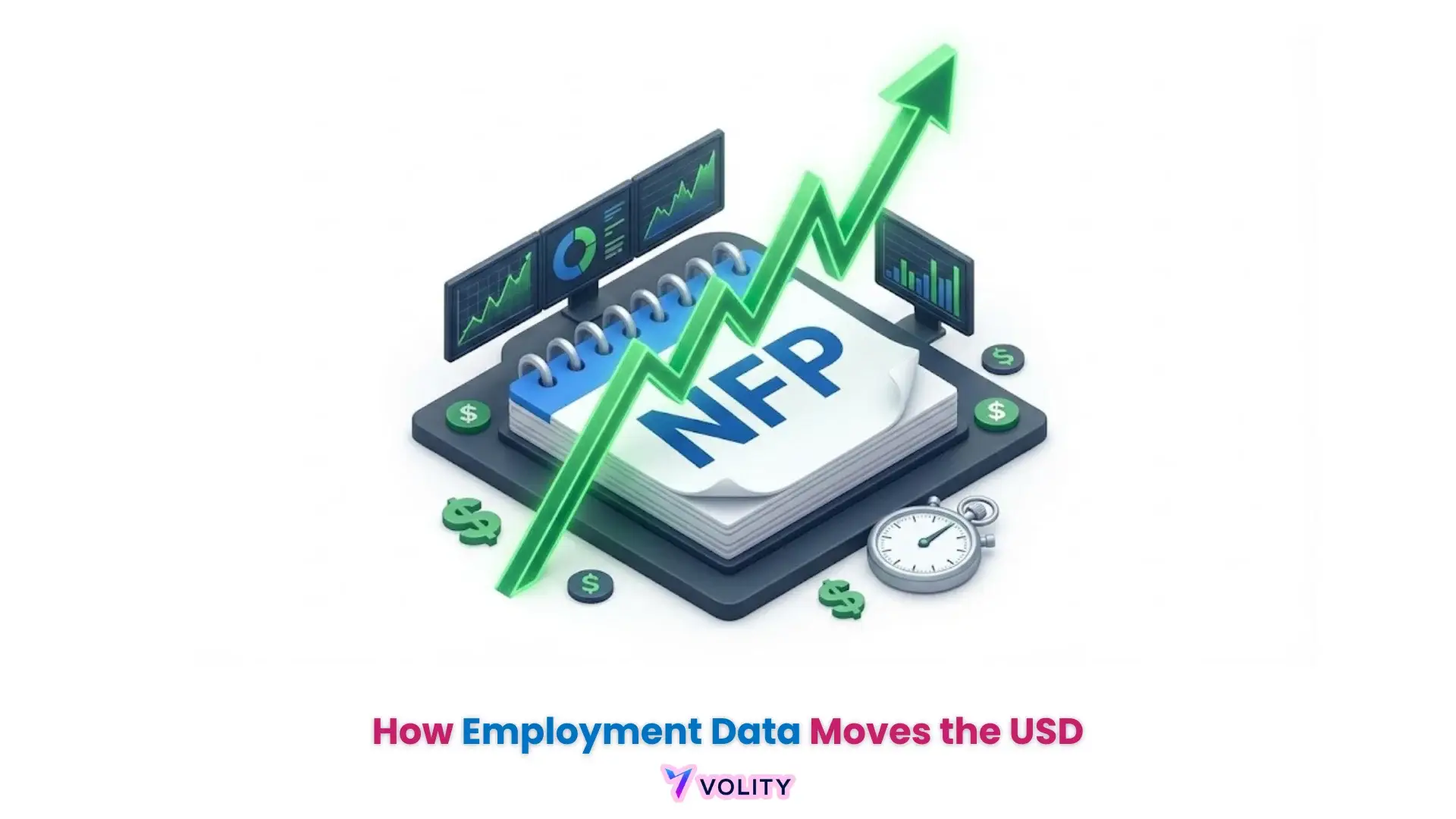
The **Non-Farm Payrolls (NFP)** report is a pivotal economic indicator that provides a monthly snapshot of US employment health, excluding farm and government workers. Its release triggers extreme **volatility** in the **Forex market**, often moving major **currency pairs** by 50-100 pips in minutes. This guide will equip you with essential strategies for trading NFP before, during, and after its release, alongside critical **risk management** techniques. You’ll learn to navigate market reactions, avoid **fakeouts**, and master the psychological challenges of high-impact news trading.
While understanding Trading Non Farm Payrolls Nfp is important, applying that knowledge is where the real growth happens. Create Your Free Forex Trading Account to practice with a free demo account and put your strategy to the test.
Non-Farm Payroll (NFP): Understanding Its Market Impact
Non-Farm Payroll (NFP) represents the net change in the number of employed people in the US during the prior month, excluding farm workers, government employees, private household employees, and non-profit organization employees. This economic data is a critical indicator of the health of the US economy and significantly influences the Forex market. A strong NFP report suggests economic growth, potentially leading to a stronger US Dollar, while a weak report can signal economic contraction and a weaker dollar. Traders pay close attention to NFP due to its direct link to consumer spending and overall economic sentiment.
Key Components and Release Schedule
The NFP report is released on the first Friday of every month at 8:30 AM ET. This schedule makes it a highly anticipated event on the economic calendar.
Key components of the NFP report include the headline NFP number, the unemployment rate, and average hourly earnings. These figures provide a comprehensive snapshot of the US labor market.
The headline NFP number indicates job creation or loss, the unemployment rate reflects the percentage of the labor force without jobs, and average hourly earnings signal wage inflation pressures.
| Component | Description | Signal |
| NFP Headline | Net change in US employment (excl. farm, gov) | Job creation/loss |
| Unemployment Rate | % of labor force unemployed | Labor market health |
| Avg. Hourly Earnings | Change in worker wages | Inflation pressure |
| Labor Force Participation | % of working-age population employed | Economic engagement |
How NFP Fuels Market Volatility and Price Action
NFP figures can move major currency pairs by 50-100 pips or more in minutes, leading to significant volatility. This rapid market reaction is driven by the deviation between the actual NFP data and market expectations. When the actual figures significantly surprise analysts, the market often experiences sharp, swift price movements. Currency pairs like EUR/USD and GBP/USD are particularly susceptible to this heightened volatility. Traders aiming to capitalize on these movements must understand the dynamics of expected vs actual data and the subsequent immediate shifts in price action. This extreme volatility presents both amplified profit potential and magnified risk.
How to Trade Non-Farm Payrolls (NFP)
Trading the Non-Farm Payrolls report requires a disciplined approach, as market conditions shift dramatically across different phases. Effective trading strategies adapt to these phases, managing the intense volatility and potential for fakeouts. Understanding how to position trades before, during, and after the NFP release is critical for success.
Anticipating the Move (Pre-Release)
Professional traders prepare for NFP by assessing market sentiment and conducting thorough fundamental analysis of forecasts. This involves reviewing prior economic data and analyst predictions for the upcoming NFP report, unemployment rate, and average hourly earnings. Traders identify key technical analysis levels, such as support and resistance, where price might react.
Some advanced strategies, like straddles or options, attempt to profit from volatility regardless of direction, but these carry their own complex risks. The goal is to form a bias or identify potential reaction zones before the news hits.
Riding the Volatility Wave (During Release)
Trading during the actual NFP release is extremely high-risk due to intense volatility, wide spreads, and potential slippage. Average spreads on highly liquid currency pairs like EUR/USD can widen by 5-10 times during the NFP release. This means a standard 1-pip spread might become 5-10 pips instantly, eroding profits or triggering stop losses prematurely. Breakout strategies attempt to capture the initial surge in one direction, but often face fakeouts or sudden reversals.
Scalping involves taking very small profits from quick price swings, demanding lightning-fast execution and a deep understanding of entry and exit points. Traders frequently get caught by fakeouts and spikes; waiting for initial confirmation or avoiding direct exposure during the first few minutes is often safer.
Confirming the Trend (Post-Release)
Post-release strategies focus on waiting for the initial market reaction to subside and for price action to establish a clearer direction. This approach aims to avoid the immediate, unpredictable spikes and fakeouts that often occur in the first few minutes.
Traders look for confirmation of a trend or a clear break of key technical analysis levels after the dust settles. Momentum trading or trend following can be employed once the market digests the news and a sustainable direction emerges. Identifying optimal entry and exit points becomes more reliable as liquidity returns and spreads normalize. This approach significantly reduces the risk associated with extreme volatility.
Ready to Elevate Your Trading?
You have the information. Now, get the platform. Join thousands of successful traders who use Volity for its powerful tools, fast execution, and dedicated support.
Create Your Account in Under 3 MinutesRisk Management: The Cornerstone of NFP Trading Success
Effective risk management is paramount when trading Non-Farm Payrolls (NFP). The extreme volatility and rapid price movements during this event can quickly deplete trading accounts if not properly managed. Implementing robust risk management strategies, including the use of stop-loss orders and appropriate position sizing, is crucial to navigating NFP volatility. Without a clear risk plan, even a single NFP trade can lead to significant losses.
Understanding Your Risk Tolerance
Managing risk when trading NFP begins with understanding your personal risk tolerance. This defines the maximum percentage of your trading capital you are willing to lose on any single trade. For high-impact events like NFP, it is often advisable to reduce your standard risk per trade. A clear understanding of your risk tolerance underpins all other risk management decisions, from position sizing to stop loss placement. Never risk more than you can comfortably afford to lose, especially in such unpredictable market conditions.
Strategic Stop Loss Placement and Management
Normal stop-loss orders often fail during NFP due to extreme volatility and slippage. Rapid price spikes can trigger stop losses prematurely, only for the price to reverse in the intended direction. To counter this, traders can adapt their stop loss strategy. One approach is to use wider stop losses, accounting for the increased average true range during the NFP release. Another tactic involves using mental stops, where you exit manually if a certain price is hit, allowing for more flexibility than an automated order. Alternatively, some traders opt for a “no-trade zone” immediately around the release, entering only after the initial, unpredictable price action subsides.
The Role of Position Sizing and Leverage Control
Position sizing directly controls the amount of capital at risk. During NFP, it is prudent to reduce your standard position size to align with the heightened volatility. This means trading with fewer lots or smaller contract sizes.
Furthermore, using high leverage during NFP significantly magnifies both potential gains and losses, making it extremely dangerous. High leverage can quickly lead to a margin call or complete account wipeout if the market moves against your position, even momentarily. Emphasize conservative leverage and smaller position sizing to protect your capital during this high-stakes event.
Platform, Data, and Execution for NFP Trading
Successful Non-Farm Payrolls (NFP) trading relies not only on strategy but also on having the right tools and access to timely information. Choosing a reliable trading platform and knowing where to find real-time NFP data are crucial for effective execution. These elements combine to support informed decision-making and efficient trade management during periods of high market volatility.
Choosing the Right Trading Platform for NFP
The best trading platform for NFP must offer low latency, reliable execution speed, and competitive spreads. During high-impact news events, platforms can experience significant load, leading to delays or re-quotes. A robust broker with stable servers and direct market access is essential. Look for platforms that clearly display spread widening and offer various order types, including limit and stop orders, to manage entries and exits precisely. Reputable brokers often provide demo accounts, allowing traders to practice their NFP strategies without financial risk.
Accessing Real-Time NFP Data and Forecasts
Accessing real-time NFP data and accurate forecasts is fundamental for NFP traders. Reliable sources include economic calendars provided by financial news outlets and data providers. Websites such as Trading Economics, Investing.com, and FXStreet offer live NFP releases, historical data, and consensus forecasts from economists. These platforms allow traders to compare the actual NFP figures against market expectations, which is the primary driver of immediate market reaction. Subscribing to news feeds or using dedicated data terminals can also provide instantaneous updates.
What Are the Best Brokers for NFP Trading?
Choosing a broker with robust infrastructure is critical for navigating the extreme volatility of NFP trading. This section compares key features of top brokers suitable for high-impact news events, focusing on aspects vital for NFP success.
Advanced NFP Trading Insights and Overlooked Tactics
Mastering NFP trading requires going beyond simple strategies and delving into more nuanced market mechanics. Unlike many standard guides, this section explores advanced analytical techniques and precise timing strategies often missed by competitors. Successful NFP traders leverage these deeper insights to identify true entry and exit points and avoid common fakeouts.
Understanding market microstructure is key to this advanced approach. This refers to the detailed process of how orders are placed, executed, and cleared. During NFP, the order book can become extremely thin, leading to wide spreads and significant slippage.
Observing order flow analysis, for instance, using tools like Bookmap, provides a real-time visualization of buying and selling pressure. This allows traders to see where large orders are accumulating (liquidity pools) and how they are being absorbed or swept.
By interpreting order flow, traders can often discern whether a price spike is a genuine move backed by institutional interest or merely a fakeout driven by panic or algorithmic reactions. For example, a strong initial NFP number might cause a sharp price surge, but if order flow analysis shows a rapid depletion of buying liquidity and significant selling pressure stepping in, it signals a potential reversal or exhaustion of the move. Analyzing volume and liquidity during NFP provides a deeper understanding of market participants’ true intentions, offering an edge in navigating the chaotic post-release environment.
Turn Knowledge into Profit
You've done the reading, now it's time to act. The best way to learn is by doing. Open a free, no-risk demo account and practice your strategy with virtual funds today.
Open a Free Demo AccountThe Psychology of NFP Trading: Mastering Your Mind
The extreme volatility and rapid price swings associated with the NFP release can trigger powerful emotions like fear of missing out (FOMO), greed, and panic. These emotions frequently lead to poor decision-making, such as chasing trades, over-leveraging, or revenge trading after a loss.
- Stick strictly to this plan, regardless of the initial market reaction.
- Practicing mindfulness and emotional detachment can help traders observe price action objectively without succumbing to impulsive decisions.
- Post-trade review, focusing on adherence to the plan rather than just profit or loss, reinforces good habits and helps identify recurring emotional pitfalls.
Bottom Line
Trading the Non-Farm Payrolls report is a high-stakes endeavor that demands preparation, discipline, and robust risk management. By understanding the report’s components, implementing phase-specific strategies (before, during, and after release), and mastering the psychological challenges of extreme volatility, traders can significantly improve their chances of success. Access to reliable data and a high-performance trading platform are also crucial for effective execution in this fast-moving market.
Key Takeaways
- The NFP report is a critical economic indicator that drives significant volatility in Forex markets.
- Successful NFP trading requires distinct strategies for anticipating, riding, and confirming market moves before, during, and after the release.
- Robust risk management, including strategic stop-loss placement and conservative position sizing, is essential to mitigate losses from rapid price swings.
- Advanced tactics like market microstructure and order flow analysis can provide an edge in navigating NFP’s chaotic environment.
- Mastering the psychology of trading, including managing FOMO and panic, is as crucial as technical strategy for NFP success.