Le scalping sans données de flux d’ordres propriétaires ni latence de l’ordre de la milliseconde expose les traders à un slippage massif et à la prédation des teneurs de marché ; les pertes à haute fréquence s’accélèrent durant la volatilité des annonces. Le day trading avec moins de 5 000 $ de capital déclenche des liquidations forcées durant la volatilité normale du marché, le dimensionnement de position devient impossible. Le swing trading crée un risque de gap overnight où les annonces des banques centrales et les chocs géopolitiques effacent des gains accumulés sur une semaine entière en quelques secondes. Le position trading immobilise le capital pendant des mois tout en manquant des mouvements à plus court terme et à plus forte conviction ; la détention forcée durant les drawdowns déclenche des ventes de capitulation émotionnelles. La baisse des barrières d’entrée en 2026 a amené davantage de scalpeurs sous-capitalisés en concurrence avec des algorithmes d’IA disposant d’avantages de l’ordre de la microseconde. Les performances passées ne préjugent pas des résultats futurs. Capital à risque.
Les types de traders sont classés selon leur horizon temporel, leur tolérance au risque et leur focus analytique. En 2026, le paysage du trading a été transformé par les comptes à faible dépôt chez les courtiers réglementés et la montée du trading de sentiment piloté par l’IA. Que vous choisissiez le scalping à haute fréquence, le day trading intraday, le swing trading sur plusieurs jours ou le position trading à long terme, le succès dépend de l’alignement de votre profil avec votre base de capital et les contraintes de votre mode de vie.
Les types de traders fonctionnent comme les principales classifications professionnelles sur les marchés financiers. Ces profils vont des scalpeurs ultra court terme visant les micro-fluctuations de prix aux position traders à long terme axés sur les cycles macroéconomiques. Dans le paysage de trading de 2026, choisir un style qui s’aligne sur votre profil psychologique est le plus grand déterminant unique de la rentabilité à long terme.
La montée de l’automatisation retail et la baisse des barrières d’entrée et les comptes à faible dépôt ont démocratisé l’accès aux stratégies de niveau professionnel. Le succès en 2026 exige de dépasser les simples définitions de style vers une compréhension profonde des exigences de capital et des outils technologiques spécifiques à chaque profil.
Comprendre Types of Traders est important, mais la vraie progression commence en appliquant ces connaissances. Créez votre compte de trading forex gratuit pour vous entraîner sur un compte démo gratuit et mettre votre stratégie à l’épreuve.
Quels sont les quatre principaux types de traders en 2026 ?
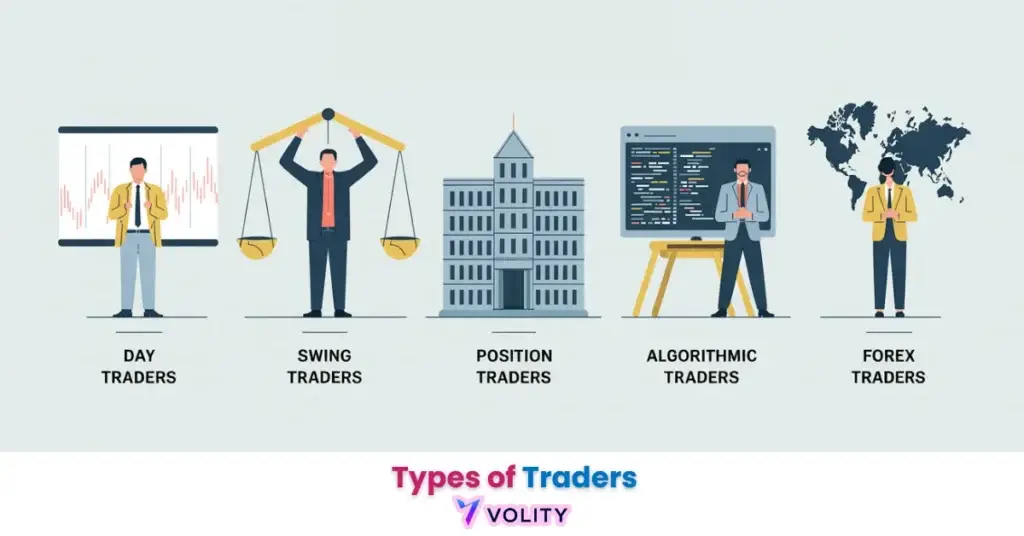
Les profils de trading identifient les quatre méthodologies principales de participation au marché : scalpeurs, day traders, swing traders et position traders. Chaque profil opère sur des unités de temps différentes et porte des exigences psychologiques et de capital distinctes. Le système de classification reflète non seulement la période de détention mais aussi l’engagement total en temps requis pour réussir.
- Scalpeurs : Exécution à haute fréquence sur les graphiques 1m-5m pour des gains de 5 à 10 pips.
- Day traders : Clôture de toutes les positions avant la fin de la séance pour éviter le risque overnight.
- Swing traders : Détention de 2 à 5 jours pour capturer des « oscillations » de prix sur plusieurs jours.
- Position traders : Allocation à long terme basée sur les fondamentaux macro (mois à années).
Les individus âgés de 25 à 34 ans représentent actuellement environ 40 % de la population mondiale de day traders en 2026 (BestBrokers, 2026). Ce biais démographique reflète le glissement vers l’exécution mobile-first et la disponibilité des marchés 24/7. Les traders plus jeunes ont grandi avec des données de marché en temps réel et n’ont pas l’ancrage psychologique aux heures de trading traditionnelles.
La poussée du trader retail 24/7
La démographie retail identifie la « poussée des jeunes » de 2026 où les participants de moins de 30 ans représentent désormais près de 48 % de l’activité totale du marché dans les régions émergentes. Le glissement vers l’exécution mobile-first permet aux traders de surveiller leurs positions de n’importe où, éliminant les contraintes de bureau du day trading traditionnel. La façon dont les marchés 24/7 (crypto/ETF) ont éliminé le risque de « gap de week-end » supprime l’un des plus anciens dangers du trading, les détenteurs de position ne font plus face aux gaps de choc du lundi liés aux actualités publiées durant le week-end.
Prêt à faire passer votre trading au niveau supérieur ?
Vous avez les connaissances. Il vous manque la plateforme. Rejoignez des milliers de traders qui choisissent Volity pour ses outils puissants, son exécution rapide et son support dédié.
Créez votre compte en moins de 3 minutesAnalyse approfondie : scalping et day trading en 2026
L’accès au day trading de détail s’est nettement ouvert en 2026 : les courtiers réglementés proposent des comptes à faible dépôt, permettant de commencer avec des montants modestes. Dans l’EEE et au Royaume-Uni, il n’existe pas de solde minimum de type Pattern Day Trader ; l’ESMA et la FCA encadrent le day trading par des plafonds de levier et la protection contre le solde négatif. L’accès élargi au day trading a montré comment des soldes minimums élevés peuvent créer un système de trading à deux niveaux où seuls les mieux capitalisés participent en intraday. La marge en temps réel démontre le glissement d’un plancher en dollars vers un cadre de marge basé sur le risque où les courtiers calculent le pouvoir d’achat overnight selon la volatilité et l’effet de levier réels des positions. Le scalping en 2026 exige une exécution à ultra-faible latence et les alertes d’IA sont obligatoires pour le succès à haute fréquence, les pures réflexes humains ne peuvent pas rivaliser avec des algorithmes opérant à des vitesses de l’ordre de la milliseconde.
Dans l’EEE et au Royaume-Uni, il n’existe pas de solde minimum de type Pattern Day Trader pour le day trading : l’ESMA et la FCA encadrent l’accès par des plafonds de levier et la protection contre le solde négatif, et les courtiers réglementés proposent des comptes à faible dépôt, ce qui élargit l’accès au trading intraday pour les participants retail.
Le trading forex pour débutants fournit un contexte fondamental pour ceux qui découvrent ce style.
La comparaison des styles 2026
L’analyse comparative des styles de trading identifie une hiérarchie claire des besoins en capital et des exigences psychologiques pour chaque profil de marché. Les exigences de capital reflètent non seulement le minimum nécessaire pour trader, mais le montant réaliste requis pour survivre aux drawdowns du compte sans liquidation forcée. Le succès à chaque niveau exige d’adapter l’allocation de capital à la volatilité et à la fréquence de trading du style.
| Type de trader | Unité de temps typique | Exigence de capital (2026) | Domaine de focus | Risque overnight |
| Scalpeur | 1m – 5m | Capital élevé (pour l’avantage) | Flux d’ordres | Aucun |
| Day trader | 15m – 1H | 2 000 $ (USA) / 500 (UK) | Figures graphiques | Aucun |
| Swing trader | 4H – quotidien | 1 000 $ – 5 000 $ | Tendances/événements | Élevé |
| Position trader | Quotidien – hebdomadaire | 5 000 $+ | Macro/taux | Très élevé |
| Sentiment | Événementiel | Variable | Données sociales/IA | Varie |
Sources : Volity Risk Labs, rapports réglementaires MyInvestingClub 2026 et Tradestation Market Insights.
Sur le marché de 2026, le swing trading est le style « optimal » pour les personnes ayant un emploi à temps plein ; se concentrer sur les graphiques quotidiens et 4 heures vous permet de filtrer le bruit de l’exécution IA à haute fréquence qui piège souvent les day traders intraday.
Stratégie
L’alignement sur le mode de vie identifie le processus consistant à adapter l’emploi du temps quotidien et la tolérance psychologique au risque d’un trader à l’unité de temps de marché appropriée. Cet alignement est le fondement d’un succès de trading durable. Tenter de scalper lorsque vous occupez un emploi de 9h à 17h crée une pression psychologique et une mauvaise prise de décision.
Le pro « à temps partiel » : Pourquoi le swing trading est la norme pour ceux ayant une carrière de 9h à 17h, vous pouvez analyser les graphiques le soir et exécuter des transactions le lendemain sans surveillance constante. Le « plein temps » acharné : Le stress élevé et la concentration requise pour le scalping intraday font que de nombreux traders connaissent un burnout en six mois. L’allocateur « passif » : Utiliser le position trading pour bâtir une richesse à long terme sans fatigue d’écran permet aux traders de maintenir des cycles de sommeil normaux et d’éviter les coûts psychologiques d’une prise de décision constante.
Un trader retail a tenté de scalper le graphique 1 minute durant une annonce majeure de la Fed en 2026 avec 2 000 $ de capital. La forte volatilité a provoqué un slippage de 15 pips sur un ordre au marché, entraînant un drawdown immédiat de 10 % du compte avant même que la tendance ne se forme. Les performances passées ne préjugent pas des résultats futurs.
AVERTISSEMENT : Dans l’EEE et au Royaume-Uni, il n’existe pas de solde minimum réglementaire pour le day trading, mais tenter de day trader avec un capital trop faible augmente le risque de liquidation immédiate du compte durant les événements de forte volatilité.
La montée du trader de sentiment et piloté par l’IA
La recherche améliorée par l’IA identifie la tendance de 2026 où les traders utilisent le scraping de données non structurées pour trouver des corrélations de marché cachées. Les scrapers sociaux utilisent l’IA pour suivre le sentiment Reddit/Twitter à la recherche de signaux de momentum, identifiant les achats ou ventes pilotés par le retail avant que ces mouvements ne se manifestent sur les graphiques traditionnels. Les bots de corrélation trouvent des liens entre les rendements obligataires et les breakouts actions en quelques millisecondes, exploitant le décalage entre la publication des données fondamentales et la réponse du prix. Le profil « hybride » combine la prise de décision humaine avec des listes de surveillance générées par l’IA, utilisant des algorithmes pour filtrer des milliers de transactions potentielles et le jugement humain pour valider l’exécution.
L’analyse technique avancée explore comment les outils techniques modernes s’intègrent aux données de sentiment de l’IA.
💡 IDÉE CLÉ : Les traders de sentiment représentent la démographie à la croissance la plus rapide en 2026, utilisant des outils d’IA pour scraper les réseaux sociaux et les données d’actualité à la recherche de « poussées de momentum » qui surviennent en dehors des figures techniques traditionnelles.
Transformez vos connaissances en profit
Vous avez lu, il est temps d’agir. La meilleure façon d’apprendre, c’est en pratiquant. Ouvrez un compte démo gratuit et sans risque et entraînez votre stratégie avec des fonds virtuels dès aujourd’hui.
Ouvrir un compte démo gratuitÉchecs courants
Le décalage de style identifie l’erreur technique principale où les traders appliquent des configurations à haute fréquence à un compte de position trading à long terme. Le surtrading représente la tentation du day trader d’entrer dans des configurations à faible conviction simplement parce que l’unité de temps est confortable, plus de transactions n’égalent pas plus de profit. La fatigue de la patience décrit le swing trader qui panique sur un pullback de 15 minutes, sortant prématurément d’un gagnant de plusieurs jours parce que la volatilité à court terme a déclenché des sorties émotionnelles.
La gestion du risque en trading et le trading forex pour débutants abordent toutes deux comment prévenir ces échecs courants par une gestion structurée des positions.
Points clés
- Les types de traders sont classés selon leurs périodes de détention, leur fréquence de transactions et les outils techniques ou fondamentaux spécifiques qu’ils privilégient.
- Le swing trading est le choix optimal pour les personnes ayant une carrière à temps plein, utilisant des graphiques d’unité de temps élevée pour capturer des mouvements de prix sur plusieurs jours.
- Dans l’EEE et au Royaume-Uni, il n’existe pas de solde minimum de type Pattern Day Trader pour le day trading ; les courtiers réglementés proposent des comptes à faible dépôt encadrés par les plafonds de levier de l’ESMA et de la FCA.
- Le scalping reste le style de trading le plus intense, exigeant une exécution à ultra-faible latence et une concentration constante sur l’action des prix de 1 à 5 minutes.
- Le trading de sentiment est une catégorie à croissance rapide en 2026 qui intègre le scraping IA des réseaux sociaux avec les figures techniques traditionnelles pour les entrées de momentum.
- L’avertissement de décalage de style indique qu’appliquer des tactiques à haute fréquence à des comptes à long terme est une cause majeure d’échec des portefeuilles retail.
Foire aux questions
Cet article contient des références aux types de traders, aux day traders, aux swing traders, aux scalpeurs, aux position traders, aux traders de sentiment, et à Volity, une plateforme de trading de CFD réglementée. Ce contenu est produit à des fins éducatives uniquement et ne constitue pas un conseil financier ni une recommandation d’acheter ou de vendre un quelconque instrument financier. Vérifiez toujours le statut réglementaire actuel et les détails de la plateforme avant d’utiliser un service de trading. Certains liens de cet article peuvent être des liens affiliés.