Investing in financial products involves risk. Losses may exceed the value of your original investment.
The Crypto Trading Starter Kit
A plain-English PDF: what to check before you trade, how orders and risk really work, and the mistakes to skip. Get it free.
Quick answer
Day trading crypto is worth it only for the small minority of retail traders who build a real edge over the cost structure of spreads, fees and tax. For everyone else the time and capital cost exceeds the expected return. The arithmetic that decides it is simple: at 1:1 risk-reward you need a win rate comfortably above 50% just to cover costs, and enough capital that a realistic percentage return is worth the hours. Most accounts clear neither bar.
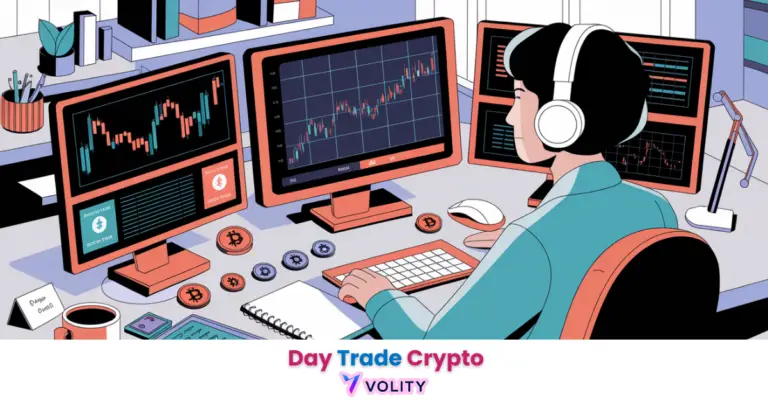
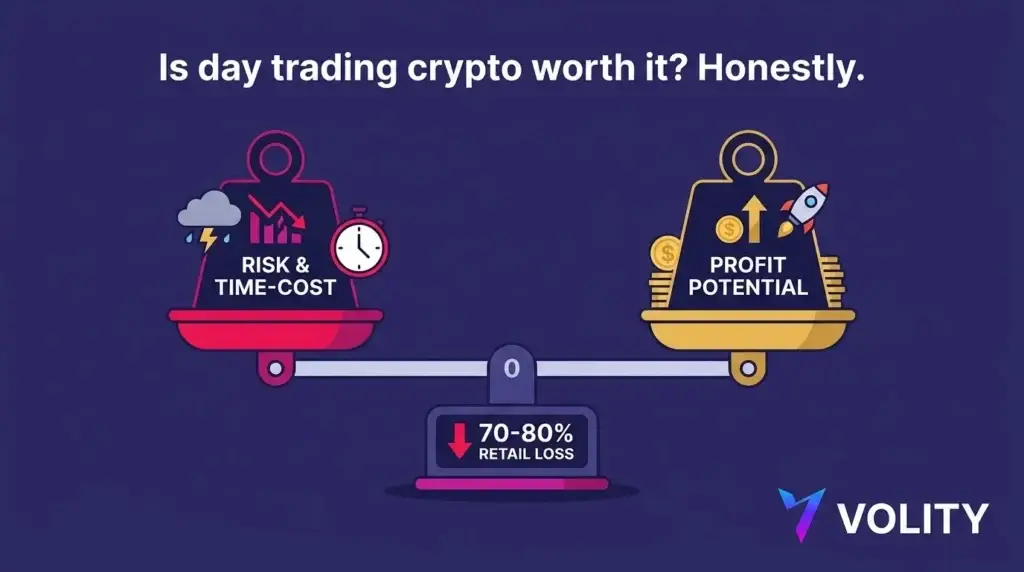
Is day trading crypto worth it? The honest answer is: for most people, no. For a small minority who treat it as a craft, yes. Broker disclosures across the EEA show 70-80% of retail CFD accounts lose money. Crypto sits at the high end of that range. The maths gets more interesting once you separate “day trading as a side hustle” from “day trading as a profession”. The first almost never pays. The second can, with a specific set of conditions.
What does “worth it” actually mean?
Three different yardsticks people use without realising they are using different ones:
- Financial: do you make more after costs and tax than a passive index would have made you?
- Time-adjusted: would the hours you spend trading earn more in your actual job at your hourly rate?
- Skill-acquisition: are you building a transferable skill (markets, risk, execution) that pays you in other ways?
The honest answer for most readers under each yardstick: financial no, time-adjusted no, skill-acquisition sometimes yes if approached deliberately.
What do the base rates actually say?
Three data points that frame the field:
- Broker-published retail loss rates (ESMA-mandated disclosure): 70-80% of retail CFD accounts lose money.
- Peer-reviewed work on day traders in Brazil and Taiwan: only a very small fraction of accounts beat a minimum wage after costs over a full year, and the same handful persist from one period to the next (see the published papers from Terrance Odean’s work with Brad Barber, Yi-Tsung Lee and Yu-Jane Liu).
- Cost drag: crypto spreads and funding costs are wider than in major FX, so the same strategy needs a larger gross edge to survive the same number of round trips.
Your job, if you decide to do this, is to be in the small upper tail. Pretending the base rate does not apply to you is the most expensive thing you can do.
What does it actually cost to day trade crypto?
- Spread + commission: check your own broker’s round-trip cost on the pairs you actually trade, then multiply it by your real trade count. At five trades a day, five days a week, even a small round-trip cost compounds into a weekly hurdle before any strategy runs.
- Time: realistically 4-6 focused hours a day, plus journal review and study. Twenty-five to forty hours a week.
- Tooling: charting platform, VPS if running automation, journal software. A recurring monthly cost that has to be earned back before the account is flat.
- Capital at risk: enough that a realistic percentage return is a meaningful sum. Below that, fixed costs dominate whatever the strategy earns.
- Tax compliance: every closed trade is potentially a taxable event in your jurisdiction. Tooling and time, every year.
When is it worth it?
Five conditions, all of which need to hold:
- You have at least 12 months of survival capital outside the trading account. You should not need the trading P&L to pay rent.
- You have a documented edge from at least 200 paper trades. Not a feeling, a spreadsheet.
- You can hold a 1% per trade risk discipline. If you have ever blown a stop, the system is not ready.
- You have a regime check. Trend, range, news-driven. You know which conditions favour your edge and you stand down in the others.
- You enjoy the process. Day trading is not romantic, it is repetitive screen time. If you do not find the work itself satisfying, you will not survive a 6-month flat stretch.
When is it not worth it?
- If you are using money you cannot afford to lose.
- If the account is small enough that a normal drawdown would end it.
- If you have a full-time job with rigid hours that prevent screen time at the right windows.
- If you cannot accept that 12 months of effort might net zero or negative.
- If you are doing it because someone on social media made it look easy. They were the marketing, not the data.
The alternatives that often pay more
For most readers, the financially-superior alternatives to day trading are dull:
- Passive crypto allocation: a small, fixed share of net worth, rebalanced on a schedule rather than on a view.
- Swing trading on the daily timeframe: far fewer trades a month, less screen time and a much lower friction cost for the same underlying idea.
- Funding-rate harvesting: mechanical, lower stress, scales with capital.
How we frame it on the desk
Day trading crypto is worth doing if you treat it as a craft, you can absorb the base-rate risk of failure, and you have the time and capital floor. It is not worth doing as a side hustle, a get-rich-quick scheme, or a hobby funded by money you need next year. We watch our own retail flow and the consistent winners share three traits: they have been at it for at least two years, they trade fewer than five setups a day, and they keep a written journal.
Day trading at Volity
Volity offers MT4 and MT5 access on 20+ cryptocurrencies, retail crypto leverage capped at 1:2 under ESMA, and negative balance protection. Eligible retail clients of UBK Markets are covered by the Cyprus Investor Compensation Fund up to EUR 20,000 per client per firm in the event of broker insolvency. Execution is by UBK Markets Ltd (CySEC 186/12).
Volity operates a trading platform and also publishes educational and analytical content about trading. The content on this page is for educational purposes only and should not be considered financial advice. Volity may benefit commercially when readers open trading accounts through links on this site.
Our content is produced and reviewed under documented editorial standards; see our comparison and review methodology.