Quick answer
Risk management in commodity trading means protecting your capital from the sharp, news-driven swings commodities are known for, through position sizing, stop-losses, and limiting how much you risk per trade. Commodities can gap on supply shocks and geopolitics, so disciplined sizing and stops matter even more than in calmer markets. Never risk more than a small percentage per trade.
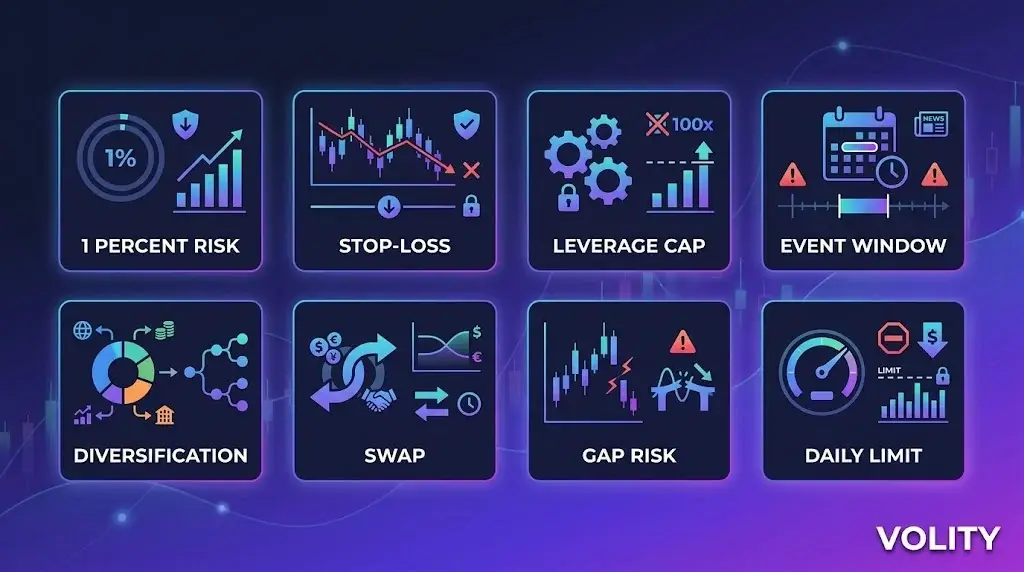
Risk management in commodity trading must account for distinct risks from forex or stocks: weather shocks, OPEC announcements, geopolitical gaps, storage cycle dynamics. Risk management has to account for these specific patterns. Here are eight practical rules that work for retail commodity traders on Volity.
Rule 1: 1% risk per trade maximum. A losing commodity trade should reduce your equity by at most 1%. On a $10,000 account, $100 per trade. This single rule prevents most blow-ups across commodities.
Rule 2: Stop-losses on every position. Commodity prices gap on news. Without stops, single bad trades destroy weeks of work. Set the stop at order entry; do not move it against you.
Rule 3: Cap leverage at 1:10-1:20 for retail. Volity supports up to 1:500 on commodities. Most retail strategies work better at 1:10 to 1:20 with proper position sizing. Maximum leverage is for proven strategies on small position sizes.
Rule 4: Reduce size around event windows. EIA oil reports (Wed 10:30 EST), WASDE crop reports (monthly), OPEC meetings, hurricane forecasts. These produce 2-8% moves in minutes. Either hold positions through events with full awareness, or close before.
Rule 5: Diversify across commodity categories. Trading only oil concentrates exposure to OPEC and geopolitical risk. Spreading across energy, metals, agriculture reduces correlation risk. The same diversification logic underpins the work of macro investor Ray Dalio. Volity supports 150+ instruments; use the breadth.
Rule 6: Account for swap fees on overnight holds. Long-term commodity positions accumulate swap costs. Budget for 7-30 days of swap per swing trade. Evaluate trade economics including the carry cost.
Rule 7: Plan for gap risk. Crude oil markets close on weekends; geopolitical events during the gap can produce Sunday-evening reopens 5-10% away from Friday close. Hold positions across weekends with this in mind.
Rule 8: Walk away after a 3% daily drawdown. Tilt is real. The trade after a bad streak is statistically often the worst trade of the day. End the trading day at a 3% drawdown, journal what happened, resume tomorrow.
How Volity supports commodity risk management:
- Stop-loss orders native in Volity MT
- Position-size calculator in the order ticket
- Negative balance protection caps maximum loss at deposit
- Account-level daily loss alerts can be configured
- Annual P&L statements for monthly review
Specific commodity risk patterns to be aware of:
- Oil: OPEC surprises (announced meetings, surprise outcomes), Middle East tensions, hurricane disruptions to Gulf production
- Natural gas: Polar vortex winters, hot AC summers, EIA storage report Thursdays
- Gold: Federal Reserve policy moves, USD strength shifts, geopolitical safe-haven flows
- Agricultural: Weather forecast errors, USDA WASDE surprises, frost-season volatility for coffee
- Industrial metals: China demand signals, manufacturing PMI surprises
Each commodity has its own risk profile; one-size-fits-all risk management is incomplete. Customize by instrument.
Key Takeaways
Risk management in commodity trading distinguishes profitable retail traders from blow-ups. The single biggest predictor of risk management in commodity trading success is the 1% per-trade rule combined with stop-losses on every position.
Three risk management in commodity trading habits that work:
- Cap leverage at 1:10-1:20 for retail commodity exposure
- Plan position size around event windows (EIA, WASDE, OPEC)
- End the trading day at 3% drawdown; tilt risk after losses destroys more accounts than wrong analysis
Volity’s negative balance protection and stop-loss orders make risk management in commodity trading enforceable at the platform level.
Sources
Related Volity commodities pages
- Volity Commodities Platform: 150+ Markets, 1:500, 24/5
- Commodity Futures vs CFDs: Which Suits Retail?
- Commodity ETFs Explained vs CFD Trading on Volity
- Agricultural Commodities Trading: Grains, Softs, Livestock
- Silver Trading on Volity: XAG/USD CFDs, 1:500
- Crude Oil Trading: WTI CFDs on Volity with 1:500
- Commodities Trading Online: How CFDs Make Markets Accessible
- Commodity Day Trading: Energy, Metals, Agriculture
Frequently Asked Questions
What is the most important risk management rule in commodity trading?
1% risk per trade maximum. This single rule prevents most retail blow-ups. Pair with stop-losses on every position for the foundation.
How much leverage should I use for commodities?
Volity supports up to 1:500. Most retail strategies work better at 1:10 to 1:20 with strict position sizing. At 1:100, a 1% adverse move wipes 100% margin; commodities routinely move more than that.
Should I trade commodity events like EIA or WASDE?
Either hold through events with full position-size awareness, or close before. The middle path (positioned but with normal size) is the worst outcome, you take event volatility without strategic gain.
How do I avoid commodity gap risk?
Crude oil and other futures-based CFDs close on weekends. Hold across weekends only with reduced size or in the direction of fundamental thesis. Avoid holding leveraged commodity positions through Friday close if you cannot tolerate Sunday gaps.
What is the safest commodity to trade?
Gold (XAUUSD) has lower historical volatility than oil or natural gas. Industrial metals (copper) are between. Energy and softs are higher volatility. “Safer” means smaller average daily moves; all commodities carry meaningful risk under leverage.
Should I diversify across commodities?
Yes. Trading only one commodity concentrates exposure to specific catalysts (OPEC for oil, weather for agri, central banks for gold). Spreading across categories reduces correlation risk and provides more trade opportunities.