Quick answer
Commodities trading online means buying and selling raw materials like gold, oil, silver and gas through a broker platform, usually as CFDs or futures, with leverage and the ability to go long or short. It gives access to global commodity markets without handling physical goods. As leveraged products, online commodity trades amplify gains and losses, so use stops and size carefully.
Commodities trading online means accessing markets through electronic platforms rather than physical exchanges. For retail traders, online CFD trading is the practical route into commodity markets that were historically institutional-only. Volity offers 150+ commodity CFDs online via Volity MT with leverage up to 1:500.
How online commodity trading works:
- Open an account with an online commodity broker (Volity, or futures-focused brokers like Interactive Brokers, TradeStation)
- Fund the account
- Access market data through the platform’s terminal
- Place orders electronically; trades fill on the broker’s execution engine
- Manage positions, P&L, and account from the same interface
The “online” part is the electronic access. Historically, retail commodity exposure required calling a futures broker by phone; now you click and trade.
Why online CFD trading vs traditional futures:
| Feature | Online CFD (Volity) | Online Futures |
|---|---|---|
| Account minimum | $1 | $1,000-$10,000+ |
| Contract size | Flexible (0.01 lot) | Fixed standard (5,000 bushels of corn, 1,000 barrels of oil) |
| Expiry management | None | Monthly/quarterly roll |
| Leverage | Up to 1:500 product-dependent | Margin-based (~3-10% of notional) |
| Commission | Spread-based, $0 on Markets | Per-contract fee ($1-5) |
| Multi-asset account | Yes (forex + crypto + commodities) | Often segregated futures account |
For retail traders, online CFD trading is more accessible. For traders specifically needing futures (tax treatment, large institutional sizing), futures-broker is appropriate.
Commodities you can trade online:
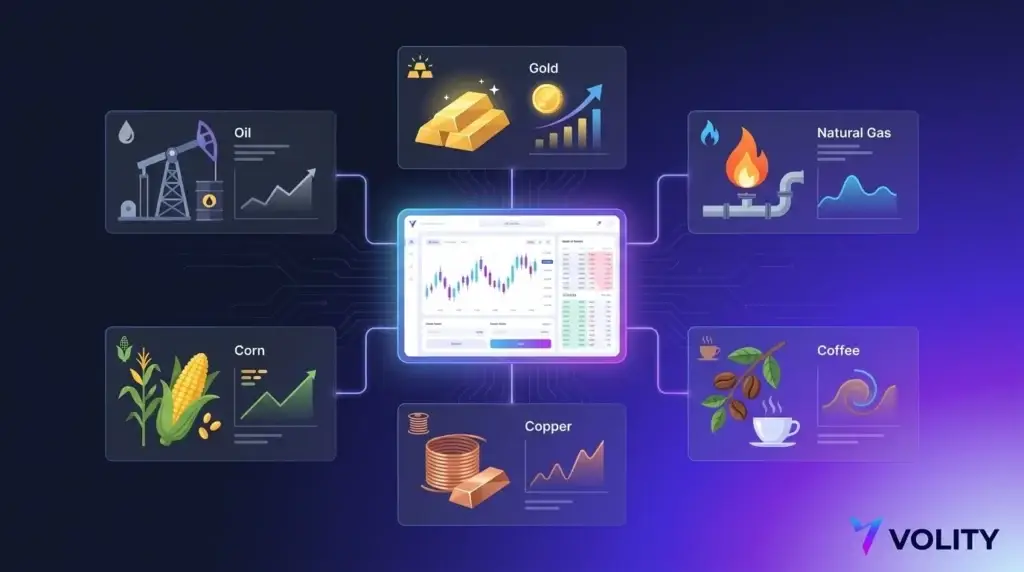
Energy: WTI crude, Brent crude, Henry Hub natural gas, heating oil, gasoline Precious metals: gold (XAUUSD), silver (XAGUSD), platinum, palladium Industrial metals: copper, aluminium, nickel, zinc Agricultural grains: corn, wheat, soybeans, rice Soft commodities: coffee, sugar, cocoa, cotton, orange juice Livestock: lean hogs, live cattle, feeder cattle
Volity’s 150+ commodities span all six categories.
What makes good online execution:
- Fast fills: sub-1-second on most major commodities
- Tight spreads: competitive with futures markets on liquid contracts
- Reliable order types: market, limit, stop, OCO, trailing stop
- Real-time data: live tick prices, not delayed snapshots
- Charting: integrated TradingView or equivalent
Volity meets all five.
What to expect when you start online commodity trading:
Week 1-2 (Demo): practice platform mechanics, place 10-20 trades across 3+ commodities, get familiar with how each behaves Week 3-4 (Demo): pick one commodity to focus on first (e.g., gold for lower volatility), practise risk management Month 2 (Live small): open live with smallest viable size, trade your chosen commodity, journal everything Month 3+: scale up based on demonstrated results; add additional commodities
Costs to plan for:
- Spread on each trade (built into price)
- Swap on overnight positions (small to large depending on commodity and rate environment)
- 1% FX conversion if funding currency differs from trading currency
- No commission on Markets accounts
- No data fees, no platform fees
Total cost of trading on Volity is competitive with other major regulated brokers.
Risk in online commodity trading:
- Event-driven volatility (EIA, WASDE, OPEC, Fed)
- Gap risk on weekend closes for futures-based commodities
- Concentration risk in any single commodity
- Leverage amplifies losses; commodities routinely move 1-3% intraday
Standard risk management (1% per trade, stops, leverage discipline) applies.
Sources
Related Volity commodities pages
- Volity Commodities Platform: 150+ Markets, 1:500, 24/5
- Commodity Futures vs CFDs: Which Suits Retail?
- Commodity ETFs Explained vs CFD Trading on Volity
- Agricultural Commodities Trading: Grains, Softs, Livestock
- Silver Trading on Volity: XAG/USD CFDs, 1:500
- Crude Oil Trading: WTI CFDs on Volity with 1:500
- Commodity Day Trading: Energy, Metals, Agriculture
- Risk Management in Commodity Trading: 8 Rules That Work
Frequently Asked Questions
Can I trade commodities online?
Yes. Online CFD trading on Volity lets retail traders access 150+ commodities (oil, gold, gas, agricultural, metals) from one account. Live execution via Volity MT with 99.6% sub-1s fills.
What is the cheapest way to trade commodities online?
For retail: CFD via Volity. $1 minimum, no commission on Markets, spread-based pricing, 1:500 leverage product-dependent, no per-contract fees. Futures markets have higher access friction for small accounts.
What online commodities should beginners trade?
Gold (XAUUSD) has lower historical volatility than oil/gas, a starting point for learning commodity mechanics. WTI crude has more volatility but predictable EIA events. Major agricultural (corn, soybeans, wheat) have monthly WASDE events.
Do I need special licenses to trade commodities online?
No special license for retail. KYC is required for any regulated broker (Volity included). Volity operates under CySEC 186/12; account onboarding includes ID and address verification.
What times can I trade commodities online?
Markets follow underlying futures schedules. Oil and metals: roughly Sunday 23:00 GMT to Friday 22:00 GMT with brief daily settlement breaks. Agricultural: US session primarily. Gold trades almost 24 hours. Specific hours per instrument visible in Volity MT.
Are online commodity profits taxable?
Yes in most jurisdictions. CFD profits typically taxed as derivatives gains or capital gains. Treatment varies by country. Volity provides annual P&L statements for tax filing; consult a local tax advisor.
What is the difference between online commodity trading and physical commodity investment?
Online trading (CFDs, futures) is leveraged price exposure. Physical commodity investment (bullion, ETFs holding physical) is unleveraged ownership. Different tools: online for active trading; physical for long-term wealth preservation.