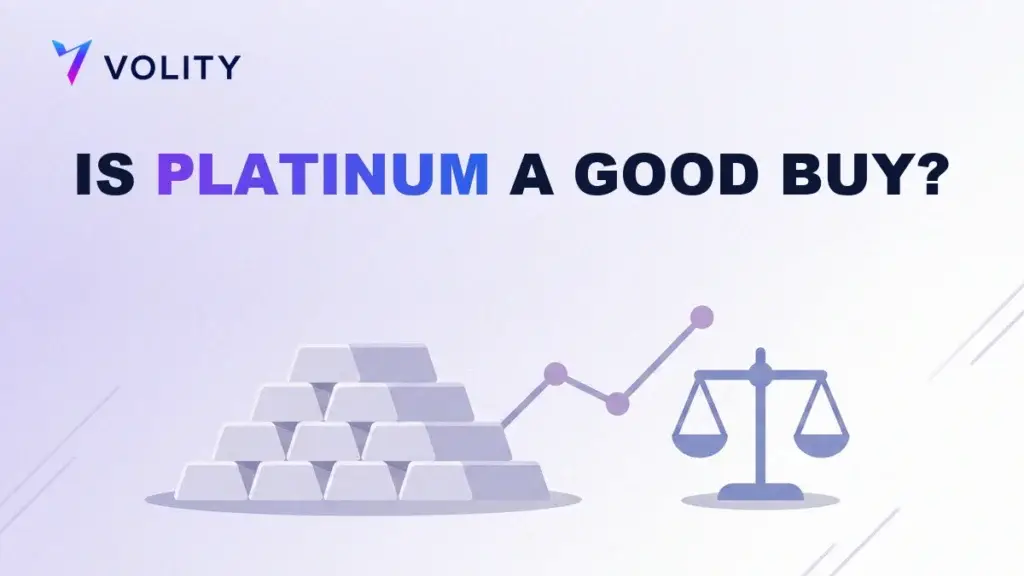
Platinum can be a worthwhile holding for investors who want a metal tied to industry rather than to safe-haven flows, though it trades in a thin, volatile market, pays no income, and leans heavily on the car industry for demand. Whether it earns a place in your portfolio comes down to your time horizon, your appetite for sharp swings, and how you plan to hold it. This guide sets out the honest case for and against platinum, then the practical ways to get exposure, including CFDs on Volity.
Here is what matters before you decide.
- Platinum produces no yield, so your return depends entirely on the price rising while you hold it.
- Around 70% of mined platinum comes from one country, South Africa, which leaves supply exposed to a single set of problems.
- Close to half of yearly demand comes from the car industry, so platinum moves with the economic cycle and the shift toward electric vehicles.
- Platinum was the best-performing precious metal of 2025, but that run started from a low base and came with big swings.
- For most people platinum works as a small, considered position rather than the core of a portfolio.
Why do people invest in platinum?
The strongest reason is industrial demand. Platinum is a workhorse metal, and its largest single use is in autocatalysts, the devices that clean exhaust gases in petrol and diesel vehicles. The car industry takes close to half of annual demand, with the rest going into chemicals, glass, petroleum refining, electronics and medical devices, according to the United States Geological Survey. That industrial backbone means platinum can hold demand even when investment interest is quiet. If precious metals are new to you, our overview of investing in precious metals covers the basics.
Supply matters just as much. Around 70% of new platinum comes from a small stretch of South Africa, where the deep ore bodies are costly and slow to expand. The World Platinum Investment Council reported a third consecutive annual supply deficit in 2025, which drew above-ground stocks down to a little over four months of global demand. A market that keeps using more than it mines is a large part of why prices have firmed.

Then there is the growth story. Platinum works as a catalyst in the fuel cells that power hydrogen vehicles and in the electrolysers that split water to make green hydrogen. This is a small slice of demand today, but the Council’s research suggests hydrogen could add close to 900,000 ounces of yearly demand by 2030 if policy support holds, as it sets out in its work on hydrogen demand. That growth angle, plus a long-standing discount to gold, is a large part of the appeal.
What are the risks of investing in platinum?
Start with the drawback that applies to any metal. Platinum pays you nothing while you own it, so it carries a real opportunity cost against a dividend-paying share or an interest-paying bond. Your whole return has to come from the price going up.
Then there is volatility. Platinum trades in a far smaller market than gold, so prices can move violently in either direction. That was clear in 2025, when platinum climbed to an all-time high near $2,320 an ounce during a sharp autumn rally before giving some of it back, as Kitco reported. Buying straight after a run like that raises the risk of a painful pullback.
The deepest risk is structural. Because the car industry drives demand, platinum is tied to the economic cycle and to the move away from combustion engines. A battery electric car uses no autocatalyst, so if pure electric vehicles replace petrol and diesel faster than expected, the metal’s biggest demand pillar shrinks, and the USGS expects autocatalyst demand to soften as electrification spreads. Hybrids and tighter emissions rules offset some of this, but the long-run direction is a genuine question. Leverage adds a further risk, which is why both the Financial Conduct Authority and the European Securities and Markets Authority cap retail leverage on commodities and require clear risk warnings.
Platinum vs gold: how do they compare?
Platinum and gold get lumped together as precious metals, yet they behave very differently. Gold is a monetary metal, bought as a store of value and a safe haven and held in size by central banks. Platinum is an industrial metal that happens to be precious, so it tracks factory demand and the car cycle far more closely than it tracks fear in the markets. When shares fall, gold often rises, while platinum can fall with everything else because a weaker economy means fewer cars.
Price history tells the story. Platinum was once dearer than gold and earned the nickname “rich man’s gold,” but the collapse in diesel demand after the 2015 emissions scandal cut its autocatalyst use, and it has traded at a steep discount to gold ever since, as the International Precious Metals Institute describes. Even after the 2025 surge, an ounce of platinum still costs a fraction of an ounce of gold. UK buyers face a tax gap as well. Investment-grade gold is exempt from VAT, but platinum bullion is standard-rated at 20% VAT, as set out in HMRC’s investment gold guidance and by The Royal Mint, a real cost to overcome before physical platinum turns a profit. For the safe-haven side of the trade, our guide to gold trading covers the other metal in depth.
What does the platinum price forecast say?
Forecasts are opinions with wide error bars, not targets to trade on, so treat every view as one scenario among many. The bullish case rests on the supply shortfall. With deficits stacking up and above-ground stocks thinning, the World Platinum Investment Council argues the market has moved onto a firmer footing and sees the tightness persisting in its two-to-five-year view. The 2025 rally that carried platinum above its 2008 record was driven by that deficit, a squeeze in lending rates and a wave of fresh buying, which the LBMA prices through the London Platinum and Palladium Market.
The cautious case matters just as much. Sharp moves reverse, analysts disagree by wide margins, and the same electrification that threatens autocatalyst demand hangs over the long-run outlook. Platinum has spent long stretches going nowhere, and past gains never promise future ones, so treat any single bold prediction as a scenario rather than a signal.
How can you invest in platinum?
There are three main routes, and they suit different goals. The first is physical metal, meaning bars and coins bought from a dealer and kept at home or in a vault. You own the metal outright, but you take on storage, insurance, the dealer spread, and that 20% VAT on bullion in the UK. Platinum coins such as the Britannia are legal tender, so they share the Capital Gains Tax exemption their gold cousins enjoy on any profit, as The Royal Mint explains, though the upfront VAT still applies.
The second route is a platinum-backed fund. These exchange traded products hold the metal for you and trade like a share through an investment account, which sidesteps storage and lets you buy and sell for a small annual fee. They work much like the funds in our look at commodity ETFs, and you never handle the metal yourself.
The third route is a contract for difference, which tracks the platinum price without owning any metal. A contract for difference lets you go long if you expect a rise or short if you expect a fall, and you post margin rather than the full value. On Volity you can trade platinum as a CFD through the Volity MT platform, alongside gold, silver and other markets in one account, with leverage of up to 1:500 depending on the product. You can open an account for $0, invest from $1, and start trading from $1, with Volity operating under CySEC licence 186/12 through UBK Markets. Because leverage magnifies losses as much as gains, a CFD suits shorter-term trading and hedging rather than a long buy-and-hold, and the FCA warns that most retail CFD accounts lose money. You can trade commodities on Volity from the same wallet you use for everything else, with full pricing on the charges and fees page, and silver trading works in a similar way if you want a second industrial metal.
So, should I invest in platinum?
For most people the sensible answer is a cautious maybe, as a small satellite holding rather than a core one. The supply picture is genuinely tight and the hydrogen story gives platinum a growth angle that gold does not have, but against that sit real drawbacks, since platinum pays no income, swings hard, and depends on a car market that is slowly changing shape. If you buy, size the position to what you can afford to lose and do not let a recent rally do your thinking for you. It is worth reading platinum alongside its closest cousin, whether palladium is a good investment, and against the monetary metals to see if gold or silver suits you better. This article is general information and not personal financial advice, so weigh it against your own circumstances first.
Want to see how platinum moves before risking real money? Open a free Volity demo account and practise with virtual funds first.
Frequently asked questions
Is platinum a good investment right now?
Platinum enters this period on the back of a strong 2025 and a run of supply deficits, which supports the price, but it also sits well above where it started the year. Tight supply is a real tailwind, yet buying just after a big move raises the risk of a pullback, so treat it as a small diversifier rather than a sure thing.
Is platinum a better investment than gold?
Neither is simply better, because they do different jobs. Gold is a monetary safe haven with a deep, liquid market and no UK VAT on investment-grade bullion, so it tends to steady a portfolio in a crisis. Platinum is a cyclical industrial metal that tracks the car cycle, trades in a thinner market, and carries 20% VAT on physical bullion, making it a higher-risk play on industry and hydrogen.
How can beginners invest in platinum?
The simplest starting points are a platinum-backed fund inside an ordinary investment account, or a small allocation of coins from a reputable dealer if you want the metal itself. Both avoid the leverage that makes trading risky. If you would rather trade the price short term, a platinum CFD on Volity lets you start small and practise on a free demo, though leverage magnifies losses.
Why is platinum cheaper than gold?
Platinum once traded above gold, but the fall in diesel demand after 2015 cut a large chunk of its autocatalyst use while gold climbed on safe-haven and central-bank buying. That left platinum at a steep discount that held through 2025 even as it rallied hard, and whether the gap closes depends on industrial and hydrogen demand recovering faster than investors expect.