Palladium can be a good investment for people who understand what actually drives it, but it is not a quiet buy-and-hold saver’s asset. Almost all its demand comes from catalytic converters in petrol and hybrid cars, and almost all its supply comes from two countries, Russia and South Africa. That narrow base has produced both spectacular rallies and brutal falls. Whether it belongs in your portfolio depends on your time horizon, your view on electric vehicles, and how you get exposure.
Key points before you invest
- Roughly 80 to 90% of palladium demand comes from vehicle autocatalysts, mostly petrol and hybrid engines.
- Supply is concentrated in Russia and South Africa, making the price sensitive to sanctions, mine cuts and geopolitics.
- Palladium hit a record near $3,440 an ounce in March 2022, then fell by more than two thirds by late 2024.
- The biggest long-term threat is the battery electric vehicle, which uses no catalytic converter at all.
- Most investors get exposure through physical bars, exchange-traded products or contracts for difference.
What is palladium and what moves its price?
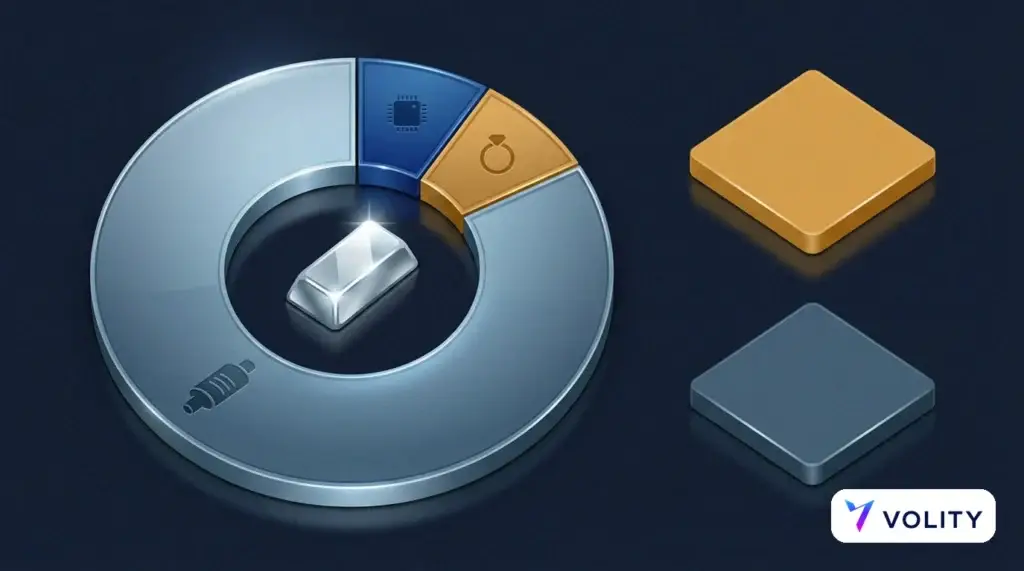
Palladium is one of the six platinum group metals, a soft, silvery-white metal rarer than gold. What defines it as an investment is how narrow its demand is. Industry analysis compiled by The Oregon Group puts more than 80 to 90% of palladium demand in the automotive sector, where it sits inside the catalytic converter that scrubs pollutants from petrol exhaust. Jewellery, electronics and dentistry take the rest. In short, palladium is a bet on how many petrol and hybrid cars the world builds.
Supply is just as concentrated. Russia’s Norilsk Nickel produced around 2.75 million ounces in 2024 and accounts for roughly 40% of mined palladium, with South Africa supplying most of the rest, as reported by Euronews. The European Commission lists palladium as a critical raw material precisely because so much supply sits in politically sensitive places, a point set out in its supply-security briefing. The result is an asset whose price can be moved sharply by a single mine strike, a sanctions headline or a shift in car production.
Should I invest in palladium? The case for
The bullish argument rests on scarcity. Palladium ran a supply deficit every year from 2012 to 2024, according to the Johnson Matthey 2025 PGM Market Report. The Oregon Group puts the shortfall at about 0.91 million ounces in 2023 and 0.50 million in 2024, together roughly 15% of a year’s demand. When a market consumes more than it produces for a decade, inventories thin and prices turn jumpy on any supply scare.
That is what happened in early 2022. When Russia invaded Ukraine, spot palladium spiked to an all-time high near $3,440 an ounce as traders priced in the risk that Russian metal could not reach the market, a rally documented by MetalMiner. The bulls also read the electric-vehicle story as softer than the headlines suggest. The International Energy Agency notes that while global EV sales keep rising, growth is slowing in several major markets as subsidies are rolled back, and petrol hybrids, which still use catalytic converters, are selling well. If combustion fades slowly, palladium demand holds up longer than pessimists assume.
The case against palladium
The bearish case starts with that same technology. A pure battery electric vehicle has no exhaust and no catalytic converter, so every combustion car it replaces removes palladium demand for good. Johnson Matthey expects lower petrol vehicle production to cut automotive palladium demand by about 5% in 2025 and to push the market from persistent deficit toward balance. Heraeus Precious Metals goes further, warning through its head of trading that palladium “may face a widening surplus as battery electric vehicles gain market share,” in comments reported by the Investing News Network.
Volatility is the next problem. Palladium trades in a small, thin market, so moves are violent in both directions. After peaking near $3,440 in 2022 it fell to around $813 an ounce by August 2024, a drop of more than three quarters, as charted by the precious-metals consultancy SFA (Oxford). Physical palladium also pays no dividend or interest, costs money to store and insure, and in the UK and many other jurisdictions it carries VAT, unlike investment-grade gold. An asset that earns nothing has to rise just to justify holding it.
Palladium vs platinum: how do they compare?
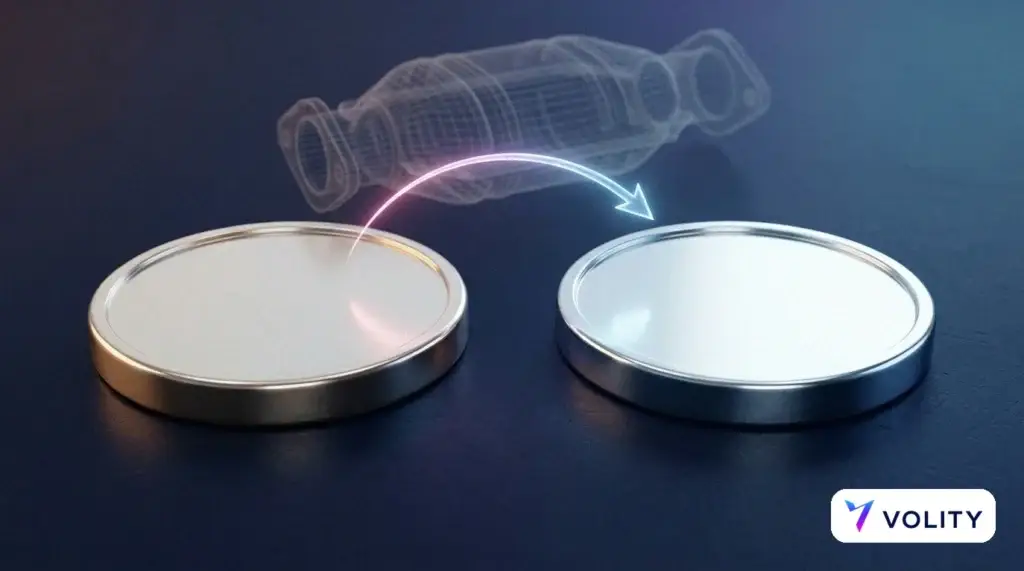
Palladium and platinum are close cousins, and the relationship between them is central to the investment case. Both are platinum group metals used in autocatalysts, but their demand profiles differ. Platinum spreads across diesel catalysts, jewellery, industry and a growing role in hydrogen fuel cells, while palladium is overwhelmingly a petrol-catalyst metal. That matters because carmakers can, within limits, swap one for the other.
Because palladium traded at a premium to platinum from 2017 onward, engineers began designing cheaper platinum back into petrol catalysts. The World Platinum Investment Council estimates this substitution at about 620,000 ounces in 2023, rising toward 700,000 in 2024, and stresses that once a swap is engineered into a vehicle it is typically locked in for that platform’s life of around seven years. The Royal Mint makes the same point. The takeaway for an investor is blunt: some palladium demand has already moved permanently to platinum and will not return quickly even if palladium gets cheap again.
| Feature | Palladium | Platinum |
| Main demand source | Petrol and hybrid autocatalysts | Diesel catalysts, jewellery, industry, hydrogen |
| Top supply regions | Russia, South Africa | South Africa, Russia, Zimbabwe |
| Electric-vehicle risk | High, no use in pure EVs | Lower, aided by fuel-cell demand |
| Substitution role | Being replaced by platinum | Winning share from palladium |
Palladium price forecast: what are analysts saying?
No one can promise where palladium goes next, and honest forecasts come as ranges, not single numbers. For 2026, Heraeus Precious Metals projects a band of roughly $950 to $1,500 an ounce, reflecting a market it sees drifting toward surplus, per the Investing News Network. Other analysts sketch a base case nearer $1,300 to $1,600, a spread the International Precious Metals Institute ties to the tug-of-war between lost EV demand and fragile supply.
The width of those ranges is the real message. When credible desks disagree by 50% or more, the fundamentals are balanced on a knife edge between supply risk and demand decline. That is why palladium suits a tactical, actively managed position more than a long-term store of value, and why position sizing and a clear exit plan matter so much here. For a genuine long-term store of value, the monetary metals are the better comparison, so it is worth weighing whether gold is a good investment or even silver instead.
How to invest in palladium, including on Volity
There are four common routes, each with a different trade-off between ownership, cost and flexibility.
- Physical bars and coins. You own the metal outright, but pay dealer spreads, storage and insurance, usually pay VAT, and earn nothing while you hold it.
- Exchange-traded products. A physically backed palladium ETC tracks spot without you handling metal. Our guide to commodity ETFs explains how these vehicles work.
- Futures. Exchange-traded contracts give direct exposure but come in large sizes and must be rolled before expiry, which suits professionals. See our comparison of commodity futures versus CFDs.
- Contracts for difference. A CFD lets you trade the palladium price in both directions with no metal to store.
On Volity you trade palladium as a contract for difference, taking a position whether you expect the price to rise or fall, with no bars to store and no VAT to pay. Because a CFD is leveraged, a smaller deposit controls a larger position, with leverage available up to 1:500 depending on the instrument. New to trading metals this way? Our CFD gold trading explainer covers spreads and leverage, and the broader gold and commodity trading guide sets the context. You can open an account for $0, invest from $1 and trade from $1, with Volity operating under CySEC oversight (licence 186/12) through UBK Markets, and the full metals line-up sits on the Volity commodities trading platform. Leverage magnifies losses as easily as gains, so read the FCA’s guidance on high-risk investments and practise on a free demo account first.
This article is general information and education, not personal financial advice. Palladium is a volatile asset and past price moves are no guide to future returns. Consider your own circumstances, and speak to a suitably qualified adviser if you are unsure before investing.
Palladium investment FAQs
Is palladium a better investment than gold?
They play different roles. Gold is a monetary safe-haven bought for stability, while palladium is an industrial metal whose price rides on car production and mine supply. Palladium is far more volatile and pays no monetary premium, so it can outperform gold in a supply squeeze but fall much harder when demand weakens. Most portfolios treat gold as a core holding and palladium as a smaller, tactical position.
Why did the palladium price fall so much after 2022?
Three forces combined. Carmakers substituted cheaper platinum for palladium in petrol catalysts, battery electric vehicles began removing catalyst demand outright, and the market moved from a decade of deficit toward balance as demand cooled. The result was a slide from a record near $3,440 in 2022 to around $813 an ounce by August 2024.
Is the world going to run out of palladium?
Depletion is not the near-term worry; concentration is. Known reserves and a growing stream of recycled metal from scrapped catalytic converters mean palladium is not about to disappear. The real risk is that so much fresh supply depends on Russia and South Africa, so a disruption in either place can move the price far more than any change in global reserves.