Quick answer
Commodity futures trading uses standardized contracts to buy or sell a commodity at a set price on a future date, used for both speculation and hedging. Futures offer leverage and deep liquidity but require larger capital and carry expiry. For most retail traders, commodity CFDs offer similar exposure with smaller size and no fixed expiry.
Commodity futures trading uses standardised contracts to buy or sell a commodity at a fixed price on a future date. They trade on regulated exchanges (CME, ICE) with defined contract sizes and expiry cycles. For most retail traders, CFDs offer the same directional exposure with smaller minimum sizes and no expiry roll. This page compares both paths.
What commodity futures are
A commodity futures contract specifies:
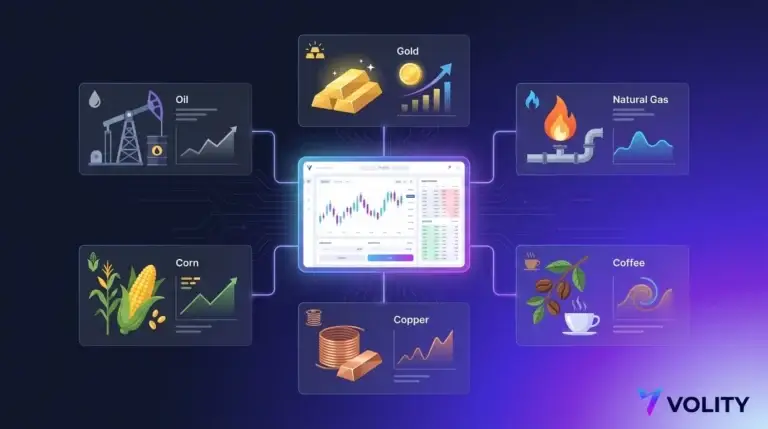
- The underlying commodity (WTI crude oil, gold, corn, etc.)
- The contract size (1,000 barrels of oil, 100 oz of gold, 5,000 bushels of corn)
- The delivery month (monthly or quarterly cycles)
- The delivery point (Cushing for WTI, COMEX warehouses for gold, etc.)
- The price (negotiated in trading; settles to market price at expiry)
The contract is standardised; only the price is negotiated. This makes futures highly liquid and tradeable.
Where commodity futures trade
| Exchange | Major contracts |
|---|---|
| CME Group (NYMEX, COMEX, CBOT) | WTI crude (CL), natural gas (NG), gold (GC), silver (SI), corn (ZC), wheat (ZW), soybeans (ZS) |
| ICE (Intercontinental Exchange) | Brent crude (B), gasoil (G), coffee (KC), sugar (SB), cocoa (CC), cotton (CT) |
| Dalian Commodity Exchange (China) | Iron ore, soybean meal, palm oil |
| Tokyo Commodity Exchange | Gold, platinum, rubber |
For retail traders, CME and ICE contracts (via licensed brokers) are the most accessible.
Contract specifications matter
Standard contract sizes are large:
| Contract | Size | Notional at indicative price |
|---|---|---|
| WTI crude (CL) | 1,000 barrels | $70,000 at $70/barrel |
| Gold (GC) | 100 troy oz | $200,000 at $2,000/oz |
| Natural gas (NG) | 10,000 MMBtu | $35,000 at $3.50/MMBtu |
| Corn (ZC) | 5,000 bushels | $25,000 at $5/bushel |
| Coffee (KC) | 37,500 lbs | $75,000 at $2/lb |
Most retail accounts cannot hold even one full contract. Brokers offer “mini” or “micro” contracts on some products (e.g., MNG mini natural gas at 2,500 MMBtu), but selection is limited.
Why retail traders often prefer CFDs
Three practical reasons:
1. Smaller contract sizes. Volity CFDs let you size positions to any multiple of small lot increments (0.01 lot minimum). The same commodity exposure, scaled to your account.
2. No expiry roll. Futures contracts expire monthly or quarterly. Holding a position across expiry requires closing the expiring contract and opening the next month, administrative overhead plus the roll spread cost. CFDs on Volity are open-ended.
3. Multi-asset account. Futures brokers typically specialise; you need a separate account from your stock or forex brokerage. Volity holds all asset classes (forex, indices, stocks, commodities, crypto) in one account.
Where futures beat CFDs
Three cases:
1. Tax-advantaged treatment. Tax treatment of futures gains depends on where you live; in some jurisdictions futures receive more favourable treatment than ordinary derivatives. CFDs typically taxed as derivatives gains.
2. Institutional-grade liquidity. For position sizes above $100,000 per trade, futures markets have deeper books than retail CFD venues. Most retail traders never hit this size limit.
3. Specific strategies tied to futures structure. Calendar spreads, basis trades, and contango/backwardation plays require actual futures contracts. CFDs do not replicate these.
For retail traders running directional strategies at sub-$50,000 position sizes, CFDs cover the use case more efficiently. For institutional or specialised structural trades, futures remain the right tool.
Cost comparison: same trade, two paths
A 30-day long position on WTI crude, $10,000 notional:
Via CFD on Volity: – Entry spread: indicative $5 round trip – Swap fee at 1:10 leverage: indicative $1 per day × 30 = $30 – Commission: $0 – Total cost: ~$35
Via NYMEX CL futures (mini contract): – Mini contract size = 500 barrels at $70 = $35,000 notional (closest to $10,000 needs 0.3 mini contracts which is not possible, must use full contract or different broker) – Commission per contract: $2-5 – Roll spread (if held across expiry): $5-15 – Plus margin requirement ~$5,000 per mini contract (for full $35,000 exposure) – Plus exchange data fees on some platforms
For a $10,000 directional position over 30 days, the CFD is more capital-efficient.
Risk comparison
| Risk | Commodity futures | Commodity CFD |
|---|---|---|
| Liquidation | Yes if margin breached | Yes if margin breached |
| Negative balance | Possible (in extreme moves) | Capped at deposit (NBP on Volity) |
| Counterparty | Exchange clearinghouse | Broker (CySEC-regulated for Volity) |
| Settlement | Cash or physical (by contract) | Cash, broker-settled |
| Expiry administration | Yes | None |
The negative balance protection on Volity CFDs is a meaningful retail-friendly feature. Futures accounts can go negative in extreme moves; CFD accounts at Volity cannot.
Sources
Related Volity commodity guides
- Commodity ETFs Explained vs CFD Trading
- Agricultural Commodities Trading on Volity
- Commodity Trading Platform on Volity
- Oil Trading on Volity: WTI and Brent CFDs
- Silver Trading on Volity: XAG/USD CFDs
Frequently asked questions
What is commodity futures trading?
Commodity futures trading uses standardised contracts to buy or sell commodities at fixed prices on future dates. Contracts trade on regulated exchanges (CME, ICE). Standard contract sizes are large ($25,000-$200,000 notional); retail access is through licensed brokers, sometimes with mini or micro contract variants.
What is the difference between commodity futures and commodity CFDs?
Futures have defined expiry, fixed contract sizes, and trade on exchanges with clearinghouse counterparty. CFDs are open-ended, flexible-size, and trade with a broker (Volity is CySEC-regulated). Futures suit institutional positions and tax-advantaged structures. CFDs suit retail directional trading.
Can I trade commodity futures on Volity?
Volity offers commodity CFDs, not actual futures contracts. The CFD prices reference the underlying futures or spot market. For traders specifically needing futures contracts (for tax treatment or specialised strategies), a dedicated futures broker is required.
What are the most popular commodity futures?
By global volume: WTI crude oil (CL), gold (GC), corn (ZC), natural gas (NG), Brent crude (B), soybeans (ZS), silver (SI), coffee (KC), sugar (SB), wheat (ZW). All available as CFDs on Volity for retail-friendly position sizing.
How much capital do I need for futures trading?
Initial margin for one standard contract typically runs 3-10% of notional value. One WTI contract at $70/barrel needs ~$5,000-7,000 margin. One gold contract needs ~$10,000-15,000 margin. With CFDs on Volity, the same exposure at 0.01-lot increments requires fraction of the capital.
Are commodity futures profits taxable?
Yes. Futures tax treatment varies by country; some jurisdictions offer a favourable blended capital-gains treatment for active traders. CFD gains are typically taxed as derivatives gains; treatment varies by country. Consult a local tax advisor.
Are commodity futures riskier than CFDs?
Futures can produce negative account balances in extreme moves (some brokers, not all). Volity CFDs cap downside at deposit via negative balance protection. Beyond this, the underlying market risk is similar; the wrapper does not change the volatility of the underlying commodity.