Quick answer
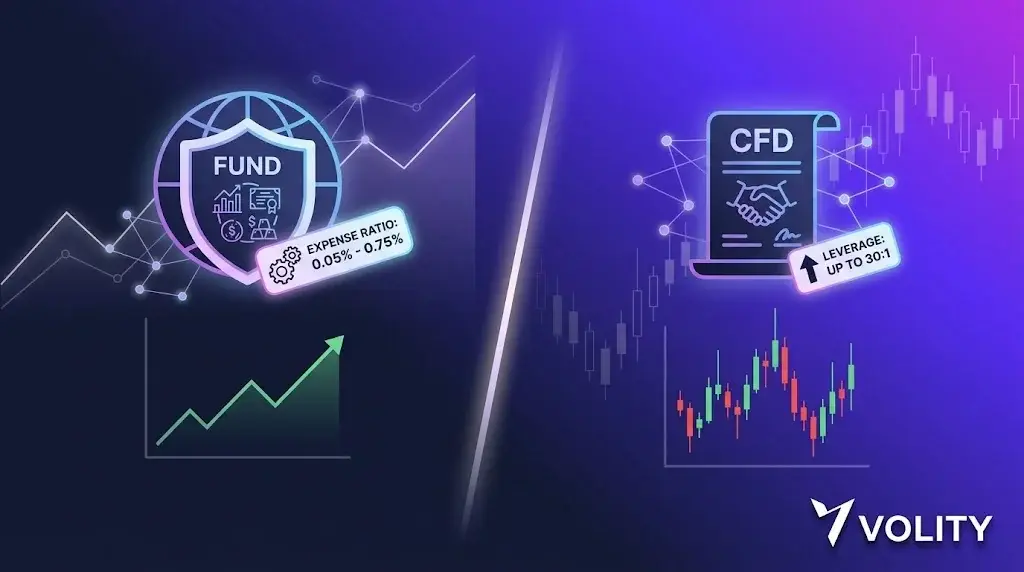
Commodity ETFs are funds that track the price of a commodity or basket of commodities, like gold, oil or agriculture, so you get exposure through a normal brokerage account without futures or physical goods. They are simple and liquid but charge an expense ratio and offer no leverage. Active traders often prefer commodity CFDs for leverage and short selling.
Commodity ETFs (exchange-traded funds) give you exposure to oil, gold, agricultural commodities, and broader baskets through a single ticker on a stock exchange. They suit passive long-term holders. For active traders, CFDs on Volity offer the same underlying exposure with leverage, no expense ratio, and the ability to go short. This page explains both.
What a commodity ETF is
A commodity ETF holds underlying assets (futures contracts, physical commodity, or a basket) and issues shares against them. The share price tracks the underlying commodity’s price with some tracking error. You buy shares like any stock; you sell shares to exit.
Three structural types:
1. Physical-backed ETFs. Hold the actual commodity in vaults. Common for gold (GLD, IAU) and silver (SLV, SIVR). Lowest tracking error for spot prices because the fund holds the underlying directly.
2. Futures-based ETFs. Hold rolling futures contracts. Common for oil (USO, UCO), natural gas (UNG), agricultural (DBA, JJG). Subject to contango/backwardation tracking error as futures roll.
3. Equity-based ETFs. Hold stocks of commodity producers (XLE for energy, GDX for gold miners). Track commodity prices indirectly through producer profitability.
How ETFs differ from CFDs
| Feature | Commodity ETF | Commodity CFD (Volity) |
|---|---|---|
| Account type | Brokerage / IRA | CFD broker |
| Underlying | Shares of fund | Contract for difference |
| Leverage | Generally none (or specialised leveraged ETFs ~2-3x) | Up to 1:500 product-dependent |
| Short selling | Possible but harder for retail | Native, one-click |
| Expense ratio | 0.20-0.95% annually | None |
| Tracking error | Real (contango drag, expense ratio) | None for spot CFDs |
| Roll cost | Implicit in futures-based ETFs | Swap fee at 22:00 GMT |
| Tax treatment | Capital gains | Derivatives (varies) |
| Available in | Stock-trading account | CFD trading account (Volity) |
When ETFs make sense
Long-term passive exposure. A 10-year horizon position in gold or oil works fine through GLD or USO. The expense ratio is small relative to the holding period. No active management required.
Tax-advantaged accounts. US IRAs and similar wrappers can hold ETFs but cannot trade CFDs. Long-term retirement allocations to commodities go through ETFs by default.
Simplicity preference. ETFs trade like stocks on regulated exchanges. Investors familiar with stock investing find the ETF wrapper more comfortable than CFDs.
No leverage desired. Most commodity ETFs are unleveraged. If your strategy does not require leverage, the ETF wrapper removes leverage-related risk entirely.
When CFDs beat ETFs
Active trading. Frequent entries and exits accumulate ETF expense ratios. CFD spreads paid on each trade are typically lower over a year of active trading.
Short selling. Going short oil through USO requires shares to borrow, often constrained. Going short oil through a Volity CFD is one click.
Leverage. A directional view with 1:10 or 1:20 leverage requires CFDs (or specialised leveraged ETFs, which carry decay risk).
Multi-asset accounts. ETFs sit in your stock brokerage; CFDs sit in your Volity account alongside forex, crypto, indices, stocks. One platform for all asset classes.
Tighter spot tracking. Futures-based ETFs drift from spot due to contango/backwardation in the futures curve. Volity CFDs price the underlying directly.
The contango drag problem
Futures-based ETFs roll their positions monthly. Each roll closes the expiring contract and opens the next month. In contango (further-month futures trade above near-month), this means selling cheap to buy expensive. Over a year of rolls in contango, this drag can subtract 5-15% from the ETF’s return relative to spot.
The classic example: USO during 2015 oil bear market. Spot oil fell ~30%; USO fell ~60% partly due to contango drag on top of spot decline.
Volity CFDs price spot directly. No roll, no contango drag. Swap fees on overnight leveraged positions exist but are typically smaller than annual contango drag.
Common commodity ETFs
| Ticker | Underlying | Type | Expense ratio |
|---|---|---|---|
| GLD | Gold | Physical | 0.40% |
| IAU | Gold | Physical | 0.25% |
| SLV | Silver | Physical | 0.50% |
| USO | WTI Crude Oil | Futures | 0.79% |
| UNG | Natural Gas | Futures | 1.06% |
| DBA | Agricultural basket | Futures | 0.93% |
| GSG | Broad commodities | Futures | 1.13% |
| GDX | Gold miners | Equities | 0.51% |
| XLE | Energy stocks | Equities | 0.09% |
Volity does not offer ETF trading. Volity offers CFDs on the underlying commodities directly. For traders who want exposure to specific ETFs, a stock-trading broker is the right tool.
Decision framework
Use ETFs when: – Long-term hold (3+ years) – Tax-advantaged account requires ETF wrapper – No leverage required – Comfortable with annual expense ratio – Want exposure to commodity producer equities (not pure commodity)
Use CFDs (Volity) when: – Active trading (multiple positions per month) – Short selling needed – Leverage required – Multi-asset account preferred – Want pure spot tracking with no contango drag
Sources
Related Volity commodity guides
- Commodity ETFs Explained vs CFD Trading
- Agricultural Commodities Trading on Volity
- Commodity Trading Platform on Volity
- Oil Trading on Volity: WTI and Brent CFDs
- Silver Trading on Volity: XAG/USD CFDs
Frequently asked questions
What are commodity ETFs?
Commodity exchange-traded funds (ETFs) are investment vehicles that track commodity prices through holding underlying assets, physical commodities, futures contracts, or producer equities. ETFs trade like stocks on exchanges. Examples: GLD (gold), USO (oil), SLV (silver).
What is the difference between commodity ETFs and CFDs?
ETFs trade as shares on stock exchanges with annual expense ratios (0.2-1%); CFDs trade through CFD brokers with spread costs but no expense ratios. ETFs are mostly unleveraged; CFDs offer leverage up to 1:500. ETFs suit long-term passive; CFDs suit active trading.
Does Volity offer commodity ETFs?
No. Volity offers CFDs on the underlying commodities (oil, gold, silver, natural gas, agricultural) directly. For ETF exposure (GLD, USO, SLV, etc.), a stock brokerage is the right tool.
Are commodity ETFs better than commodity CFDs?
Different tools for different jobs. ETFs are better for long-term passive exposure, tax-advantaged accounts, and unleveraged positions. CFDs are better for active trading, short selling, leverage, and multi-asset accounts. Many investors hold both.
What is contango drag in commodity ETFs?
Contango drag occurs when futures-based ETFs roll their positions. In contango (further-month futures above near-month), the ETF sells cheap and buys expensive on each roll. Over a year this can subtract 5-15% from returns vs spot. USO is the classic example of severe contango drag.
What is the expense ratio on commodity ETFs?
Typical expense ratios: 0.25-0.50% for physical-backed gold/silver (GLD, IAU, SLV); 0.79-1.13% for futures-based oil and agriculture (USO, UNG, DBA, GSG). The annual fee compounds over long holding periods.
Can I get leveraged commodity exposure through ETFs?
Yes, through specialised leveraged ETFs (UCO 2x oil, NUGT 3x gold miners). These reset daily, which causes decay over time in volatile markets. Most retail strategies fare better with CFD leverage at Volity than with leveraged ETFs over multi-week holds.