Platinum vs palladium comes down to what moves each price. Palladium is mostly a bet on petrol-car exhaust systems: cars took 81.1% of its demand in 2025, and Russia and South Africa mined most of it. Platinum’s demand is spread across cars, industry, jewellery and investment, while South Africa dominates its supply. This guide sets the two side by side, dates the 2024 price flip and shows how to trade each one as a CFD.
TL;DR: Palladium is a concentrated bet on petrol-car catalysts and on Russian and South African mines. Platinum has broader demand, but South Africa mined 71.2% of its new supply in 2025. Palladium averaged 2.21 times platinum’s price in 2021 and an estimated 0.92 times in 2025. Both can fall fast, so practise on a demo before you trade either one with leverage.
Both are platinum group metals (PGMs), usually mined together, and both do their main job in car exhausts. For the single-metal case, read is platinum a good investment and is palladium a good investment. This page compares them on 2025 data and dated price milestones.
What platinum and palladium are used for
Both metals are catalysts: they speed up a chemical reaction without being used up. Their biggest use is the catalytic converter, which cleans car exhaust gases. The US Geological Survey (USGS) says palladium replaced platinum in most petrol-engine converters because it was historically cheaper. Diesel converters lean more on platinum.
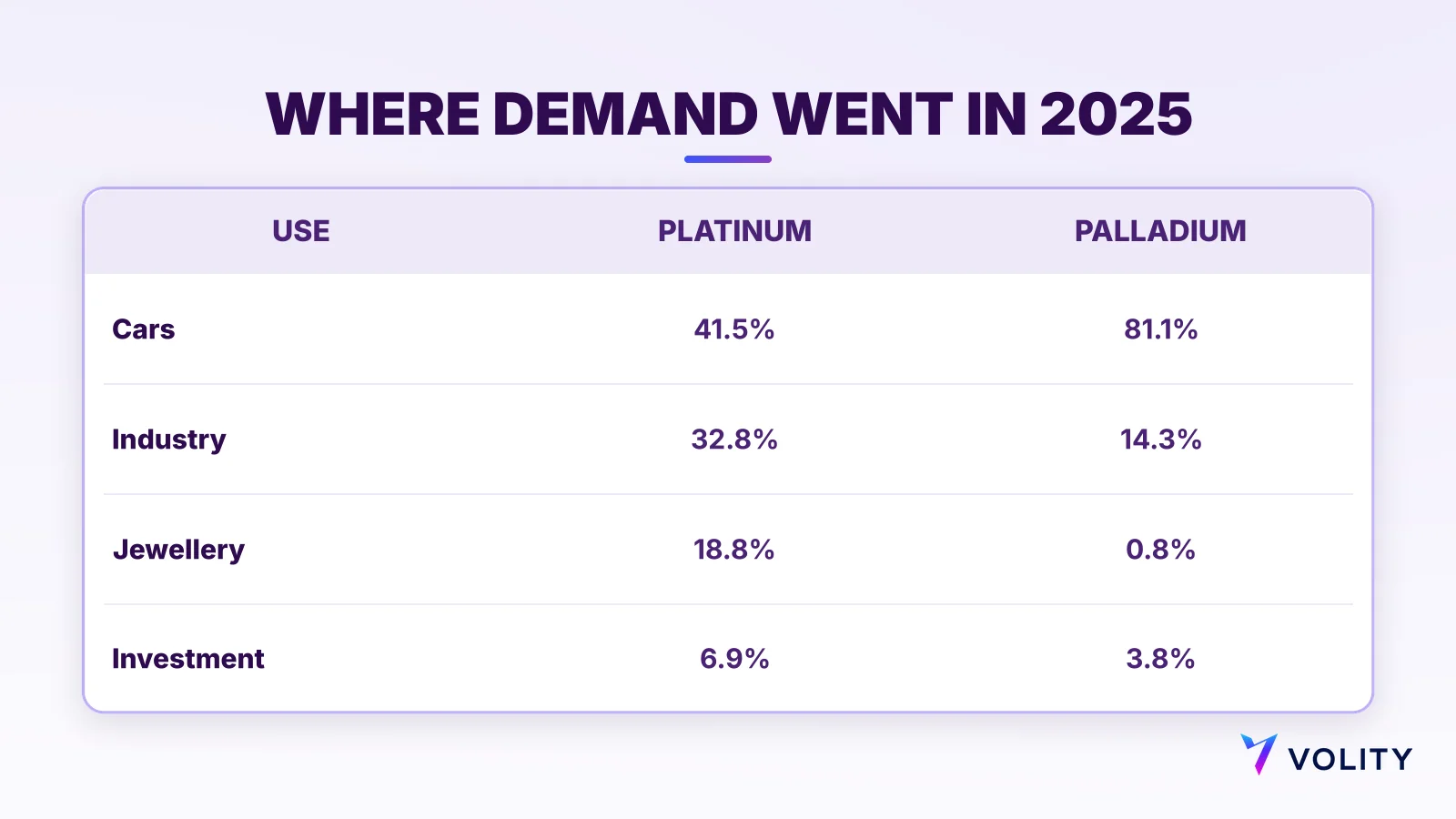
Other uses include chemical and oil-refining catalysts, electronics, dental devices, glass and jewellery. Johnson Matthey (JM), a catalyst maker and refiner, gives the 2025 split in its PGM market report:
| Use in 2025 | Platinum, thousand oz | Platinum share | Palladium, thousand oz | Palladium share |
|---|---|---|---|---|
| Cars | 3,329 | 41.5% | 8,227 | 81.1% |
| Industry | 2,627 | 32.8% | 1,448 | 14.3% |
| Jewellery | 1,507 | 18.8% | 83 | 0.8% |
| Investment | 556 | 6.9% | 382 | 3.8% |
| Total demand | 8,019 | 100% | 10,140 | 100% |
One troy ounce (oz), the unit precious metals are priced in, is about 31.1 grams.
So the two metals answer to different news. JM says the auto sector “accounts for more than 80% of palladium demand”, so a palladium chart is mostly a car-industry chart. Platinum has more sources of demand. In 2025, JM says, “High gold prices led to a surge in platinum jewellery fabrication” in China. Hydrogen is small today. The World Platinum Investment Council (WPIC), set up by South Africa’s leading platinum producers, put stationary and other hydrogen uses at 71,000 oz in 2025, under 1% of demand.
Where each metal’s supply comes from
USGS estimates of 2025 mine output show a different leader for each metal:
| Country, 2025 estimate | Platinum, tonnes | Palladium, tonnes |
|---|---|---|
| South Africa | 120 | 70 |
| Russia | 20 | 84 |
| Zimbabwe | 18 | 15 |
| Canada | 5 | 16 |
| World total, rounded | 170 | 190 |
In JM’s figures, South Africa produced 71.2% of the world’s newly mined platinum in 2025. Russia supplied 44.8% of newly mined palladium and South Africa 34.1%, together 78.9%. The European Commission lists PGMs among its 34 critical raw materials and says “South Africa provides 71% of the EU’s needs for platinum”.
That concentration turns local events into price events. USGS says South African PGM output fell an estimated 9% in 2025. It cites lower palladium prices, deep-level mining costs and “ongoing disruptions to the supply of electricity”. JM adds that extreme rainfall closed parts of the Amandelbult mine run by Valterra Platinum.
Russian supply carries a different risk: trade routes. Nornickel, the main Russian producer, turned out 2.73 million oz of palladium in 2025, JM says. The London Platinum and Palladium Market (LPPM), which lists the refiners whose bars London accepts, removed Russian refiners on 8 April 2022. JM reports that the UK, Germany, South Korea and Japan have cut or stopped buying Russian metal. Since 2024, “virtually all Russian platinum has been exported to the Chinese market, mainly via Hong Kong”.
Recycling softens this, more so for palladium. Recycled metal, such as metal from scrapped catalytic converters, made up 32.2% of palladium supply in 2025, against 21.8% for platinum.
Demand drivers: cars, industry and investment
Cars come first for both, and the shift to electric cars matters more for palladium. The International Energy Agency (IEA) says one in four new cars sold worldwide in 2025 was electric: almost 55% in China and 28% in Europe. A battery-electric car needs no catalytic converter. Plug-in hybrids, which the IEA also counts, still carry one.
Carmakers can swap one metal for the other, which ties the prices together. USGS says palladium can routinely replace about 25% of the platinum in diesel converters, and up to 50% in some uses. When palladium became much dearer, carmakers used more platinum instead. USGS links the 2025 price rises partly to “the substitution of platinum in automobile catalysts”.
Euro 7, the next EU emissions standard, starts on 29 November 2026 for new light-duty models and covers all new vehicles a year later, JM says. It expects “an initial uplift to PGM loadings”, meaning a little more metal per converter, with some “platinum-rich systems” chosen while palladium cost more. As carmakers later cut the metal used per car, a process called thrifting, JM says “we expect this substitution to be reversed”.
Industry is platinum’s second pillar, at 32.8% of 2025 demand against 14.3% for palladium.
Investment is the smallest slice but often the fastest. Exchange-traded funds (ETFs) hold metal for their shareholders and release it when investors sell. JM says platinum ETFs shed around 260,000 oz in the first quarter of 2026 and palladium ETFs about 100,000 oz. WPIC’s Platinum Quarterly puts platinum ETF outflows in the first half of 2026 at over 500,000 oz.
Both markets ended 2025 short of metal, with the gap filled from existing stocks. In its May 2026 report, JM puts the 2025 deficit at 915,000 oz for platinum and 416,000 oz for palladium. It notes palladium was in deficit every year from 2012 to 2025. WPIC, using its own method, put platinum’s 2025 deficit at 1,440,000 oz in September 2026, so compare like with like.
Price history side by side
Both metals are priced in US dollars per troy ounce. The benchmarks are the LBMA Platinum and Palladium Prices, set in twice-daily auctions run by ICE Benchmark Administration. A CFD on either metal follows the market price, so this is the history a trader faced.
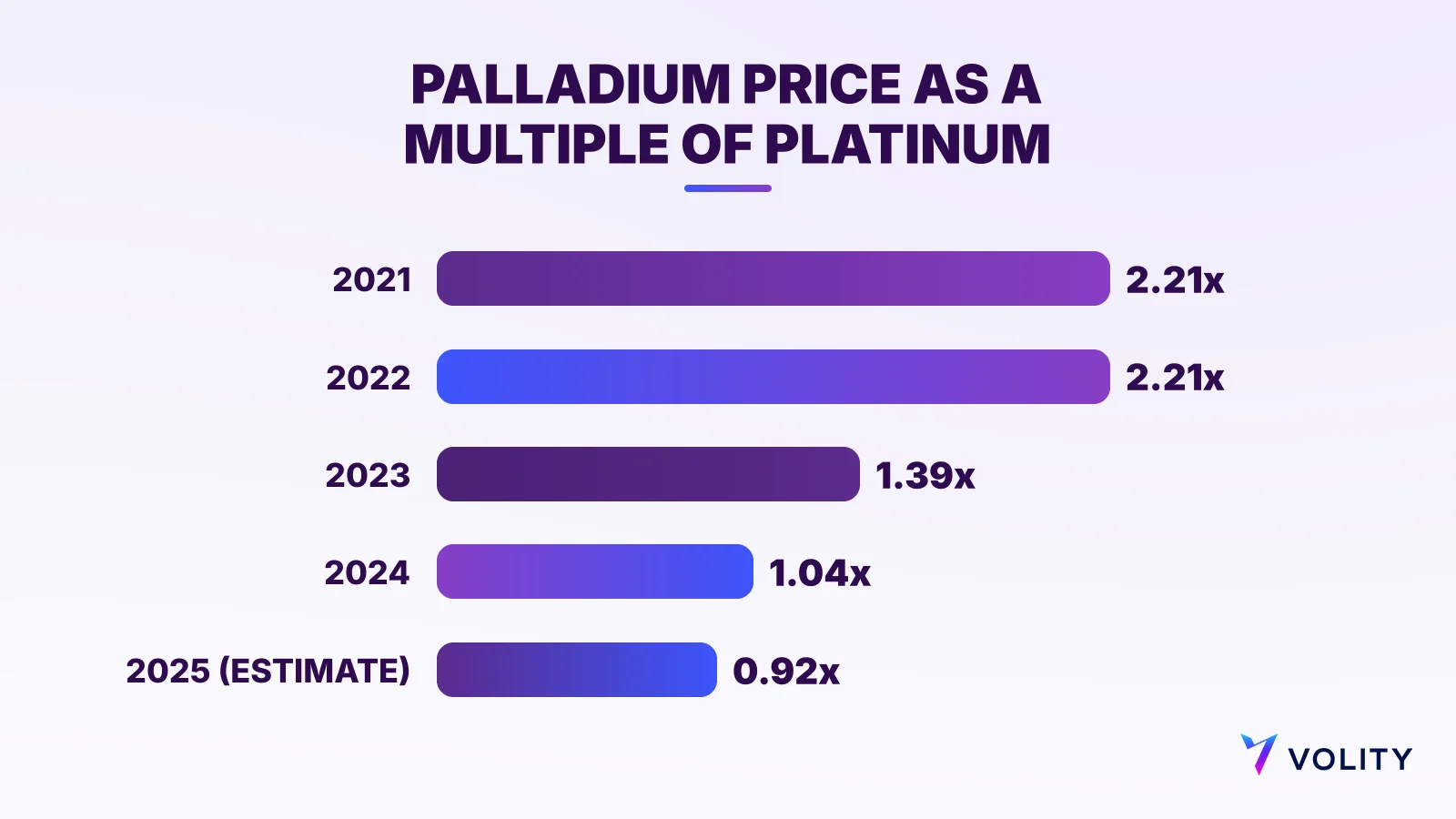
| Year | Palladium, USD per oz | Platinum, USD per oz | Palladium-to-platinum ratio |
|---|---|---|---|
| 2021 | 2,419 | 1,094 | 2.21 |
| 2022 | 2,134 | 967 | 2.21 |
| 2023 | 1,352 | 973 | 1.39 |
| 2024 | 995 | 961 | 1.04 |
| 2025 (estimate) | 1,100 | 1,200 | 0.92 |
These are USGS annual averages, rounded. A ratio above 1 means palladium cost more. USGS puts the 2025 rise at 25% for platinum and 11% for palladium.
The averages hide sharp moves. Dated points from Johnson Matthey’s reports:
- 7 March 2022: palladium peaked at $3,339, less than two weeks after Russian troops entered Ukraine (JM, May 2023).
- February 2024: after “a large premium to platinum for much of the 2018 to 2023 period”, palladium “slid to parity” (JM, May 2025).
- July to October 2025: platinum passed $1,450 in July, its highest level since 2014, and briefly topped $1,700 in October.
- December 2025: heavy trading on China’s Guangzhou Futures Exchange lifted platinum by more than $600 to all-time highs above $2,300.
- January 2026: platinum set a record of $2,860, and palladium peaked above $2,100.
- End of March 2026: platinum stood at $1,908 and palladium at $1,448, after palladium fell more than 30% from its January high.
Platinum ended March 2026 about a third below its January record. Any plan for these metals has to survive moves of that size. Prices have moved since then, so check the live quote on the platform before you act.
Platinum also reacts to gold, though not reliably. JM notes it “generally traded at a premium to gold” before 2014 and at “a widening discount” since. It “derived little if any benefit” from gold’s 2024 rally. In 2025, a steep rise in gold “helped fuel interest in much cheaper platinum and palladium”. If you follow XAU, the gold price in US dollars, watch both metals beside it.
Risks specific to each metal
For platinum, the main risks are:
- South Africa mined 71.2% of new supply in 2025, so floods, power cuts and costs there move the price.
- Jewellery and investment demand can reverse fast, as the ETF outflows of early 2026 show.
- Buyers drawn in by high gold prices can leave quickly. Platinum fell about a third from January to the end of March 2026.
- JM expects the switch to platinum in some Euro 7 cars to be reversed by thrifting, which would hand car demand back to palladium.
For palladium, the list is different:
- With 81.1% of demand in cars, each battery-electric car sold instead of a petrol car cuts demand.
- Russia mined 44.8% of new supply in 2025, and the trade routes for its metal keep shifting.
- When palladium gets dear, carmakers switch to platinum, as they did before Euro 7.
- Recycling supplied 32.2% of the market in 2025, adding metal whatever the mines do.
For a CFD trader, these risks arrive as price swings. The UK Financial Conduct Authority (FCA) wrote that in 2022 it found “approximately 80% of customers lose money when investing in CFDs”. Leverage is how a modest move becomes a large loss.
How to trade metals with CFDs
A contract for difference (CFD) lets you trade the price change of platinum or palladium without owning metal. You buy if you expect a rise and sell if you expect a fall. Your profit or loss is the position size times the price change.
Leverage means you put up only part of the position’s value, called margin. On Volity, metals CFDs carry leverage of up to 1:500, depending on the product. Say, as a hypothetical example, you open a $10,000 platinum position. At 1:500 the margin is $20. A 5% fall then loses $500, which is 25 times that margin. Leverage magnifies losses as much as gains.
Positions held past 22:00 GMT may pay or receive an overnight amount. The rate for each instrument is shown on the platform, and the full schedule is on the Volity charges and fees page.
On Volity, platinum and palladium sit next to gold and silver among 350+ CFD instruments, with oil, natural gas and copper listed on the commodities trading page. The Markets account is commission-free, and spreads are dynamic, shown live on the platform.
A simple way to start with the two metals:
- Open the free demo and put platinum, palladium and gold on one watchlist.
- For a few weeks, note what moved each metal on its biggest days: car news, supply news, gold or ETF flows.
- Mark the dates: JM’s report each May, the WPIC quarterly reports and Euro 7 from 29 November 2026.
- Before any trade, check each instrument’s spread, margin, trading hours and overnight amount on the platform.
- Size each position so that a 10% move against you is a loss you can accept. Palladium fell more than three times that in two months of 2026.
- Set a stop-loss, an order that closes the position at a price you choose. In a fast market it can fill at a worse price.
- Compare your demo results with your notes before you trade live.
The methods in gold trading strategies can be tested on both metals in the same demo. The silver trading guide covers the other metal traders watch beside gold.
One account covers metals, forex, indices, shares and crypto, with a free demo on every account tier.
Fact check: Demand, supply, deficits and dated prices come from Johnson Matthey’s PGM market reports (May 2023, May 2025 and May 2026). Mine output, annual averages and substitution come from the USGS Mineral Commodity Summaries (February 2026). Also used: WPIC Platinum Quarterly Q2 2026 (9 September 2026, set up by South Africa’s leading platinum producers), the IEA, the European Commission, the LBMA, the LPPM and the FCA. Sources checked 10 November 2026.
Frequently asked questions
Which is more valuable, platinum or palladium?
It has changed. On USGS yearly averages, palladium cost 2.21 times as much as platinum in 2021 and about 0.92 times as much in 2025. Palladium still holds the higher record: $3,339 in March 2022, against platinum’s $2,860 in January 2026, both per Johnson Matthey.
Why has palladium cost more than platinum at times?
Petrol cars. Palladium became the main metal in petrol-engine converters, and its market was in deficit every year from 2012 to 2025, says Johnson Matthey. Fears over Russian supply drove its 2022 record. It slid to parity with platinum in February 2024.
What are platinum and palladium used for?
Mainly car catalytic converters, which clean exhaust gases. Cars took 81.1% of palladium demand and 41.5% of platinum demand in 2025. Platinum also goes into glass, chemicals, jewellery and investment.
Is platinum or palladium a better investment?
It depends on which risks you accept. Platinum rests on South African supply and on jewellery and investment demand. Palladium rests on petrol cars and Russian supply. Industry forecasts, such as WPIC’s, reflect the publisher’s view.
Can I trade platinum and palladium on Volity?
Yes, as CFDs next to gold and silver, in the same account as forex, indices, shares and crypto. You can go long or short with leverage of up to 1:500, depending on the product, and watch both on the free demo first.
Are platinum and palladium safe-haven assets?
Not in the way gold is often described. Most demand for both comes from cars and industry, so prices follow car output and the wider economy. Early 2026 showed the downside: palladium lost more than 30% in about two months.