The bucket trade returns
Traders love buckets. They make a chaotic tape look slightly less deranged before the opening bell.
Today’s watchlist does more than sort tickers. It shows how this market is stitched together: AI infrastructure, fading index breadth, earnings traps, defensive hiding spots and a crypto pulse running underneath equities.
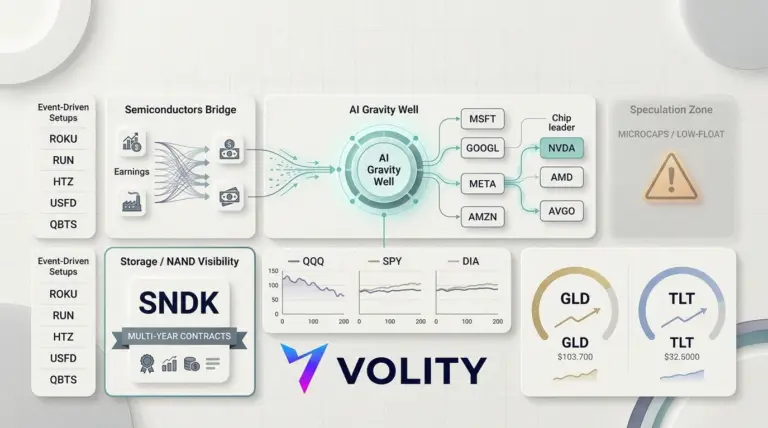
The dashboard starts with SPY, QQQ, DIA, TLT, GLD and BTCUSD. That is not filler. It is the morning weather report.
Weak US indices keep the big equity ETFs in view. Meanwhile, TLT tracks rate nerves, GLD catches the hedging bid, and Bitcoin tests whether risk appetite still has legs. Sector action matters too. Communication services have held up better, while parts of tech have lagged. So money is not abandoning AI. Instead, it is becoming more selective.
That distinction matters. When leadership narrows, single-stock catalysts carry more weight. Earnings beats, analyst upgrades and one stray cloud contract can matter more than the index tape.
Where good news still gets paid
PRGS, Progress Software, sits in the old-fashioned momentum bucket. The company beat fiscal second-quarter expectations on profit and revenue, then gave investors enough confidence to stay involved. Stronger licence demand and cash generation helped. Legal noise from MOVEit remains a known risk, but traders have not treated it as fresh poison.
META offers a different route into the AI race. It is not just an advertising company with a lab coat. Management has talked about building tens of gigawatts of AI compute over time. Investors now view Meta as part social network, part ad machine and part infrastructure platform. If excess capacity can be sold or leased, the story changes again.
NOW, ServiceNow, is riding the quieter side of AI. Workflow automation lacks the glamour of chips, yet enterprise buyers still spend on it. A co-innovation push with Accenture and an analyst upgrade have added fresh oxygen. However, the attraction is steadier than spectacular.
GIS, General Mills, brings a different kind of bullishness. Nobody buys cereal stocks for fireworks. Still, better-than-expected quarterly results and a defensive staples profile make the shares useful when investors want equity exposure with less beta. In this market, boring can be a position.
OKLO is not boring. The nuclear micro-reactor name remains an event-driven trade. The Energy Department’s safety-analysis sign-off for its Groves Isotope Test Reactor gives traders a date-sensitive catalyst. If the company hits its targeted July criticality milestone, the stock can move sharply. If it slips, the air pocket could be just as sharp.
- MU remains tied to AI memory demand and data-centre spending.
- PANW keeps its place as a liquid cybersecurity momentum trade.
- AAPL sits in the second-half rebound and AI-features bucket.
- AMGN offers healthcare ballast against a tech-heavy list.
Television mentions will not change discounted cash-flow models, but they can nudge volume in megacaps. For short-term traders, that still counts.
Where the air gets thinner
CRWV, CoreWeave, deserves careful wording. The risk is not simply that Meta will crush it. In fact, Meta is better understood as a major customer after expanded multi-year capacity commitments. That makes the bear case more subtle.
The pressure points are concentration, capital intensity and AI spending expectations. A company built around a small group of hyperscale clients can rise quickly. However, it can also fall hard when investors question contract terms or future demand. In an AI infrastructure tape, high beta cuts both ways.
NKE, SSTK and CRON land in the downside monitor bucket for more straightforward reasons. Nike is digesting soft consumer signals and a bruising post-earnings tone. Shutterstock sits in the messy fight over content, intellectual property and generative-AI licensing. Cronos remains tied to a cannabis sector where regulatory disappointment can still flatten bids quickly.
None of those tickers needs an end-of-days thesis. They simply need close watching when risk appetite fades.
AI leaves the server room
The most interesting part of the list is not Nvidia. It is CAT.
Five years ago, placing Caterpillar beside NVDA would have looked odd. Now traders link excavators, power gear, cooling systems and grid upgrades to the AI build-out. Data centres need land, concrete, backup power and equipment before they need inference revenue.
So the market has broadened the AI basket. It now includes industrials, utilities, storage providers and electrical-equipment makers. Comparing Caterpillar’s valuation with Nvidia’s is not a clean valuation study. However, it is a sentiment check. Traders are paying for anything plausibly attached to AI construction.
The hyperscaler backbone remains familiar: MSFT, ORCL, META, GOOGL and AMZN. After a June wobble over AI capital-spending fears, these names have moved towards mean-reversion territory. The question is simple. Was that pullback just a pause, or the start of a broader derating?
Stretched does not mean broken
FBIN, CRS and CXW sit in the overbought bucket. That does not make them broken businesses. It makes them candidates for tactical fades if momentum stalls.
All three have rallied hard enough to trigger stretched screens. Meanwhile, crowded trades can reverse without much warning. Traders should watch volume, intraday reversals and failed breakouts rather than inventing grand short stories.
In a market this thematic, a short-into-strength list can be as useful as a bullish one. Discipline matters more than drama.
Earnings keep the fuse lit
GS brings scheduled volatility. Profit, revenue and capital-return expectations set clear lines for a beat or miss. Banks also carry wider messages on net interest margins, credit quality and deal activity.
BAC belongs in the same macro-sensitive group. Meanwhile, MSM offers a read on industrial demand beneath the index surface. VEEV can influence the tone around vertical software multiples. MRVL remains another AI-infrastructure proxy, closely watched by chip traders.
The point is not to fall in love with any single setup. Instead, traders need to know when numbers arrive, what the market expects and which sector might react next.
Crypto watches the side door
The CRCL and BTCUSD pairing matters because crypto now behaves like a high-beta extension of growth sentiment. Stablecoin competition headlines around Circle can spill into payment and exchange stories. Bitcoin, meanwhile, still reacts quickly to macro stress and liquidity shifts.
When Bitcoin rallies with growth stocks, risk appetite looks broader. However, if crypto fades while megacap tech holds, the rally may be narrower than it appears.
Special situations remain combustible
The speculative edge includes a SPAC tied to Agility Robotics, Klarna’s court win and SpaceX-adjacent themes. These are not core holdings. They are headline options.
A filing, a court update or one high-profile comment can move these names more than fundamentals justify. That makes position size the entire trade. The story may be exciting, but the exit still needs to exist before entry.
Key takeaways
- Index breadth is thin: watch SPY, QQQ and sector rotation before chasing breakouts.
- AI has widened: infrastructure trades now include cloud, chips, power and machinery.
- CoreWeave risk is nuanced: customer concentration matters more than a simple Meta rivalry.
- Defensives still have value: names like GIS can reduce beta without leaving equities.
- Earnings can reset sectors: GS, BAC, VEEV and MRVL deserve calendar discipline.
Taken together, the list is not a portfolio. It is a working map of the tape: AI pulling in everything from memory chips to excavators, defensives trying to hold their corner, momentum names growing stretched, and earnings risk humming under the floorboards.
Related coverage on Volity
- What Is a P/E Ratio and How to Use It
- Fundamental Analysis in Stock Trading: A Working Definition
- Growth Investing vs Value Investing: Which Style Fits You?
- Fractional Shares Explained: How to Start Investing With $50
- How to Start Stock Trading: A 2026 Beginner Guide
- Dividend Investing for Beginners: How to Start