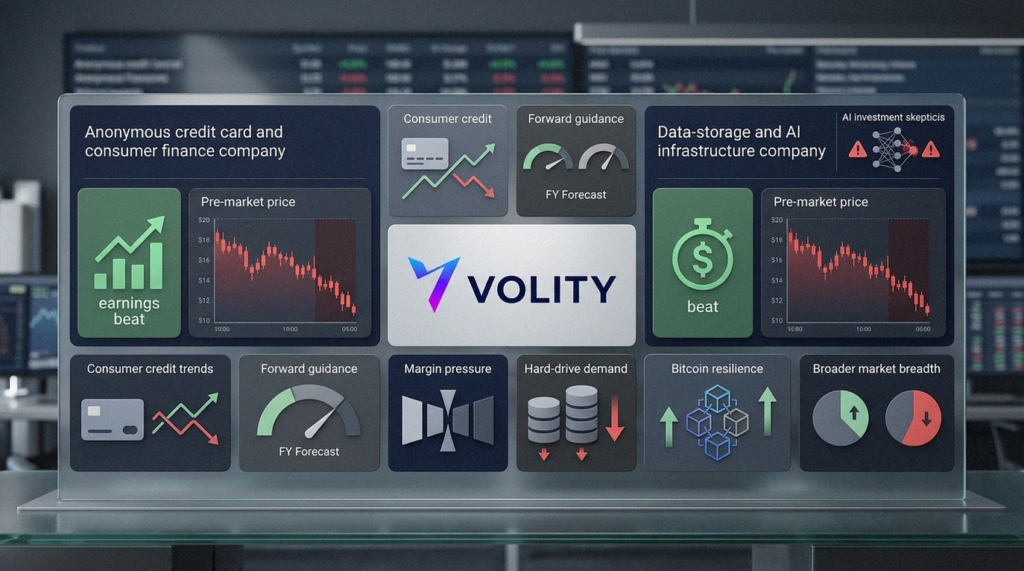
Earnings beats, market retreats: what traders should watch on Oct. 23
Wall Street is delivering a stern earnings-season lesson: a company can beat forecasts and still lose ground.
U.S. equity futures pointed lower before Friday’s opening bell, while SPY and QQQ also weakened in premarket trading.
Technology shares carried much of the pressure, as oil climbed and artificial-intelligence spending again troubled investors.
The selling was selective rather than indiscriminate. However, expensive growth shares faced the toughest scrutiny.
Investors are asking a harder question than, “Did the company beat estimates?” They want proof that the quarter improves the forward outlook.
American Express reported adjusted third-quarter earnings of $4.68 a share, above expectations near $4.50.
Revenue rose 8.9% from a year earlier to about $20.06 billion, broadly matching Wall Street’s forecast.
The card company also raised its full-year earnings outlook to $18.30 to $18.60 a share.
Despite those figures, AXP shares fell in premarket trading.
The reaction suggests that much of the good news had already reached the share price.
Investors may also have wanted a clearer revenue beat, as affluent consumers drive much of American Express’s spending growth.
Spending has stayed firm among wealthier customers. Still, traders want to know whether that resilience can last.
AXP now offers a useful test of post-results demand. If shares reclaim their opening range, buyers may view the drop as profit-taking.
If the shares remain below that level, expectations may have become the bigger problem than earnings.
Western Digital shows why guidance sets the price
Western Digital reported adjusted earnings of $4.64 a share on revenue of $4.38 billion.
Analysts had expected roughly $4.07 a share and $4.13 billion in revenue.
The company’s second-quarter outlook also exceeded consensus forecasts. Even so, WDC fell about 3% in early trading.
That decline put the market’s attention squarely on the durability of hard-drive pricing.
Management indicated that price growth could cool eventually, which tempered enthusiasm around an otherwise robust quarter.
Storage demand has benefited from data-centre expansion and AI infrastructure spending. Yet investors remain wary of cyclical peaks.
A recovery above the opening range would show that buyers accept management’s outlook.
Continued weakness would signal that traders expect slowing prices to erode future profit growth.
For WDC, the reported beat matters less than whether the market believes current margins can endure.
Enova needs more than a modest beat
Enova International reported adjusted earnings of $4.48 a share, against expectations of $4.42.
Revenue reached $1.009 billion, slightly ahead of the $1.002 billion analysts expected.
The numbers offer a constructive starting point. However, a lender faces a higher burden of proof than a headline earnings result.
Investors will watch loan demand, delinquency trends, funding costs and the quality of new originations.
Higher borrowing costs can squeeze weaker borrowers, while credit losses can quickly reverse a promising quarterly trend.
ENVA may attract momentum traders after the release. Still, sustained gains require evidence that risk metrics remain contained.
The stock is a confirmation trade, not an automatic chase after a narrow earnings surprise.
Oil and AI spending darken the market backdrop
WTI crude traded near $101 in morning updates, adding another concern for equity investors.
Higher oil prices can complicate the inflation picture, particularly if fuel costs filter through transport and consumer budgets.
That backdrop can pressure rate-sensitive shares, as investors reconsider how quickly borrowing costs might decline.
At the same time, the AI investment boom is drawing more sceptical questions.
Companies are spending enormous sums on chips, data centres and power capacity. Investors want to see a credible return timetable.
Demand for AI services is not the issue. The uncertainty lies in whether future profits will justify today’s capital expenditure.
Businesses with strong cash flow can tolerate a costly investment cycle more easily.
Companies valued on distant earnings promises face a sharper valuation test when rates and oil prices rise.
- AXP: Adjusted third-quarter earnings reached $4.68 a share.
- WDC: Adjusted earnings came in at $4.64 a share on $4.38 billion revenue.
- ENVA: Revenue reached $1.009 billion, modestly above expectations.
- WTI crude: Morning updates placed the benchmark near $101 a barrel.
- Bitcoin: The token traded around $81,400 to $81,700.
Bitcoin holds up, but the signal remains incomplete
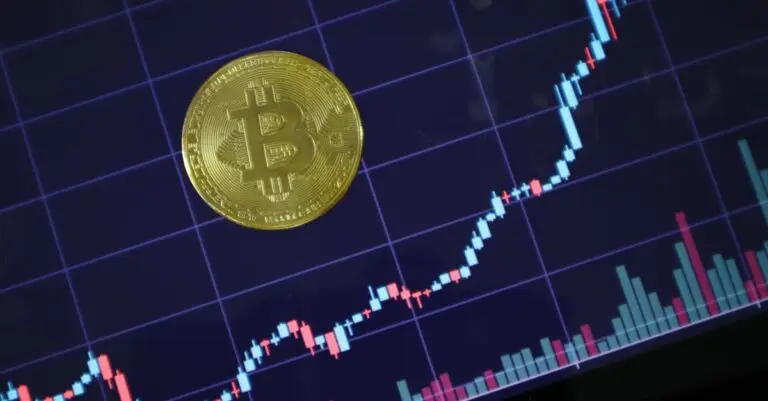
Bitcoin traded near $81,400 to $81,700, holding steadier than some equity benchmarks.
That resilience deserves attention, although it does not confirm a broad return to risk-taking.
Crypto can move independently because of positioning, liquidity shifts and forced liquidations.
Crypto-linked equities add company execution risk to the underlying asset’s already large price swings.
A more useful signal would combine Bitcoin strength with improving equity breadth and falling market volatility.
Until then, one firm morning in digital assets offers observation, not conviction.
Tesla’s robotics ambitions remain a distant variable
Tesla’s Optimus robot programme still offers long-term optionality for shareholders.
However, robotics should not yet drive near-term earnings assumptions or trading decisions.
Production costs, reliability, customer demand, deployment rates and margins remain difficult questions.
Measurable commercial progress would change the calculation. Until then, Optimus belongs in Tesla’s long-range valuation story.
What traders should watch
The market is separating verified performance from future promise with unusual discipline.
American Express and Western Digital both beat expectations, while their shares still weakened.
That gap matters because price action reveals what investors believe earnings will look like next quarter.
- Watch the opening range after earnings instead of buying solely on an EPS beat.
- Give guidance, margins and demand commentary more weight than a single quarterly surprise.
- Prefer visible cash flow when higher oil and rate concerns pressure long-duration growth stocks.
- Treat Bitcoin’s resilience as a market clue, rather than proof of a risk-on turn.
- Require a technical recovery before buying a falling stock that merely beat forecasts.
Friday’s trading may look harsh, but it is not a rejection of good earnings.
The market is demanding better prices for those earnings, particularly where valuations already assume years of rapid growth.
For traders, that distinction separates a temporary dip from a longer repricing.