Crypto’s uneasy rebound: hacks, politics and the race for institutional trust
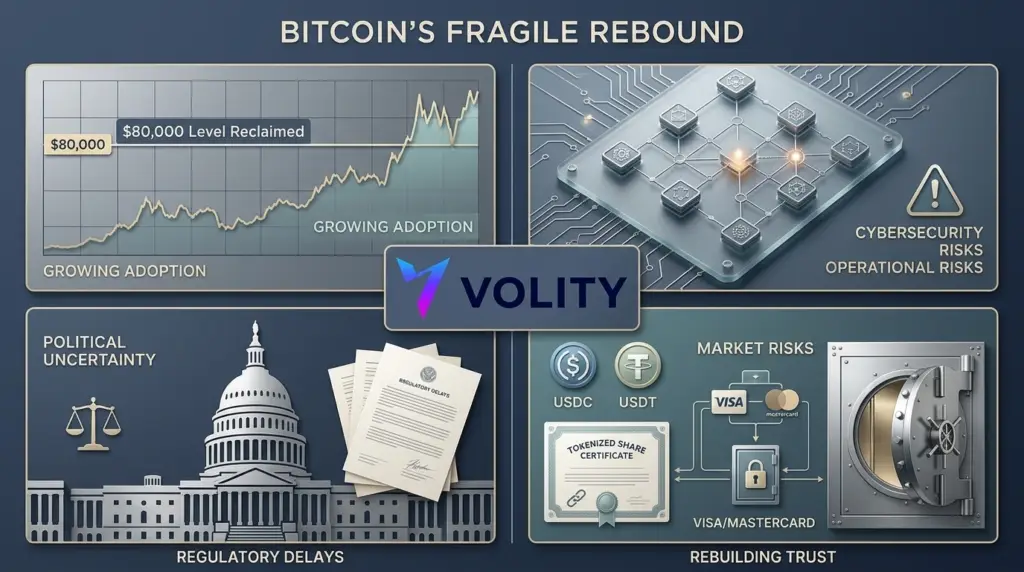
November 5, 2026. Crypto markets are climbing out of the midterm-election sell-off, although confidence remains thin. Bitcoin traded near $80,250 early Thursday, roughly 2.5% higher over 24 hours.
Ether changed hands near $2,418, while the CoinDesk 80 index gained about 0.9%. Earlier, bitcoin had slipped towards $75,700 before recovering the closely watched $80,000 level.
That move tracked a firmer session for US shares and a modest return of risk appetite. Yet traders remain focused on Friday’s employment report and its implications for interest rates.
Strong hiring could lift the dollar and pressure speculative assets. Softer figures, by contrast, could revive expectations for cheaper money and deeper liquidity.
For now, bitcoin appears to be testing a floor rather than confirming a fresh bull run. The rebound has also arrived as Washington becomes less accommodating.
Congress puts market rules in play
Democrats are projected to control both chambers after the November 3 midterms. That result places the industry’s market-structure ambitions under fresh pressure before January.
The CLARITY Act would split responsibilities between the Securities and Exchange Commission and Commodity Futures Trading Commission. It would also create registration routes for exchanges, brokers and custodians.
However, the proposal needs 60 Senate votes. An earlier procedural vote failed to reach that threshold, leaving its path uncertain.
Crypto businesses want predictable rules for token listings, custody and trading. Investors, meanwhile, want to know whether regulation will produce clarity or another jurisdictional dispute.
Binance cuts SignalPlus connections
Security concerns returned sharply after Binance removed every API key linked to SignalPlus. The derivatives-trading platform had disclosed a potential security issue.
Binance said its systems were unaffected and customer funds remained safe. Deribit also removed SignalPlus keys and reported no evidence of a compromise within its own infrastructure.
Users who linked accounts to SignalPlus were told to inspect positions and outstanding orders directly. They were also urged not to reconnect until SignalPlus resolves the incident.
The warning follows a separate Binance attack that investigators estimated at roughly $6.3 billion. That episode has made API permissions a portfolio risk, not merely technical housekeeping.
Changpeng Zhao advised SignalPlus users to revoke keys across other exchanges. Each connection can grant an outside service meaningful power over orders, balances or account information.
Large traders increasingly rely on automated execution across several venues. Yet that convenience creates a wider attack surface, especially when third-party vendors manage sensitive permissions.
Networks confront their own weak points
Loopscale halted operations after reporting as many as 30,000 malicious API requests each day. The incident exposed a familiar weakness in decentralised-finance infrastructure.
Protocols may be non-custodial, but their interfaces, pricing feeds and administrative tools often remain centralised. Attackers need only find one badly defended route.
ZetaChain has proposed moving its ecosystem to Solana and ending its existing layer-1 network on December 9. The plan could improve liquidity and developer access.
Still, migrations bring their own hazards. Bridges, wallet support, exchange listings and legacy-token redemptions can all produce abrupt trading dislocations.
Traders should check contract addresses, conversion terms and redemption deadlines before acting. A migration announcement alone says little about how holders will actually be treated.
The XRP Ledger has also patched a bug that might have enabled unauthorised token minting. No public exploit is required for a flaw to unsettle a market.
Once vulnerabilities become known, attackers can move faster than token holders. Investors may also price dilution risk before the practical threat becomes clear.
Zcash, meanwhile, is preparing shorter block times in its next upgrade cycle. Faster confirmation may help users, although miners and infrastructure providers must adjust their systems.
Stablecoins edge towards ordinary payments
The more constructive news came from stablecoin payments. Stripe is offering US-dollar stablecoin payouts to wallets across more than 160 markets.
The service could support payroll, creator payments and cross-border settlement. It also puts digital dollars closer to ordinary commercial activity.
Circle’s Arc network has gone live with USDC paying transaction fees. Users therefore need not acquire a separate native token before sending money.
That detail may seem small, but it removes a stubborn friction point. Payments work better when customers do not first need to understand network economics.
South Korea is considering won-denominated stablecoin support within Samsung Wallet, according to a company executive. The proposal would wrap an unfamiliar asset in a familiar consumer product.
Questions remain over issuers, reserve supervision and consumer protections. Policymakers must also decide whether such tokens resemble payments products, deposits or something entirely new.
- Bitcoin: about $80,250, after touching roughly $75,700.
- Ether: about $2,418 in early Thursday trading.
- Loopscale: reported up to 30,000 malicious API requests daily.
- ZetaChain: proposed layer-1 shutdown date of December 9.
- Stripe: stablecoin wallet payouts across more than 160 markets.
Crypto balance sheets become market signals
American Bitcoin, associated with Eric Trump, reported a $126 million third-quarter profit. It also added 425 bitcoin during the period.
Those figures will attract equity investors, but mining economics can shift quickly. Bitcoin prices, network difficulty, power costs and financing terms all matter.
Trump Media reportedly moved 4,259 bitcoin to Crypto.com before a debt deadline. The transfer prompted speculation about a sale or financing arrangement.
A wallet transfer does not prove a disposal. Until the company explains the move, markets will treat it as an uncertain and potentially volatile signal.
Canton Strategic also executed what it described as the first tokenised US-stock trades under an SEC exemption. The development points towards a more ambitious version of market tokenisation.
Tokenised shares could eventually shorten settlement and widen access to illiquid assets. Yet the harder task involves ownership records, corporate actions and legal claims during disputes.
What traders should watch
Crypto is producing two competing narratives. Institutional adoption is advancing through stablecoin payouts, tokenised securities and more sophisticated trading systems.
At the same time, API compromises, malicious requests and code flaws reveal fragile foundations. Bitcoin has reclaimed $80,000, but the next advance will demand more than enthusiasm.
- Review and revoke unused exchange API keys, especially those linked to third-party trading tools.
- Confirm token migration details through official network and exchange notices.
- Watch Friday’s US employment report for a fresh rates and dollar catalyst.
- Treat corporate wallet transfers as clues, not confirmation of sales.
- Separate stablecoin payment adoption from token-price speculation.