Tuesday, October 6, 2026
Crypto markets are advancing on two tracks. Prices remain tentative, while the industry’s financial machinery is becoming more ambitious.
Bitcoin traded near $85,400 on Tuesday, leaving the total crypto market near $3.02 trillion. Yet sellers again defended $87,000, turning that level into the market’s immediate test.
Bond yields, inflation expectations and dollar liquidity still hold more sway than crypto headlines. If yields retreat, Bitcoin could push towards $93,000. Until then, that target remains a scenario rather than a signal.
Bitcoin waits while altcoins gather momentum
Money has rotated into selected altcoins and higher-beta tokens. Cardano open interest rose about 25%, alongside a price rally that drew derivatives traders back.
That distinction matters. Rising open interest can support a trend, but it also creates fuel for violent liquidations.
NEAR has climbed roughly 135% in 30 days, making it one of this rotation’s standout trades. Meanwhile, LayerZero has attracted fresh attention after announcing ZRO buybacks.
Aave is also on traders’ screens after deposits into its V4 products exceeded $1 billion. Hyperliquid gained another mark of legitimacy as Bloomberg Terminal added prices for its perpetual futures.
Memecoin activity remains brisk across Dogecoin, Shiba Inu and PEPE. However, liquidity can vanish quickly when social momentum fades.
These tokens suit defined risk capital, not a substitute for an investment thesis. A crowded order book can look reassuring right up to the moment it does not.
Market levels to watch
- Bitcoin: $87,000 remains the near-term resistance level.
- Bitcoin upside case: $93,000, if yields and inflation expectations ease.
- Crypto market value: about $3.02 trillion.
- NEAR: roughly 135% higher over 30 days.
- Aave V4 deposits: more than $1 billion.
Solana offers a faster settlement rail
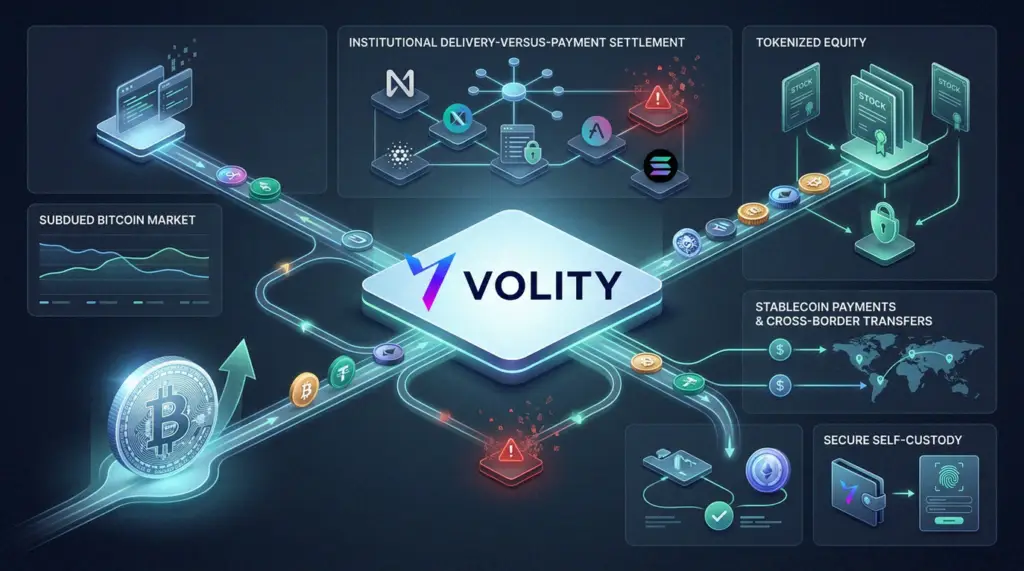
The day’s most consequential development may have little to do with token prices. The Solana Foundation has launched Solana DvP, an open-source settlement system for financial institutions.
The platform handles delivery versus payment in a single onchain transaction. A tokenised asset and its payment settle together, or neither transaction completes.
Traditional securities trades can pass through custodians, clearing firms and several reconciliation steps. Solana’s design aims to reduce that process to seconds.
The project uses an MIT licence, allowing banks and developers to adapt the code. Still, speed alone will not win institutional adoption.
Custody arrangements, privacy controls, compliance checks and links to existing systems will decide its usefulness. Yet the sales pitch has shifted noticeably.
Blockchains are increasingly marketed as settlement infrastructure, rather than as venues for speculative trading. Ethereum is pursuing much the same opportunity from another direction.
Developers are testing cheaper block space and simpler transfers between Ethereum’s main network and layer-two chains. Those changes target a familiar frustration: moving assets without a thicket of bridges, fees and delays.
Binance has introduced onchain stock exposure for users. At the same time, OKX and Intercontinental Exchange are preparing a market for 24-hour tokenised U.S. equity trading.
The structure could give global investors access beyond Wall Street’s regular hours. Still, a token does not automatically carry the legal rights of a share.
Investors need to know exactly what sits behind the screen price. They may own equity, a derivative, a custodial claim, or simply an instrument tracking a stock.
Round-the-clock trading also raises harder questions about liquidity, dividends, voting rights and price gaps. The underlying exchanges will still close, even if a token trades through the night.
Ondo is taking the same idea into private markets with around-the-clock pre-IPO exposure. Private-company values, however, rarely offer the transparency of public quotations.
A liquid trading interface does not guarantee a liquid underlying asset. That gap may matter most when investors want to leave at once.
Stablecoins become consumer products
OKX Money combines stablecoin savings, payments and cards in one application. The product treats digital dollars less like trading collateral and more like a spending account.
That shift reaches beyond exchanges. Stablecoins now sit between remittances, merchant payments, yield products and cross-border transfers.
Visa research suggests up to 46% of Asia-Pacific consumers could use stablecoins by 2031. Dollar access, mobile finance and cross-border commerce make the region a natural testing ground.
Adoption will depend on less glamorous details. Redemption reliability, reserve quality, local rules and merchant acceptance will determine whether usage persists.
European regulation presents another barrier. Circle says only three of the 30 largest stablecoins meet current Markets in Crypto-Assets requirements.
The compliant group includes USDC, USDG and EURC. Circle wants changes to cross-border issuance and reserve rules, arguing that fragmented standards could split liquidity.
Washington eases one proposal while writing another
The Treasury’s financial-crime bureau withdrew proposed reporting rules for self-custody wallets and crypto mixers. Neither proposal had taken effect.
The wallet plan would have required records for certain transfers above $3,000. It also envisaged reports for transactions above $10,000.
Existing Bank Secrecy Act obligations remain in place. The decision removes a proposed expansion, rather than ending current compliance duties.
Meanwhile, the Commodity Futures Trading Commission is seeking comments on new rules for leveraged and margined retail crypto trading. Eligible exchanges could gain a federal path for certain products.
Spot trading remains less clearly covered, preserving the familiar overlap between federal and state oversight.
Security costs remain stubbornly high
Investigators continue tracing funds linked to the Bybit theft and Lazarus-associated wallets. A separate analysis found Bitget-related laundering generated about $761,725 in intermediary fees.
That sum captures an awkward truth about crypto crime. Stolen funds can support a whole service economy built to disguise their trail.
Security firms are deploying automated monitoring tools to flag suspicious transactions and respond faster to attacks. Samsung has also filed a U.S. patent covering a smart-contract-powered crypto wallet.
For traders, Bitcoin still needs to reclaim $87,000 before the broader recovery looks convincing. Beneath that stalled price chart, though, settlement, tokenisation and payments are changing fast.
Related coverage on Volity
- How to Avoid Crypto Scams: A Beginner Safety Checklist
- How to Choose a Trading Platform: A 10-Point Checklist
- Demo vs Live Trading Account: A 7-Step Checklist Before You Go Live
- How to Size a Trade: Position Sizing and Risk Per Trade for Beginners
- Risk-Reward Ratio Explained: How to Set It and Why It Matters
- ETF vs Index Fund: The Difference and Which to Pick