Crypto market on edge as ethereum promises a leaner future
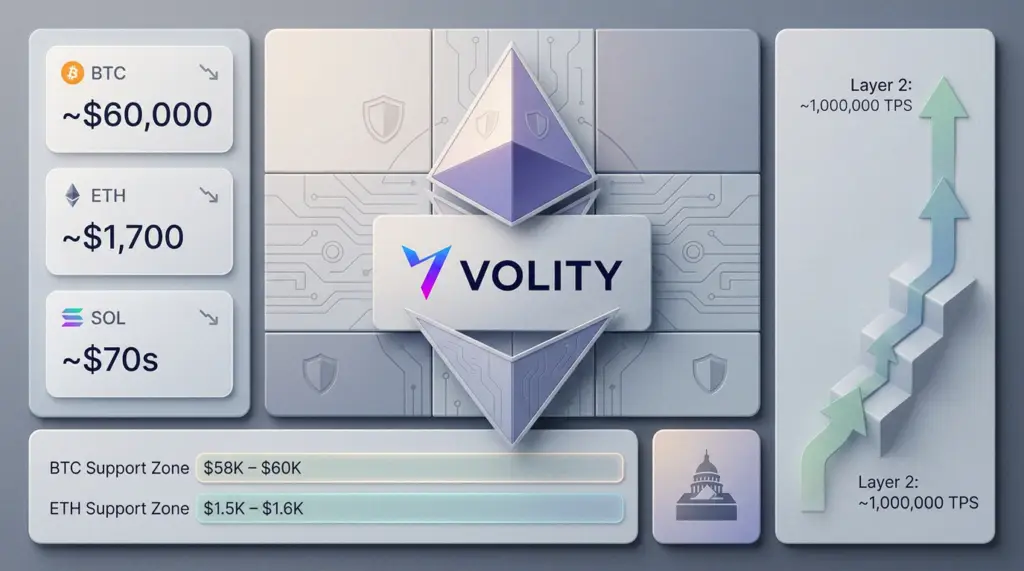
The crypto market enters July 2026 looking bruised, jumpy and far from beaten. Bitcoin trades in the low $60,000s after briefly losing $60,000. Ethereum sits near $1,700, while Solana hovers in the high $70s.
However, the story is not just another summer sell-off. Ethereum is sketching its most radical redesign in years. Meanwhile, exchange-traded funds are leaking money, altcoin traders are chasing catalysts, and Washington has become part of the trade.
For investors, this is the awkward bit. Prices suggest stress. Yet the industry beneath them is becoming more ambitious, more political and harder to ignore.
Market mood turns fragile
Bitcoin has not cracked, but it has lost its swagger. Traders now watch $58,000 to $60,000 as the danger zone. A clean break below it would invite louder calls for $53,000, or even $40,000 to $46,000.
Still, those bearish targets remain scenarios, not facts. Bitcoin has repeatedly found buyers near round-number stress points. The next few sessions matter more than the last few headlines.
Ethereum faces its own test. The $1,500 to $1,600 band has become the line many desks care about. If ETH loses that range, forced selling could spread through leveraged altcoin books.
Solana, meanwhile, has slipped back into the high $70s. A fall through the low $70s would weaken one of crypto’s favourite growth trades. Yet a hold there could preserve the case for a faster rebound.
By the numbers
- BTC: low $60,000s, with $58,000 to $60,000 as the near-term risk band.
- ETH: near $1,700, with $1,500 to $1,600 seen as key support.
- SOL: high $70s, with the low $70s now acting as a confidence test.
- ETF flows: continued outflows would deepen the bearish case for July.
- Politics: crypto firms have spent about $189 million in the 2026 U.S. election cycle.
Lean ethereum changes the conversation
Against this uneasy market, Ethereum is trying to look past the next candle. Researcher Justin Drake has outlined a “lean ethereum” roadmap, now discussed across the Ethereum Foundation orbit.
The plan aims to rebuild Ethereum’s consensus, data and execution layers. Its goals are blunt: survive state-level attacks, prepare for quantum computing, and scale far beyond today’s capacity.
The headline targets are deliberately aggressive. Ethereum mainnet would process about 10,000 transactions per second. Layer 2 networks anchored to Ethereum would aim for roughly 1 million transactions per second.
Those figures matter because Ethereum has spent years defending congestion as a design trade-off. However, rivals such as Solana have sold speed as the user experience. Lean ethereum tries to close that gap without abandoning decentralisation.
Three pillars under the redesign
The roadmap divides the work into three large blocks. Each touches a core part of the network.
- Lean consensus: a redesign of the validator and finality system, sometimes framed as Beacon Chain 2.0.
- Lean data: a new approach to blobs, with more flexible data and quantum-resistant design.
- Lean execution: a streamlined EVM 2.0, built to work better with zero-knowledge proofs.
In plain terms, Ethereum wants to become lighter without becoming weaker. Developers want faster finality, easier proof generation and stronger long-term cryptography.
Hash-based signatures sit at the centre of the plan. They could replace older signature schemes that may look vulnerable in a quantum world. Meanwhile, hash-based commitments could reshape how Ethereum stores and verifies data.
This is not a quick trade. The roadmap stretches from 2026 into 2029, with several hard forks expected. Glamsterdam, planned for the second half of 2026, would begin that longer process.
ETH traders should resist treating every roadmap comment as a pump signal. The bigger question is more serious. Can Ethereum rebuild itself while billions of dollars still move across it daily?
Altcoins need events, not vibes
Altcoin markets look less forgiving than they did earlier this year. Momentum has faded, and broad beta no longer lifts every token. As a result, traders are favouring coins with timed catalysts.
Solana remains the obvious battleground. It still belongs near bitcoin and ethereum in many institutional conversations. However, its price weakness makes forthcoming upgrades and app launches more important.
Hyperliquid has a clearer event calendar. Governance proposals such as HIP-3 and HIP-4 give traders something measurable to price. That matters when broader risk appetite is poor.
Zcash is also getting attention. Privacy has returned as a tradeable theme, partly because regulation keeps tightening. Still, privacy coins carry policy risk that can move faster than technical upgrades.
Ondo and TRON sit in a different bucket. Their charts alone do not carry the argument. Instead, traders need to see real-world asset demand, stablecoin volumes and fresh integrations.
Washington becomes part of the chart
Crypto is no longer lobbying from the edge of the room. The industry has become one of America’s most aggressive corporate political spenders.
Crypto companies have spent roughly $189 million so far on the 2026 midterm cycle. That makes the sector the top corporate spender in this election round. It also follows about $170 million in the 2024 cycle.
The aim is not mysterious. Firms want clearer rules for stablecoins, exchanges, custody and decentralised finance. They also want lawmakers who understand the difference between fraud and open-source software.
However, money brings scrutiny. President Donald Trump’s crypto ventures, including branded meme tokens, have intensified the ethics debate. Reports of vast gains from politically linked tokens have sharpened questions about conflicts of interest.
For markets, this cuts both ways. Lobbying may slow hostile regulation and support institutional adoption. Yet scandal around meme coins could trigger harsher bills, sudden hearings and exchange caution.
Trading map for july
- Watch BTC first: a reclaim of $61,000 to $62,000 would calm nerves quickly.
- Track ETF flows: slowing outflows would matter more than another bullish podcast clip.
- Respect ETH support: $1,500 to $1,600 is the level where positioning could change.
- Prefer catalysts: upgrades, listings and governance votes matter more than vague narratives.
- Price politics: stablecoins, meme tokens and prediction markets carry extra headline risk.
Near term, crypto remains a market of levels. Bitcoin below $58,000 would darken the tape. Ethereum below $1,500 would hurt broader confidence. Solana below the low $70s would pressure high-beta trades.
Yet the long-term story has not gone quiet. Ethereum is preparing for a harder, faster, quantum-aware internet of value. At the same time, crypto’s political machine is becoming too large for Washington to shrug off.
That leaves traders with an uncomfortable mix. The screen says caution. The engineering says ambition. The campaign finance records say power. In July, all three matter.
Related coverage on Volity
- How to Avoid Crypto Scams: A Beginner Safety Checklist
- How to Choose a Trading Platform: A 10-Point Checklist
- Demo vs Live Trading Account: A 7-Step Checklist Before You Go Live
- How to Size a Trade: Position Sizing and Risk Per Trade for Beginners
- Risk-Reward Ratio Explained: How to Set It and Why It Matters
- ETF vs Index Fund: The Difference and Which to Pick