ASX trading hours for Australian shares run from about 10:00 to 16:00 Sydney time on a normal trading day. Orders can be entered from 07:00, the open is a randomised auction that starts at 09:59, and a closing auction sets the official price at 16:10. The ASX fixes these times on the Sydney clock, so they shift on yours when Sydney or your city changes its clocks. Below are the sessions, the holidays to the end of 2027 and the times in London for each season.
TL;DR: The ASX takes orders from 07:00 Sydney time, opens with an auction at 09:59, trades until 16:00 and runs a closing auction at 16:10. In London that is 23:00 (the evening before) to 05:00 until 27 March 2027, then 00:00 to 06:00, and 01:00 to 07:00 from 4 April 2027. The staggered open ended on 23 June 2025.
This guide is for anyone who follows Australian shares from another time zone or still holds an older guide that describes the staggered open. The DAX trading hours guide covers the Frankfurt clock in the same format.
ASX trading day at a glance
The ASX publishes one timetable for its cash market, the market where listed shares are bought and sold. All times are Sydney time. The table follows the ASX page Cash market trading hours, read on 10 November 2026.
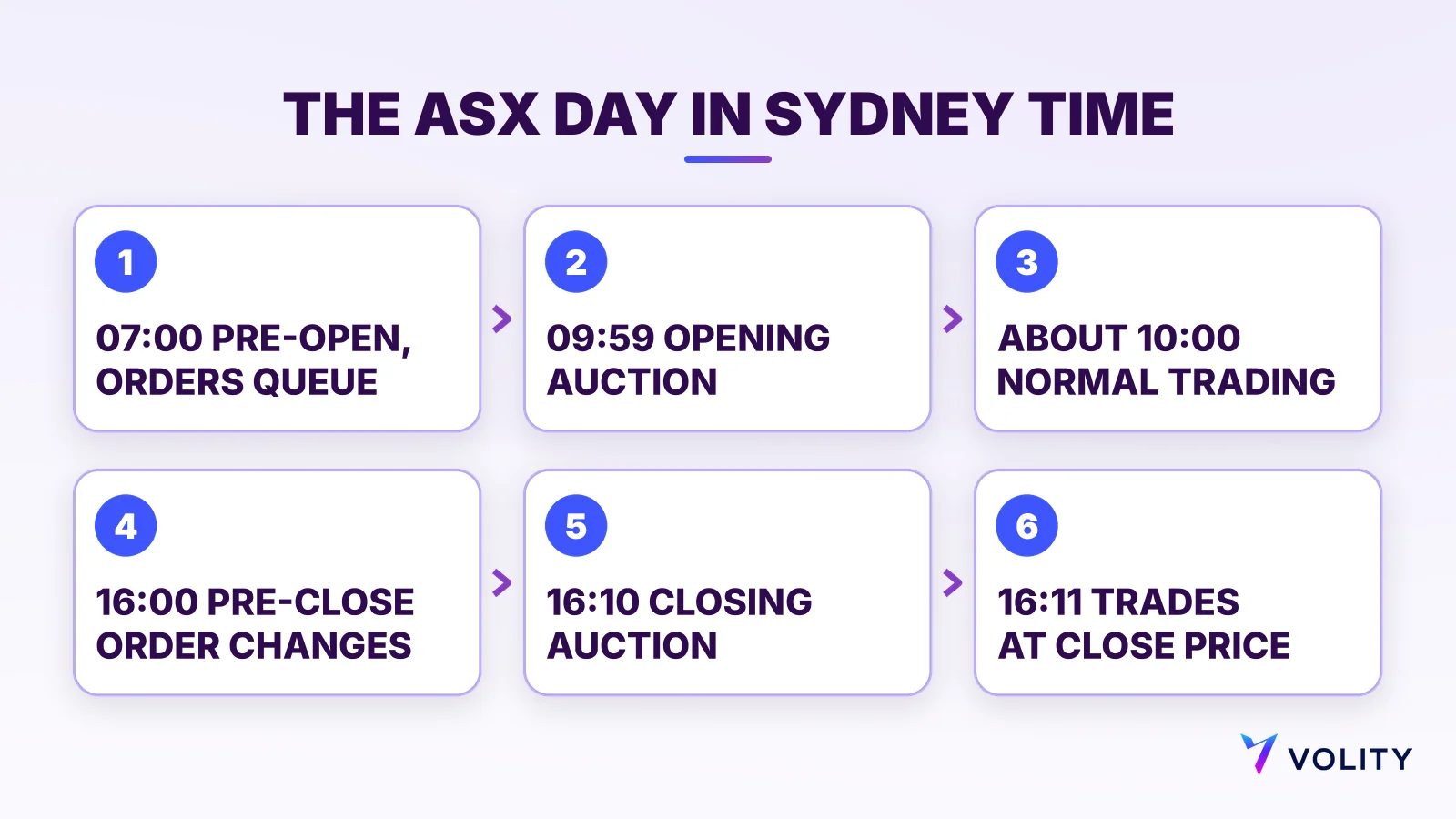
| Phase | Sydney time | What happens |
|---|---|---|
| Pre-open | 07:00 to 09:59 | Orders queue; no matching |
| Opening auction (OSPA) | 09:59 to 09:59:45 | Opening prices set; cancel only |
| Normal trading | About 10:00 to 16:00 | Continuous matching |
| Pre CSPA | 16:00 to 16:10 | Orders can change; no matching |
| Closing auction (CSPA) | 16:10 to 16:11 | Closing price set |
| Post close | 16:11 to 16:21:30 | Orders at the closing price only |
| Adjust | 16:21:30 to 16:42 | No new orders, no execution |
Both auctions start at a random moment. The opening auction starts within a 15-second window from 09:59:00. The closing auction starts within 30 seconds of 16:10:00. So “10:00” is a rounding, and the exact second of the open varies from day to day.
Sydney time itself changes. New South Wales uses Australian Eastern Daylight Time (AEDT, UTC+11) from the first Sunday in October and Australian Eastern Standard Time (AEST, UTC+10) from the first Sunday in April. UTC is the world reference clock. The NSW Government lists the current period as 4 October 2026 to 4 April 2027. Queensland, Western Australia and the Northern Territory do not use daylight saving, so the open moves on their local clocks when Sydney’s clocks change.
The UK moves its clocks forward on the last Sunday in March and back on the last Sunday in October, according to GOV.UK. London is on GMT (UTC+0) in winter and BST (UTC+1) in summer. Because the two countries change in opposite seasons, London is 9, 10 or 11 hours behind Sydney, and the gap changes four times a year.
| Dates | Sydney clock | ASX 10:00 to 16:00 in London | In UTC |
|---|---|---|---|
| 25 Oct 2026 to 27 Mar 2027 | AEDT | 23:00 (day before) to 05:00 GMT | 23:00 to 05:00 |
| 28 Mar to 3 Apr 2027 | AEDT | 00:00 to 06:00 BST | 23:00 to 05:00 |
| 4 Apr to 2 Oct 2027 | AEST | 01:00 to 07:00 BST | 00:00 to 06:00 |
| 3 Oct to 30 Oct 2027 | AEDT | 00:00 to 06:00 BST | 23:00 to 05:00 |
Each row is calculated from the official clock-change dates; 3 October 2027 follows the first-Sunday rule.
Pre-open, open and close auctions
An auction collects orders for a set time, then matches them at one price. The ASX runs two each day, one to open and one to close. Both changed on 23 June 2025.
The pre-open queue
From 07:00 to 09:59, brokers can enter orders for the day, but ASX Trade, the exchange’s matching system, does not match them. Orders queue by price, then by time of entry. Trades agreed overnight or overseas can be reported until 09:45. A limit order, which sets the highest price you will pay or the lowest you will accept, waits in this queue until the auction.
The randomised opening auction
The ASX calls it the Opening Single Price Auction (OSPA). It starts at a random moment in the 15 seconds after 09:59:00, and a levelling period of at least 30 seconds follows. The earliest move to continuous trading is 09:59:45. During the auction, brokers may cancel orders but cannot enter or change them.
Older guides describe a staggered open, where shares opened in five alphabetical groups from about 10:00 to about 10:09. That ended on 23 June 2025, when every stock moved to the same randomised open (ASX June 2025 note). The ASX Service Release 15 report (August 2025) found that the opening auction’s share of on-market volume fell from 3.65% to 2.97% after the change.
The closing auction and post close
From about 10:00, ASX Trade matches orders continuously, by price and then by time. At 16:00 continuous matching stops. For the next 10 minutes, the Pre CSPA phase, brokers can enter, change and cancel orders ahead of the close. The Closing Single Price Auction (CSPA) then runs from 16:10, with a random start of up to 30 seconds, and sets each stock’s closing price.
The ASX notes that many market-related instruments use that price, such as the equity part of an asset sale or the price of a dividend reinvestment plan. In June 2025 the ASX said that “Transactions in the closing auction currently represent over 20% of the entire day’s liquidity”.
Since 23 June 2025 a Post Close phase follows, from 16:11 to 16:21:30. Orders must be at the closing auction price, and other orders are rejected.
How ASX hours compare with other exchanges
Tokyo and London publish their hours in local time, so the Sydney view depends on the season.
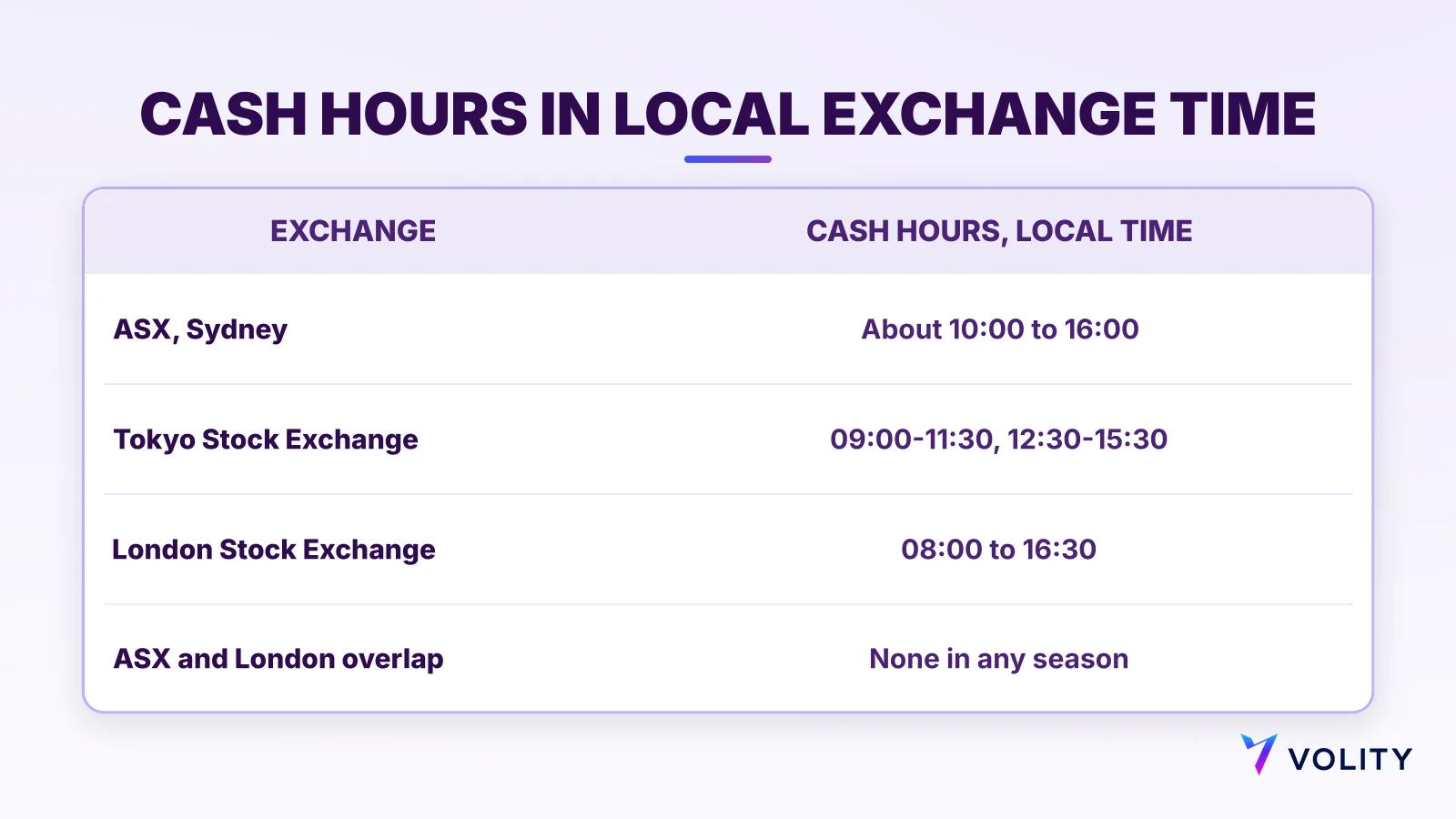
| Exchange | Cash hours, local time | Same hours in Sydney |
|---|---|---|
| ASX | About 10:00 to 16:00 | About 10:00 to 16:00 |
| Tokyo Stock Exchange | 09:00 to 11:30 and 12:30 to 15:30 | 11:00 to 17:30 (AEDT), 10:00 to 16:30 (AEST) |
| London Stock Exchange | 08:00 to 16:30 | 19:00 to 03:30 (AEDT and GMT), 17:00 to 01:30 (AEST and BST) |
The Tokyo Stock Exchange trades a morning session from 09:00 to 11:30 and an afternoon session from 12:30 to 15:30, according to Japan Exchange Group. The afternoon close moved from 15:00 to 15:30 on 5 November 2024, when a closing auction was added. Japan Standard Time is UTC+9 with no daylight saving (Wikipedia), so only Sydney’s change moves the gap.
From October to April, Sydney is two hours ahead of Tokyo. The ASX then opens at 08:00 Tokyo time, an hour before Tokyo, and closes at 14:00. From April to October the gap is one hour, and both markets open at the same moment. The overlap runs from 09:00 to 14:00 Tokyo time in the southern summer and 09:00 to 15:00 in the southern winter. Tokyo’s lunch break sits inside it.
The London Stock Exchange says its “trading hours are from 8:00 to 16:30” (LSE FAQ). The ASX and the LSE never overlap, in any combination of clocks. At the closest, with AEST in Sydney and BST in London, the LSE opens at 17:00 Sydney time, one hour after ASX normal trading ends.
Public holidays and early closes
The ASX closes on the public holidays it lists each year and closes early on two days each December. The official list is the ASX trading calendar, which has tabs for 2026 and 2027. The ASX “reserves the right to declare additional Non-Business Days”, so check it before you plan around a date.
Four dates are still ahead in 2026. Thursday 24 December closes early. Friday 25 December (Christmas Day) and Monday 28 December (Boxing Day) are closed. Thursday 31 December closes early.
| Date in 2027 | Occasion | ASX |
|---|---|---|
| Fri 1 Jan | New Year’s Day | Closed |
| Tue 26 Jan | Australia Day | Closed |
| Fri 26 Mar | Good Friday | Closed |
| Mon 29 Mar | Easter Monday | Closed |
| Mon 26 Apr | ANZAC Day substitute | Open |
| Mon 14 Jun | King’s Birthday | Closed |
| Fri 24 Dec | Last business day before Christmas | Early close |
| Mon 27 Dec | Christmas Day substitute | Closed |
| Tue 28 Dec | Boxing Day substitute | Closed |
| Fri 31 Dec | Last business day of the year | Early close |
ANZAC Day is the date to watch. In 2027 it falls on a Sunday and the public holiday moves to Monday 26 April, but the ASX calendar marks that Monday as a trading day.
On the two short days, the ASX calendar says “Normal trading ceases at 14:10 (Sydney time)”. ASX notice 1245.26.10 (30 October 2026) sets the closing auction on 24 and 31 December 2026 at 14:10, plus a random period of up to 30 seconds. The notice gives its times in AEDT, and 14:10 AEDT is 03:10 UTC.
State-only holidays are a separate case. Melbourne Cup Day, a Victorian holiday on 3 November 2026, is not on the ASX list of closed days. For closures on other markets, see the global trading holidays calendar.
Trading Australian markets from other time zones
For a reader in the UK, the ASX session falls at night or in the early morning, as the conversion table shows. For any other city, convert from UTC, not from London. The ASX day is 23:00 to 05:00 UTC while Sydney is on AEDT, and 00:00 to 06:00 UTC while it is on AEST. Add your own UTC offset, then check whether your city is on summer time that day.
Do not mix up the ASX with the forex “Sydney session”. Forex trades 24/5, and the Sydney session is a forex convention that our forex trading sessions guide places at 22:00 GMT. The ASX share market opens later, at 23:00 UTC in AEDT months and 00:00 UTC in AEST months, and it has its own auctions and holidays.
When the ASX is closed, other markets keep moving. On Volity, crypto and a growing range of markets, including gold, silver, US500, US100 and WTI, trade 24/7, and forex trades 24/5. The Volity Australia page lists crypto and forex session times in Australian time. Gold, silver, the indices and WTI are traded as CFDs, contracts that track a price without you owning the asset. CFDs can be traded with leverage, which magnifies losses as well as gains.
Holding a position past 22:00 GMT may pay or receive an overnight (swap) amount. The rate for each instrument is shown on the platform, and the full schedule is on the charges and fees page.
Plan your orders around the sessions
The sessions decide when an order can fill and at what kind of price. A simple routine:
- Check both clocks first. Confirm whether Sydney is on AEDT or AEST and whether your city is on summer time, then read the right row of the conversion table.
- Enter orders in the pre-open if you want to be in the opening auction. Nothing matches before 09:59, so a limit order sets the worst price you accept.
- Do not plan to amend at 09:59. During the opening auction you can cancel an order, but you cannot enter or change one.
- Allow for the random start. Continuous trading begins at 09:59:45 at the earliest, so a plan built on exactly 10:00:00 can be a few seconds out.
- Use 16:00 to 16:10 if you want the closing price. That is the window to enter, change or cancel orders for the closing auction.
- Mark the short days. On 24 and 31 December the closing auction moves to 14:10 Sydney time.
- Keep futures separate. ASX index futures such as the SPI 200 trade from 09:50 to 16:30, plus 17:10 to 07:00 or 08:00, and change hours on their own calendar (ASX index derivatives).
The ASX trading hours and calendars hub links every timetable.
Before real money is at stake, practise placing, amending and cancelling orders on the markets Volity offers. A free demo account is available on every Volity account tier and runs on virtual funds. See the demo vs live account guide for how the two differ.
Fact check: Sessions, auctions, holidays and early closes come from the ASX (trading hours, trading calendar, notice 1245.26.10, the June 2025 note and the Service Release 15 report). Clock-change dates come from the NSW Government and GOV.UK, Tokyo and London hours from Japan Exchange Group and the London Stock Exchange. London and UTC times are calculated from those dates. Sources checked 10 November 2026.
Frequently asked questions
What time does the ASX open?
Orders can be entered from 07:00 Sydney time. The opening auction starts at a random moment between 09:59:00 and 09:59:15, and continuous trading begins from 09:59:45, so the open is usually quoted as 10:00.
What time does the ASX close?
Normal trading ends at 16:00 Sydney time. The closing auction runs from 16:10, with a random start of up to 30 seconds, and sets the official closing price. On 24 and 31 December the close moves to 14:10.
What is the ASX pre-open session?
It runs from 07:00 to 09:59 Sydney time. Brokers enter orders, but ASX Trade does not match them. They queue by price and time until the opening auction.
Is the ASX open on public holidays?
No. It closes on the public holidays in its trading calendar, such as Australia Day, Good Friday, Easter Monday and the King’s Birthday in June. The exception is Monday 26 April 2027, the ANZAC Day substitute holiday, which the ASX marks as a trading day.
Why does the ASX closing auction matter?
It sets the official closing price, which the ASX says many market-related instruments use, including dividend reinvestment plan prices. In June 2025 the ASX said the closing auction represented over 20% of the entire day’s liquidity.
How do ASX hours compare with the London Stock Exchange?
They never overlap. The LSE trades from 08:00 to 16:30 London time, which is 19:00 to 03:30 in Sydney with AEDT and GMT, and 17:00 to 01:30 with AEST and BST.