
Most comparisons of growth investing vs value investing promise a winner. The honest answer is that there is no universal winner, only the style that fits your time horizon, your stomach for swings, and whether you want income now or growth later. By the end you will self-assess which one suits you and place a first deliberate position, even with a small amount.
TL;DR / Quick insight: Growth investing means paying a premium today for a company expected to grow earnings fast. Value investing means buying a solid company that trades cheaply relative to its fundamentals (its earnings, assets and cash flow). Neither universally beats the other: growth swings more and rewards a long horizon, while value tends to be steadier and friendlier to income. Self-assess your horizon and temperament, then pick one style or blend both. With fractional shares (a slice of one share) and ETFs (one fund holding many companies), you can start either approach small on one account.
The wrong frame wastes money. Chase the style winning this year and you buy high, then switch late. The useful question is which style you can hold through good years and bad.
Start with the one-line difference
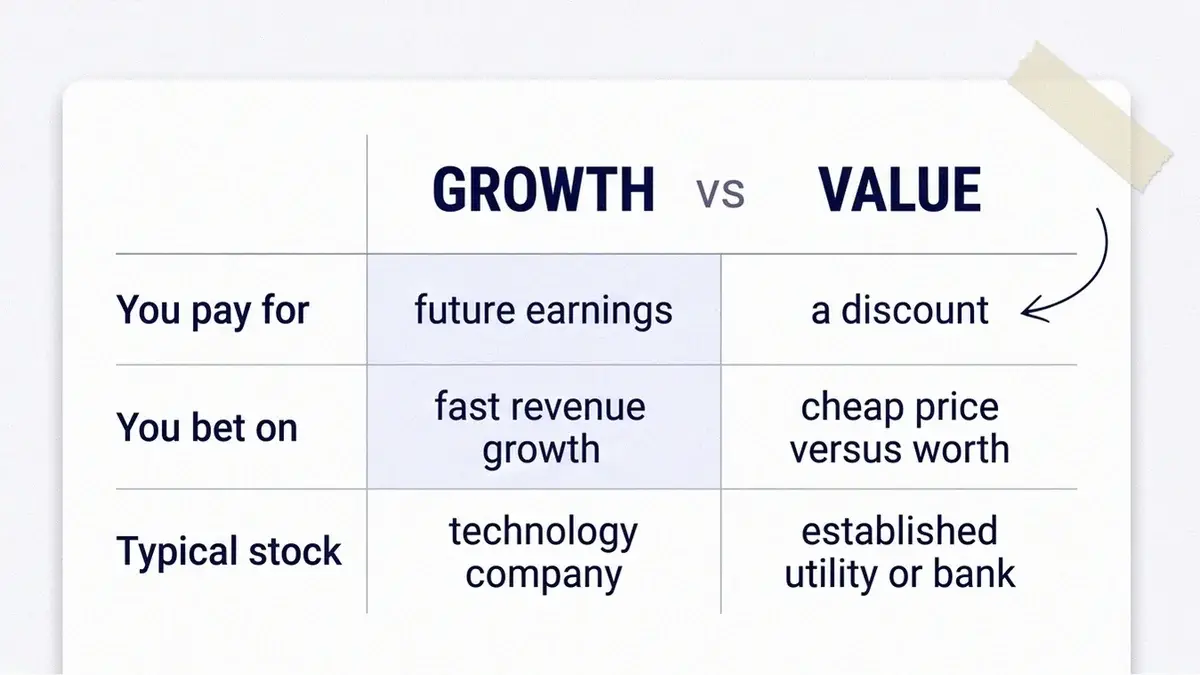
A growth investor buys tomorrow. They pay a premium today for a business expected to expand sales and profits quickly, betting it grows into that price and beyond. A value investor buys a bargain. They look for a sound business whose share price has fallen below its realistic worth, then wait for the market to notice.
Put plainly, growth pays up for future potential; value pays less for present worth. The real contest is between your goals, not the styles. Before you read on, write one plain sentence for each style in your own words.
How growth investing works
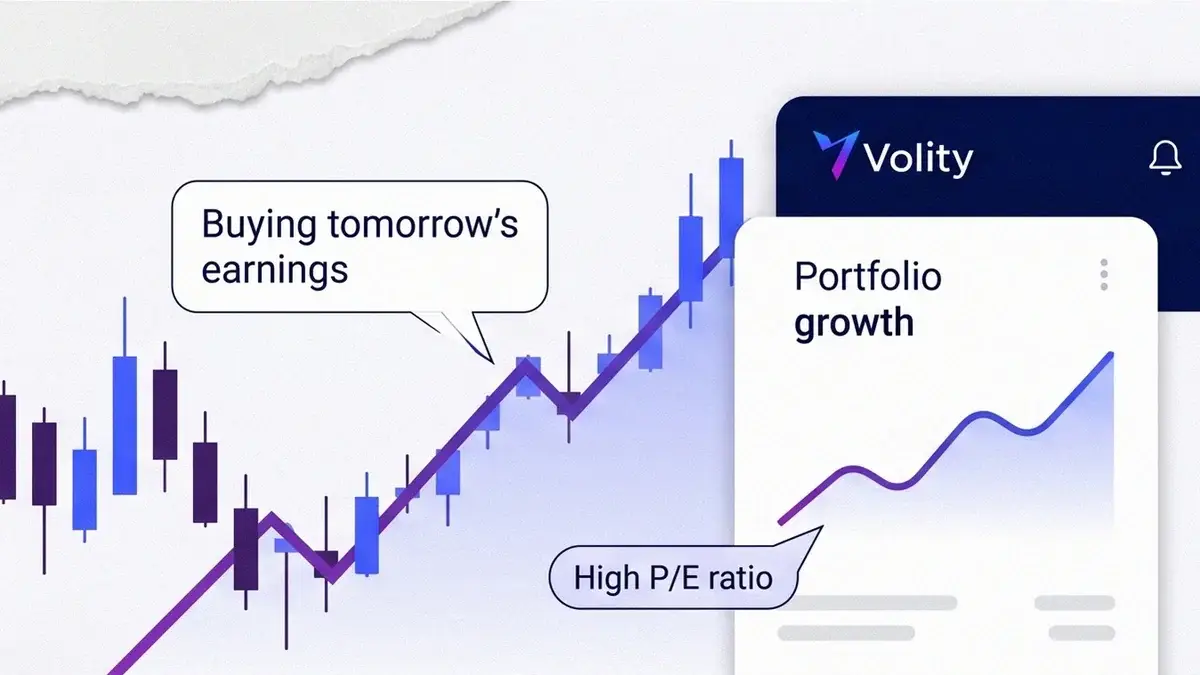
A growth investor hunts for companies whose revenue and earnings climb fast. The logic is simple: if profits keep compounding, the share price should follow. Everyone can see that potential, so these shares carry a premium valuation – a price that already assumes years of strong results.
That premium is the catch. When a fast grower merely does well instead of spectacularly, the price can fall hard, because the good news was already priced in. Growth names also pay little or no dividend (cash a company sends shareholders from profits); they reinvest to grow instead. If you lean growth, do not judge a holding by one bad quarter, and never use money you may need soon.
How value investing works
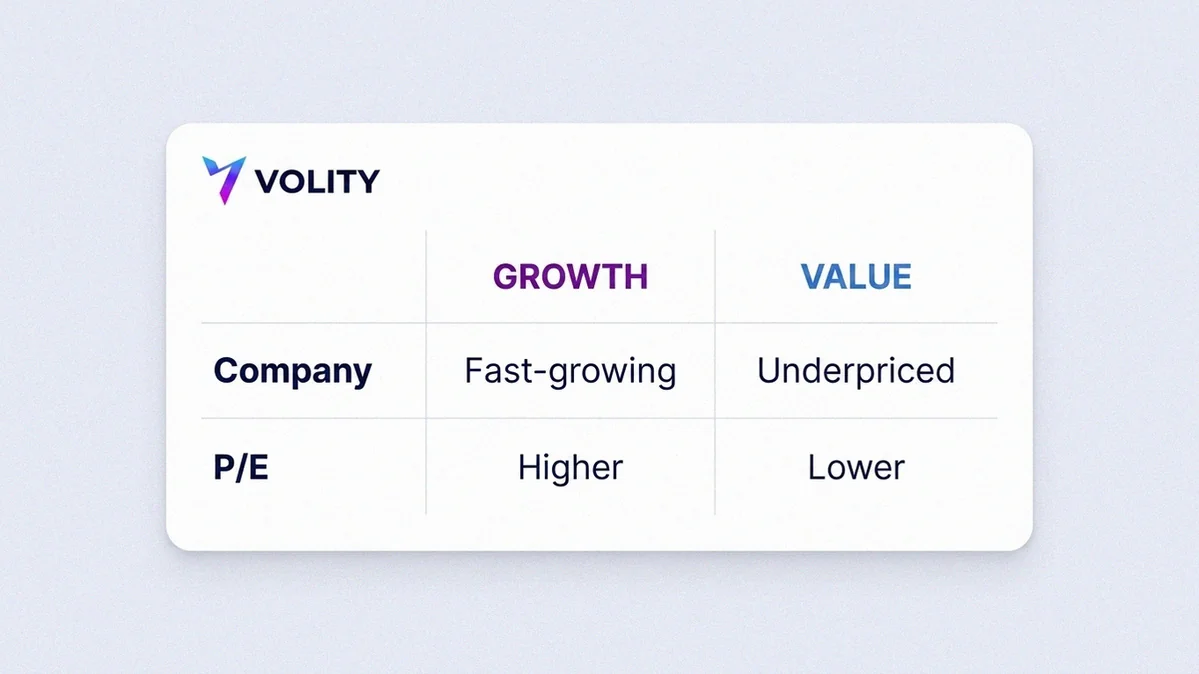
A value investor flips the question. Rather than ask how fast a company can grow, they ask what the business is worth and whether they can buy it for less today. They look for solid companies that trade cheaply relative to their fundamentals – earnings, assets and cash flow – usually because the market is temporarily pessimistic.
The reward comes if the market re-rates the stock toward fair value, and value shares are more likely to pay dividends. The trade-off is patience: a cheap stock can stay cheap. Watch for the value trap, a stock that looks cheap only because the business is in real decline. Write down why a stock is cheap before you buy; that reason protects you better than the low price alone.
The two styles side by side
The four traits below are where the real difference lives. Read each row and tick the side that sounds more like how you want to invest. The table is qualitative, not a ranking.
| Trait | Growth investing | Value investing |
|---|---|---|
| Risk and swings | Larger ups and downs; a bright future is already priced in, so disappointments bite | Generally steadier; the discount can cushion the fall |
| Time horizon | Longer; you wait for fast growth to compound | Patient but often shorter; you wait for a re-rating |
| What you look for | Fast revenue and earnings growth, premium valuation | Price below worth, strong fundamentals, often a dividend |
| Market it likes | Optimistic, expanding markets | Calmer or recovering markets where cheap quality is rediscovered |
There is no “better” column. If the growth side excites you and the swings do not scare you, that is a signal; if the steadier value side feels safer, so is that. Tally which side you ticked more often.
Match a style to your goals and temperament
Now make it personal. The point is the style you can live with, not the “right” one in the abstract. Run the self-assessment and tally your leaning.
- Time horizon. Can you leave this money untouched for many years (lean growth), or do you want it working on a shorter, more predictable arc (lean value)?
- Reaction to swings. When a holding drops sharply, do you stay calm (growth-friendly), or does a steadier ride help you sleep (value-friendly)?
- Income now or later. Do you want dividends while you hold (lean value), or are you happy for a company to reinvest for growth (lean growth)?
- How hands-on you want to be. Do you enjoy researching businesses, or prefer a simpler approach (a blend or broad ETF may suit you)?
If three or four answers point the same way, go with that leaning. If they split, do not force a choice. A split result means a blend fits you better.
Blend both styles when neither alone fits
Here is the honest part most “which wins” articles bury: you do not have to choose. Many investors hold both styles on purpose, so whichever environment shows up, part of their money is positioned for it. When growth is out of favour, value can carry you.
You can blend two ways. Hold some growth shares and some value shares side by side, or use ETFs. An ETF (exchange-traded fund) is one fund, bought like a single share, that holds many companies at once and naturally spans both styles.
What makes a blend realistic on a small account is fractional shares – buying a slice of a share rather than the whole thing. With Volity you can trade real shares, fractional shares and ETFs in one account, so even a modest amount holds a deliberate mix. Decide your split now – pure growth, pure value, or a blend – and write the percentages.
Run the checklist, then start small
This is where the decision becomes action. None of it is buy or sell advice; it turns your self-assessment into a first position you understand.
- Define your horizon. Write down how long this money can stay invested – it shapes everything else.
- Set your risk comfort. Decide how big a temporary drop you can hold without selling.
- Pick your style or blend. Use your tally – pure growth, pure value, or a written split.
- Choose your vehicles. Individual shares give more control; ETFs give instant spread, with fractional shares to start.
- Practise on a free demo. Place your intended positions on a free demo account first, to learn the mechanics before risking real cash.
- Start commission-free with a small amount. Open one real position you understand. On Volity, trading on the Markets account is commission-free, with spare cash in a $0 multi-currency wallet between trades.
- Review on a schedule. Set a quarterly reminder to check your mix against your plan, not against daily noise.
One general risk note: all investing puts your capital at risk, and prices fall as well as rise. The aim is to take risk you understand in a style you can hold, not to remove risk. When ready, you can open a Volity account and run real and fractional shares, ETFs and a $0 wallet from one login. The trader education hub helps you build the temperament behind a style.
Reviewed by: A. Bennett, Volity editorial desk.
Accuracy of data: this guide describes investing styles in general terms only – no historical return figures, no “which wins” verdict, no specific stocks. Volity product details (commission-free Markets account, fractional shares, ETFs, free demo, $0 wallet) are verified against the published fee schedule at volity.io/charges-fees.
Related Volity guides
Related coverage on Volity
- Fundamental Analysis in Stock Trading: A Working Definition
- What Is a P/E Ratio and How to Use It
- Dollar-Cost Averaging Explained: A Beginner Guide
- Dividend Investing for Beginners: How to Start
- Fractional Shares Explained: How to Start Investing With
Frequently asked questions
Is growth or value investing better?
Neither is universally better. The right fit depends on your time horizon, your tolerance for swings and whether you want income now or later. Run the four-question self-assessment and pick the style you can hold through a bad year without panicking – durability matters more than chasing whichever style looks strong today.
Can you do both growth and value investing?
Yes, and many investors deliberately do. Hold some growth shares and some value shares side by side, or use ETFs that contain both. Fractional shares make a blend affordable on a small account, because you hold slices of several companies rather than full shares.
Which style is riskier?
Growth tends to swing more and pay off over a longer horizon, while value tends to be steadier and more income-oriented. But “steadier” does not mean “safe”: both styles put your capital at risk, and a value stock can keep falling if the business is in real decline. Match the style to the movement you can hold.
What is a value stock?
A value stock trades cheaply relative to the company’s fundamentals – its earnings, assets and cash flow – often because the market is temporarily pessimistic. Value investors buy these hoping the market re-rates them toward fair value, and such stocks often pay a dividend while you wait.
How do I start with a small amount?
Use fractional shares and ETFs so a small budget can still hold a real position or a blend. Practise first on a free demo account, then start commission-free with one position you understand on a Markets account, with spare cash in a $0 wallet between trades. Begin small and add over time.
Sources
The guidance above draws on the following public sources.
- Corporate Finance Institute – what defines a growth stock
- Corporate Finance Institute – how dividends work
- arXiv (Graham's Formula for Valuing Growth Stocks) – valuing growth against fundamentals
- arXiv (Non-Stationary Dividend-Price Ratios) – research on dividend-price ratios
- Nasdaq – a growth-tilted index
- Nasdaq – a long dividend payment record
- Investor.gov – match investments to your horizon
- Investor.gov – why blending styles helps
- Euronext – ETFs spanning both styles
- Bank of England – how interest rates affect valuations