You sit down to take one good trade and somehow place eight. The clean setups stopped three trades ago, but your finger keeps clicking. That is overtrading, and it is a discipline problem, not a strategy problem. The fix is not a better indicator – it is a small set of rules you write down once and follow every session. Here are eight you can set up today to trade less and keep more.
TL;DR / Quick insight: Overtrading means placing more trades than your plan calls for – extra entries, trades outside your setup, or trading on after you should have stopped. It costs you money even on a commission-free account, because the spread (the gap between buy and sell price) is paid on every round trip. The cure is a written rule set: a cap on trades per day, a max daily loss, walk-away points, a pre-trade checklist, a journal, price alerts instead of constant chart-watching, and a free demo to rehearse on first.
Most traders who lose money bleed it out across dozens of small, unnecessary trades that felt fine in the moment. The fix is not more willpower mid-session – it is decisions made in advance, when calm, that take the choice out of your hands.
What overtrading actually is (and why it quietly drains accounts)
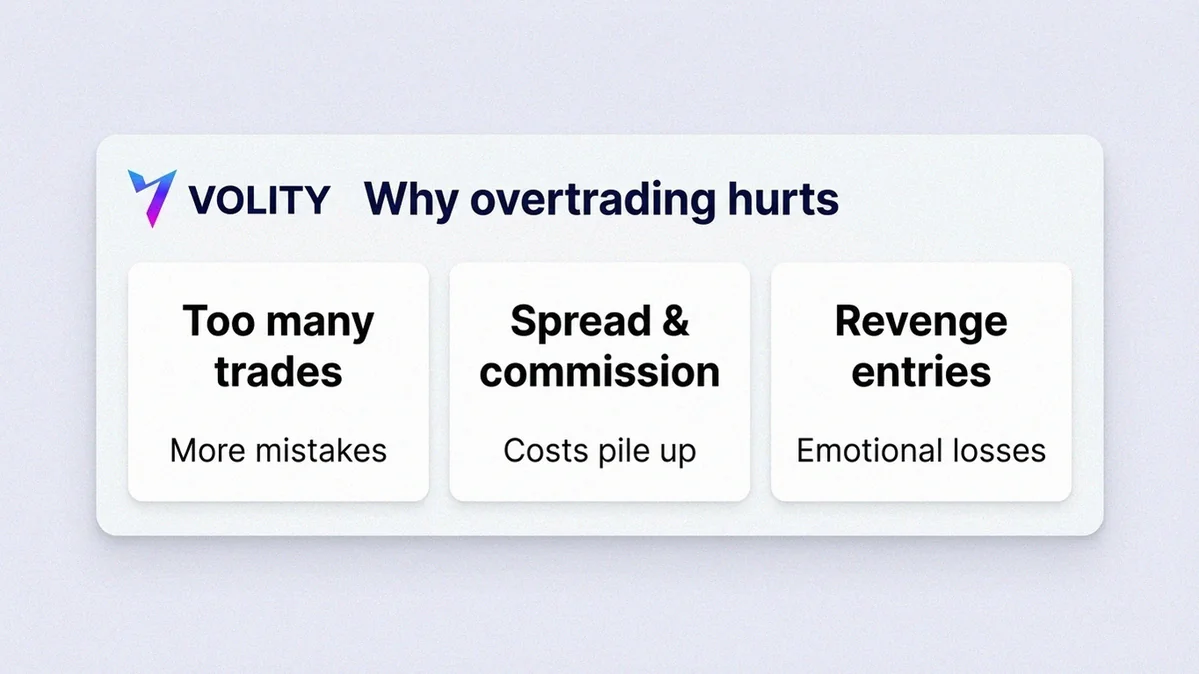
Overtrading is trading more than your plan calls for: extra trades you never planned, “close enough” trades that do not match your setup, and trading on after you have hit your limit. None feel dramatic, which is why they are dangerous.
Here is the cost most people miss. Every trade pays a spread – the small difference between the price you can buy at and sell at, a tiny toll each time you open and close a position (a “round trip”). On Volity’s Markets account trading is commission-free, so there is no separate per-trade fee. But commission-free is not cost-free: churning twenty marginal trades pays that spread toll twenty times, and holding past 22:00 GMT can add an overnight fee. Fewer, better trades keep more of your money, as Volity’s trader education hub covers.
Do this now: write one sentence defining “a valid trade” for your strategy. If a setup does not match it, it is an itch to click, not a trade.
Spot your overtrading triggers before they cost you
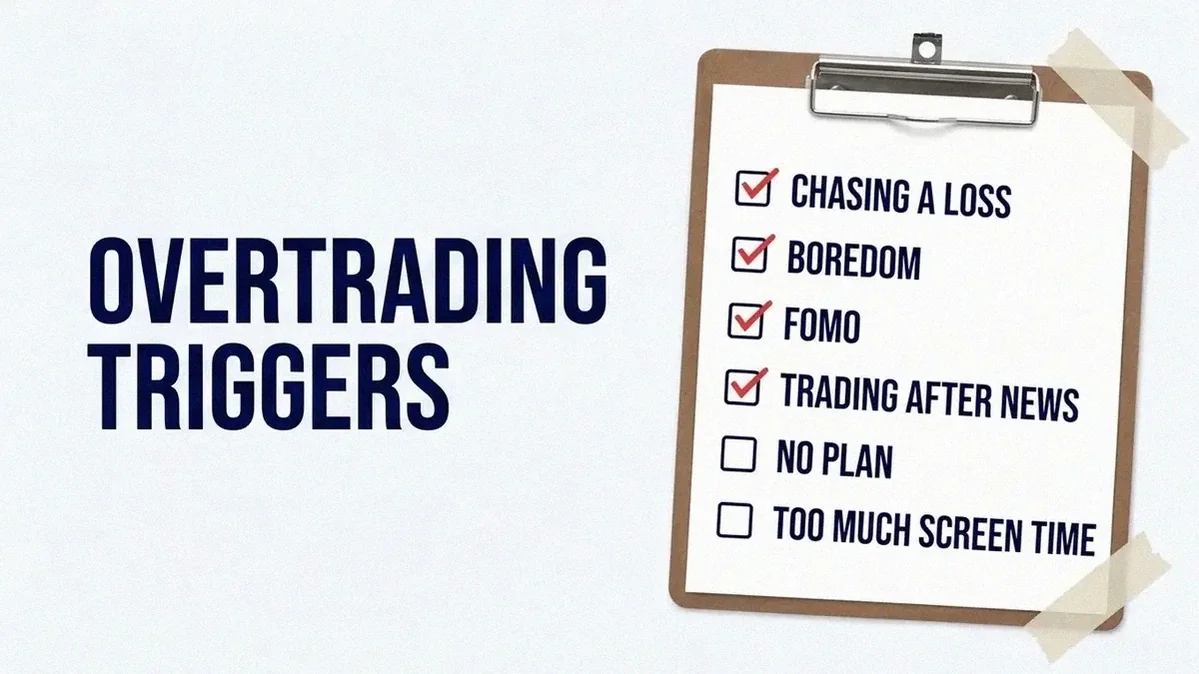
Overtrading rarely starts with a chart – it starts with a feeling, so catch it before it turns into a click. The most common triggers:
- Checking your balance constantly, looking for a reason to act.
- Sizing up after a loss to win it back fast – the classic revenge trade.
- Watching several instruments at once, so something is always moving.
- Trading out of boredom when the market is quiet and nothing qualifies.
- Decision fatigue late in the session, when tired judgement approves weak setups.
None of these are about the market – they are about your state. Revenge trading does the most damage: after a loss your brain wants the money back now, so it lowers your standards and raises your size at the worst moment. Do this now: tick every sign that applied this week, then circle the biggest one – that is what your rules must defend against first.
Rule 1 and Rule 2: cap your trades per day and your risk per day
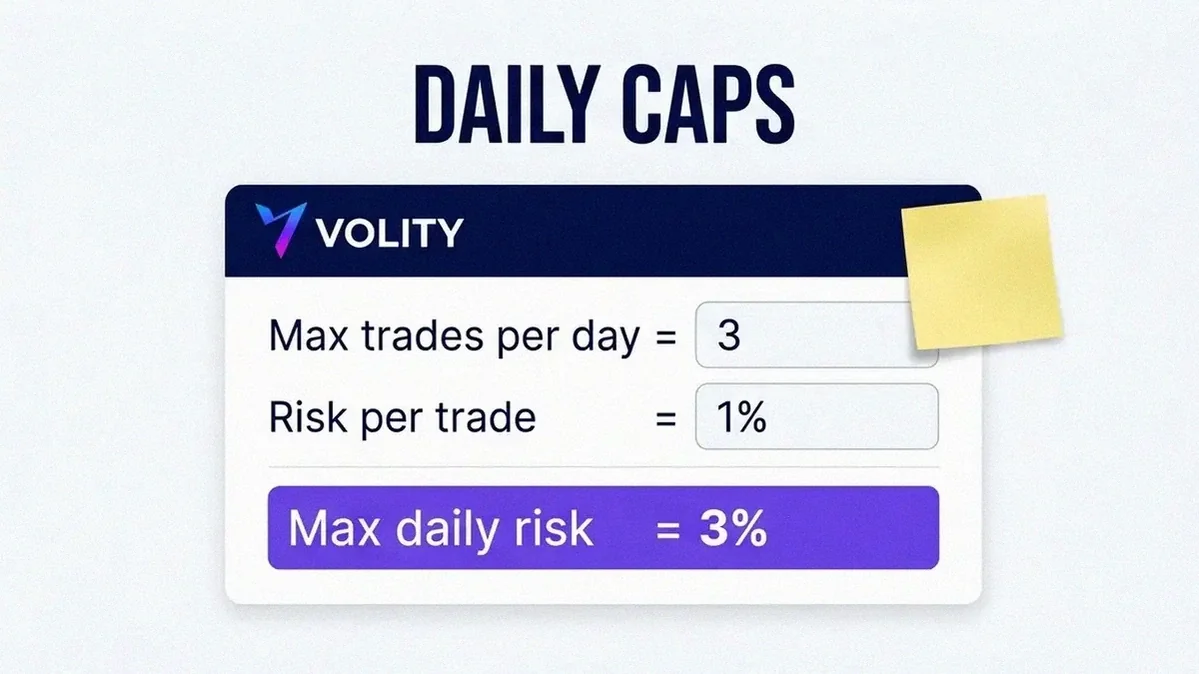
The two most powerful rules are the simplest: a hard limit on how many trades you take in a day, and a hard limit on how much you can lose in a day, both decided in advance. Do not ask the internet how many trades a day is “too many”; there is no universal number. A scalper on a tested high-frequency system is not overtrading at thirty trades, while a swing trader is overtrading at five. Derive your cap from your plan, as the table shows:
| Cap | What it limits | How to set your starting number |
|---|---|---|
| Max trades per day | How often you can click | Count the genuine setups your plan gives on a normal day; set the cap just below that |
| Max daily loss | When you stop for the day | A percentage of your account you can lose without it stinging into tomorrow |
| Max risk per trade | What one trade can cost | A small fixed percentage of the account, the same on every trade |
Do this now: write down your max trades per day and your max daily loss as hard limits.
Rule 3 and Rule 4: define your walk-away points and a kill switch
A limit only works if something happens when you hit it. That something is your kill switch: the moment either cap is reached – max trades OR max daily loss – the session is over and you close the platform. This defeats revenge trading by removing the option to act when you most want to. Add a profit walk-away too: chasing trades to extend a streak hands gains back.
Do this now: set your two stop conditions and decide the one thing you will do instead of trading when either fires.
Rule 5: trade only from a written plan and a pre-trade checklist
If a trade is not written down before you take it, it is an impulse. A trading plan is your rules on paper: the instruments you trade, what a valid setup looks like, where you enter, where your stop-loss goes (the price where you admit the trade is wrong and exit), and where you take profit. On top of it, build a short pre-trade checklist of yes/no questions you clear before every entry. If any answer is “no,” you do not trade.
Example pre-trade checklist:
Does this match my written setup? → Is my risk within my per-trade limit? → Is my stop-loss at a logical level? → Am I still under my daily trade cap? → Am I trading the plan, not a feeling?
That last question catches the emotional trades the technical checks miss. Do this now: write a 3- to 5-line pre-trade checklist and take no trade that fails it.
Rule 6 and Rule 7: journal every trade and cut screen time with alerts
You cannot fix a pattern you cannot see, and a trade journal is how you see it. Log every trade: the setup, your reason, your size, the result, and one line about your mood. Tag each trade “planned” or “impulse” – most traders find their impulse trades are a net drain.
Rule 7 attacks the source of temptation: screen time. The longer you stare at live charts, the more your brain manufactures reasons to act. Set price alerts at the levels that matter, then walk away – they pull you back only when it counts.
Do this now: start a trade journal and set price alerts at your key levels.
Rule 8: rebuild the habit on a free demo first
Rules look easy on paper and feel hard in a live market with real money moving, so do not test them with real money. A demo account – a practice account that trades live market prices with virtual funds – is the place to rebuild a low-frequency routine and prove you can take only the trades that clear your checklist. A Volity free demo is available on every account tier, and the Volity MT platform is the same in demo and live, so the discipline transfers.
Do this now: run your rule set on a free demo for several sessions before risking real capital. TRY A FREE DEMO ACCOUNT.
Your 8-rule overtrading checklist (copy this)
Copy this, fill in your own numbers, and keep it by your screen:
- Max trades per day – a hard cap derived from your own plan.
- Max risk per day – a fixed percentage of your account, then you stop.
- Walk-away points – defined stop conditions, plus a profit walk-away.
- Kill switch – trade cap OR loss cap hit, close the platform.
- Written plan plus pre-trade checklist – no trade that fails the gate.
- Journal every trade – tag planned vs impulse.
- Cut screen time with alerts – not constant chart-watching.
- Rehearse on a free demo – prove the rules work before going live.
Remember: commission-free removes the per-trade fee, but spread is paid on every round trip, so trading less is cheaper. See how spreads and account types work on the fees page; the cost is clearest in markets like forex. When the routine holds on demo, carry it live: OPEN A VOLITY ACCOUNT, where one login covers your trading and your everyday money.
Reviewed by: A. Bennett, Volity editorial desk.
Data accuracy: all Volity product facts (commission-free Markets account, free demo on every tier, dynamic spreads from 0.6 pip on Standard, overnight fee past 22:00 GMT) are verified against the published Volity fee schedule as of June 2026. No trading statistics are stated without a verified source; the right trade limits are strategy-specific and set by you.
Related Volity guides
Related coverage on Volity
- How to Size a Trade: Position Sizing and Risk Per Trade for Beginners
- Demo vs Live Trading Account: A 7-Step Checklist Before You Go Live
- How to Avoid Common Stock Trading Mistakes
- Forex Risk Management: A Position-Sizing Framework for Pairs
- Market Order vs Limit Order: Which to Use and When
Frequently asked questions
What is overtrading?
Placing more trades than your plan calls for: extra trades you never planned, trades that do not match your setup, or trades after you should have stopped. It comes from emotion, and it costs you money through the spread paid on every trip.
What causes overtrading?
It is driven by your state, not the market: boredom, the urge to win back a loss quickly (revenge trading), checking your account too often, watching too many instruments, and decision fatigue.
How do I stop overtrading?
Decide in advance so the heated version of you cannot override it: set a max number of trades and a max daily loss with a kill switch, trade only from a written plan and checklist, journal every trade, use price alerts, and rehearse it on a free demo first.
How many trades a day is too many?
There is no universal number, and a fixed figure like “more than twenty a day” ignores your strategy. Derive your own cap: count the genuine, setup-matching trades your strategy produces on a normal day and set your limit just below that.
Does commission-free trading mean overtrading is free?
No. Commission-free means no separate per-trade fee, which is true on Volity’s Markets account, but the spread is still paid on every round trip and holding past 22:00 GMT can add an overnight fee. Churning marginal trades still costs you.
Sources
This guide draws on the following public sources.
- ESMA – ESMA warning on speculative retail trading risk
- CFA Institute – CFA Institute Research Foundation on investor behaviour
- Bank of England – Bank of England explainers on markets and risk
- IOSCO – IOSCO report on retail market conduct and online marketing
- Nobel Prize – Thaler's Nobel work on behavioural economics
- Bank of England – Bank of England explainer on interest rates and risk
- IOSCO – IOSCO on retail distribution and digital engagement practices
- Nobel Prize – Kahneman's Nobel work on judgement under uncertainty
- Bank for International Settlements – BIS working paper on retail trading behaviour